Kirjojen hintavertailu – 12 859 829 kirjaa ja 27 kauppaa

Kirjailija

Kok-Meng Lee

Kirjat ja teokset yhdessä paikassa: 5 kirjaa, julkaisuja vuosilta 2011–2019, suosituimpiin kuuluu Design, Modeling and Experiments of 3-DOF Electromagnetic Spherical Actuators. Vertaile teosten hintoja ja tarkista saatavuus suomalaisista kirjakaupoista.

5 kirjaa

Kirjojen julkaisuvuodet: 2011–2019.

Design, Modeling and Experiments of 3-DOF Electromagnetic Spherical Actuators

Design, Modeling and Experiments of 3-DOF Electromagnetic Spherical Actuators

Liang Yan; I-Ming Chen; Chee Kian Lim; Guilin Yang; Kok-Meng Lee

Springer
2016
nidottu
A spherical actuator is a novel electric device that can achieve 2/3-DOF rotational motions in a single joint with electric power input. It has advantages such as compact structure, low mass/moment of inertia, fast response and non-singularities within the workspace. It has promising applications in robotics, automobile, manufacturing, medicine and aerospace industry. This is the first monograph that introduces the research on spherical actuators systematically. It broadens the scope of actuators from conventional single-axis to multi-axis, which will help both beginners and researchers to enhance their knowledge on electromagnetic actuators. Generic analytic modeling methods for magnetic field and torque output are developed, which can be applied to the development of other electromagnetic actuators. A parametric design methodology that allows fast analysis and design of spherical actuators for various applications is proposed. A novel non-contact high-precision 3-DOF spherical motion sensing methodology is developed and evaluated with experiments, which shows that it can achieve one order of magnitude higher precision than conventional methods. The technologies of nondimensionalization and normalization are introduced into magnetic field analysis the first time, and a benchmark database is established for the reference of other researches on spherical actuators.
Design, Modeling and Experiments of 3-DOF Electromagnetic Spherical Actuators

Design, Modeling and Experiments of 3-DOF Electromagnetic Spherical Actuators

Liang Yan; I-Ming Chen; Chee Kian Lim; Guilin Yang; Kok-Meng Lee

Springer
2011
sidottu
A spherical actuator is a novel electric device that can achieve 2/3-DOF rotational motions in a single joint with electric power input. It has advantages such as compact structure, low mass/moment of inertia, fast response and non-singularities within the workspace. It has promising applications in robotics, automobile, manufacturing, medicine and aerospace industry. This is the first monograph that introduces the research on spherical actuators systematically. It broadens the scope of actuators from conventional single-axis to multi-axis, which will help both beginners and researchers to enhance their knowledge on electromagnetic actuators. Generic analytic modeling methods for magnetic field and torque output are developed, which can be applied to the development of other electromagnetic actuators. A parametric design methodology that allows fast analysis and design of spherical actuators for various applications is proposed. A novel non-contact high-precision 3-DOF spherical motion sensing methodology is developed and evaluated with experiments, which shows that it can achieve one order of magnitude higher precision than conventional methods. The technologies of nondimensionalization and normalization are introduced into magnetic field analysis the first time, and a benchmark database is established for the reference of other researches on spherical actuators.
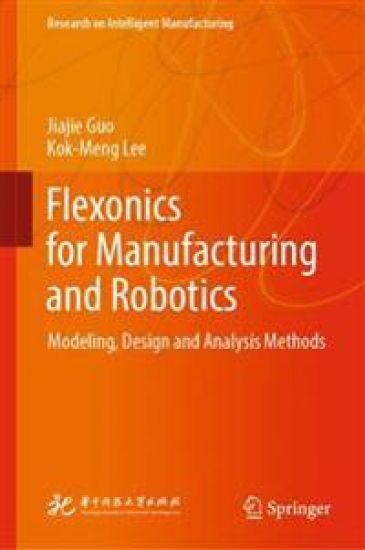
Flexonics for Manufacturing and Robotics

Flexonics for Manufacturing and Robotics

Jiajie Guo; Kok-Meng Lee

Springer Verlag, Singapore
2019
sidottu
This book presents the theoretical research and application results of a study on flexible mechatronics (flexonics). Formulating distributed models in both time and spatial domains using a geometric approach, it presents a simple yet practical field-based sensing method for robotics and manufacturing, and illustrates its applications with examples such as exoskeletons, mobile sensor network and intelligent sensing. The book is of interest to researchers, engineers and graduate students in robotics, manufacturing and automation engineering who wish to learn the core principles, theories, technologies, and applications of flexonics.
Permanent Magnet Spherical Motors

Permanent Magnet Spherical Motors

Kun Bai; Kok-Meng Lee

Springer Verlag, Singapore
2018
nidottu
This book introduces and illustrates modeling, sensing, and control methods for analyzing, designing, and developing spherical motors. It systematically presents models for establishing the relationships among the magnetic fields, position/orientation and force/torque, while also providing time-efficient solutions to assist researchers and engineers in studying and developing these motors. In order to take full advantage of spherical motors’ compact structure in practical applications, sensing and control methods that utilize their magnetic fields and eliminate the need to install external sensors for feedback are proposed. Further, the book investigates for the first time spherical motors’ force/torque manipulation capability, and proposes algorithms enabling the ball-joint-like end-effector for haptic use based on these motors’ hybrid position/force actuation modes. While systematically presenting approaches to their design, sensing and control, the book also provides many examples illustrating the implementation issues readers may encounter.
Permanent Magnet Spherical Motors

Permanent Magnet Spherical Motors

Kun Bai; Kok-Meng Lee

Springer Verlag, Singapore
2018
sidottu
This book introduces and illustrates modeling, sensing, and control methods for analyzing, designing, and developing spherical motors. It systematically presents models for establishing the relationships among the magnetic fields, position/orientation and force/torque, while also providing time-efficient solutions to assist researchers and engineers in studying and developing these motors. In order to take full advantage of spherical motors’ compact structure in practical applications, sensing and control methods that utilize their magnetic fields and eliminate the need to install external sensors for feedback are proposed. Further, the book investigates for the first time spherical motors’ force/torque manipulation capability, and proposes algorithms enabling the ball-joint-like end-effector for haptic use based on these motors’ hybrid position/force actuation modes. While systematically presenting approaches to their design, sensing and control, the book also provides many examples illustrating the implementation issues readers may encounter.