
Kirjailija
Komla Tsey
Kirjat ja teokset yhdessä paikassa: 6 kirjaa, julkaisuja vuosilta 2011–2020, suosituimpiin kuuluu Working on Wicked Problems. Vertaile teosten hintoja ja tarkista saatavuus suomalaisista kirjakaupoista.
6 kirjaa
Kirjojen julkaisuvuodet: 2011–2020.
This book is for researchers and students looking for ways to engage communities and industry in research. It is also written for community leaders, philanthropists and managers of organisations interested in building mutually beneficial partnerships with researchers, or training their own researchers. To this end, I hope that the readers of this book will appreciate that in their own way, whether big or small, they will be able to make research more meaningful by genuinely and honestly engaging with the communities of people with whom they work. I hope that an auto-ethnography or personal narrative approach will throw light on the factors that lead to positive research engagement and impact, thereby helping researchers avoid some of my pitfalls.
A Systematic Review of Rural Development Research
Neus Evans; Michelle Lasen; Komla Tsey
Springer International Publishing AG
2015
nidottu
Rapid urbanisation, inequalities in income and service levels within and between communities, and population and economic decline are challenging the viability of rural communities worldwide. Achieving healthy and viable rural communities in the face of rapidly changing social, ecological and economic conditions is a declared global priority. As a result, governments all over the world, in both developed and developing countries, are now prioritizing rural and regional development through policies and programs aimed at enhancing the livelihoods of people living in rural regions. In recognition of the important roles that research can play in rural development, a range of systematic literature reviews have rightly examined key priorities in rural development including education, gender, economic development (especially agriculture), and health and nutrition (see Department for International Development [DFID], 2011). However, none of these works has systematically examined the extent to which rural development as a field of research is progressing towards facilitating sustainable change. This book evaluates trends in rural development research across the five continental regions of the world. Specifically, it assesses the total publication output relating to rural development, the types of publications, their quality and impact over the last three decades. Additionally, it evaluates the continental origins of the publications as well as the extent to which such publications engage with issues of sustainability. The aim is to determine whether the rural development field is growing in a manner that reflects research and policy priorities and broader social trends such as sustainability. Development policy makers, practitioners, those teaching research methods and systematic literature reviews to undergraduate and graduate students, and researchers in general will find the book both topical and highly relevant.
Promoting Aboriginal Health
Mary Whiteside; Komla Tsey; Yvonne Cadet-James; Janya McCalman
Adis
2014
nidottu
"Those of us who have worked on the frontline of Aboriginal health for any length of time know that beneath the surface reality of Aboriginal people's poor health outcomes sits a deeper truth. It is about the importance of social and emotional wellbeing, and how this flows from a sense of control over one's own life. Where this is lacking, as it is in so many Aboriginal families and communities, there is instead indifference and despair and a descent into poor lifestyle choices and self-destructive behaviours. Our medical professionals do a great job of prescribing medicines and devising treatment programs but, to fix the root causes of ill-health, we need something more. As Aboriginal people we need to have a sense of agency in our lives, that we are not stray leaves blowing about in the wind. In a word, we need empowerment". Dr. Pat Anderson, Chairperson, the Lowitja Institute, Australia's National Institute for Aboriginal and Torres Strait Islander Health Research.

From Head-Loading to the Iron Horse. Railway Building in Colonial Ghana and the Origins of Tropical Development
Komla Tsey
Langaa RPCID
2012
pokkari
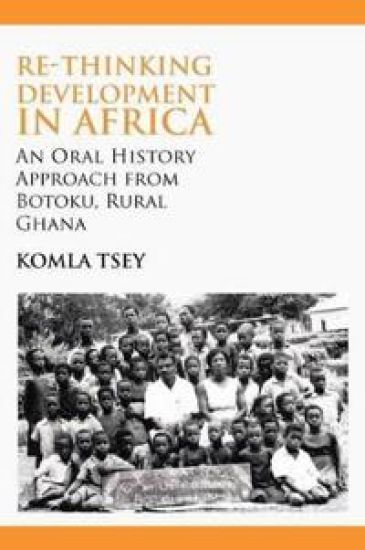
Re-thinking Development in Africa. An Oral History Approach from Botoku, Rural Ghana
Komla Tsey
Langaa RPCID
2011
pokkari