Kirjojen hintavertailu – 12 903 735 kirjaa ja 27 kauppaa

Kirjailija

Kong Yam Tan

Kirjat ja teokset yhdessä paikassa: 12 kirjaa, julkaisuja vuosilta 2012–2018, suosituimpiin kuuluu 2014 Annual Indices For Expatriates And Ordinary Residents On Cost Of Living, Wages And Purchasing Power For World's Major Cities. Vertaile teosten hintoja ja tarkista saatavuus suomalaisista kirjakaupoista.

12 kirjaa

Kirjojen julkaisuvuodet: 2012–2018.

2014 Annual Indices For Expatriates And Ordinary Residents On Cost Of Living, Wages And Purchasing Power For World's Major Cities

2014 Annual Indices For Expatriates And Ordinary Residents On Cost Of Living, Wages And Purchasing Power For World's Major Cities

Randong Yuan; Khee Giap Tan; Le Phuong Anh Nguyen; Kong Yam Tan

World Scientific Publishing Co Pte Ltd
2016
sidottu
There has been broad-base growth in wealth for cities all over the world, albeit increasingly unequal within and across cities. Some cities tend to grow faster than others, especially those emerging cities in Asia. We tend to observe longer periods of economic expansions compared to downturns with increasing volatility due to external shocks as cities are also increasingly open and interconnected. Such volatility would mean a less stable macroeconomic environment for cities causing fluctuations in prices and unemployment, as well as shares between private and public consumption. Cost of living, wages and purchasing power therefore become important key benchmark indicators to track and monitor the basic living standard for cities, not just by employers and employees; they matter even more for policymakers, multinational corporations and government of the day, politically. This book is thus a valuable compendium studies on 109 major cities around the world whereby the cost of living, wage and purchasing power indices were tracked and monitored, for both average residents and expatriates, which tend to be vastly different. Annual Indices for Average Residents and Expatriates is currently the only publication that provides comparable data on cost of living across cities for both average residents and expatriates. Cost of living analysis on the latter, widely available in published works, is often mistaken or confused as on the former! This book provides a tool to analyse questions of the differences in the cost of living in cities across the globe between ordinary city dwellers and professionals who work abroad.
2014 Annual Indices For Expatriates And Ordinary Residents On Cost Of Living, Wages And Purchasing Power For World's Major Cities

2014 Annual Indices For Expatriates And Ordinary Residents On Cost Of Living, Wages And Purchasing Power For World's Major Cities

Randong Yuan; Khee Giap Tan; Le Phuong Anh Nguyen; Kong Yam Tan

World Scientific Publishing Co Pte Ltd
2016
nidottu
There has been broad-base growth in wealth for cities all over the world, albeit increasingly unequal within and across cities. Some cities tend to grow faster than others, especially those emerging cities in Asia. We tend to observe longer periods of economic expansions compared to downturns with increasing volatility due to external shocks as cities are also increasingly open and interconnected. Such volatility would mean a less stable macroeconomic environment for cities causing fluctuations in prices and unemployment, as well as shares between private and public consumption. Cost of living, wages and purchasing power therefore become important key benchmark indicators to track and monitor the basic living standard for cities, not just by employers and employees; they matter even more for policymakers, multinational corporations and government of the day, politically. This book is thus a valuable compendium studies on 109 major cities around the world whereby the cost of living, wage and purchasing power indices were tracked and monitored, for both average residents and expatriates, which tend to be vastly different. Annual Indices for Average Residents and Expatriates is currently the only publication that provides comparable data on cost of living across cities for both average residents and expatriates. Cost of living analysis on the latter, widely available in published works, is often mistaken or confused as on the former! This book provides a tool to analyse questions of the differences in the cost of living in cities across the globe between ordinary city dwellers and professionals who work abroad.
2016 Annual Indices For Expatriates And Ordinary Residents On Cost Of Living, Wages And Purchasing Power For World's Major Cities

2016 Annual Indices For Expatriates And Ordinary Residents On Cost Of Living, Wages And Purchasing Power For World's Major Cities

Khee Giap Tan; Trieu Duong Luu Nguyen; Divya Chandran; Kong Yam Tan

World Scientific Publishing Co Pte Ltd
2018
sidottu
As cities continue to play an increasingly significant role in driving economic growth in many countries, competition among cities have shifted from the national level to the global arena. In this context, international benchmarks for cities are vital for businesses and individuals to make informed decisions. In particular, cost of living, wages and purchasing power are of great interest to employees, employers, multinational corporations and policy-makers as basic indicators tracking urban living standards. This publication by the Asia Competitiveness Institute (ACI) provides annual indices and rankings for cost of living for expatriates as well as indices and rankings for cost of living, wages and purchasing power for ordinary residents in 103 global cities since 2005. The ACI's study reflects salient differences in costs of living for expatriate and ordinary urban dwellers which arise from variations in their lifestyles and consumption preferences. This is of critical significance as cost of living for the former is usually conflated as that for the latter by the general public. In this book, we also delve into the analysis of the nexus between liveability, cost of living and purchasing power. We outline the trends and patterns of these benchmarks and explore if there are trade-offs between liveability and affordability. The ACI's study has received considerable interest from reputable media outlets such as the British Broadcasting Corporation (BBC) and the Edge Malaysia.
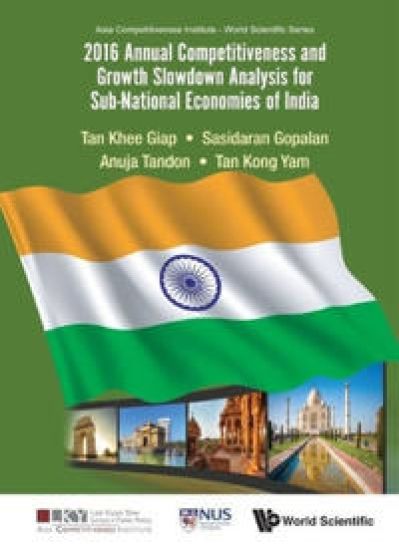
2016 Annual Competitiveness And Growth Slowdown Analysis For Sub-national Economies Of India

2016 Annual Competitiveness And Growth Slowdown Analysis For Sub-national Economies Of India

Khee Giap Tan; Sasidaran Gopalan; Anuja Tandon; Kong Yam Tan

World Scientific Publishing Co Pte Ltd
2018
sidottu
This book by the Asia Competitiveness Institute (ACI) undertakes rigorous empirical research relating to competitiveness of states and federal territories in India. The competitiveness framework employed by ACI computes the rankings for the 35 states and federal territories of India by factoring in a plethora of socio-economic development indicators that determine competitiveness. In this book, ACI's competitiveness analysis employs 75 different indicators across four different environments to capture the dynamics of competitiveness in a holistic way at the sub-national level. Further, the book produces a 'What-If' competitiveness simulation exercise to identify the specific policy areas that each state or federal territory must focus on to improve their rankings.
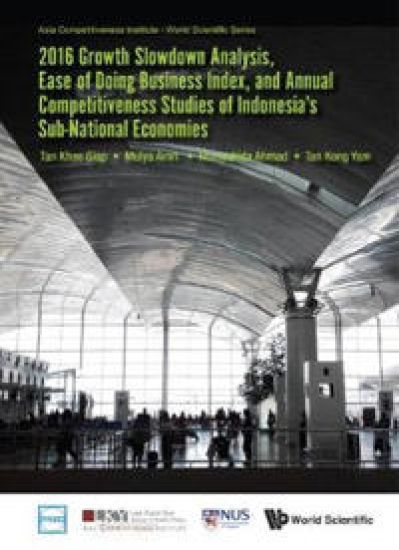
2016 Growth Slowdown Analysis, Ease Of Doing Business Index, And Annual Competitiveness Studies Of Indonesia's Sub-national Economies

2016 Growth Slowdown Analysis, Ease Of Doing Business Index, And Annual Competitiveness Studies Of Indonesia's Sub-national Economies

Khee Giap Tan; Mulya Amri; Nursyahida Binte Ahmad; Kong Yam Tan

World Scientific Publishing Co Pte Ltd
2018
sidottu
This book is the only annual study that dissects Indonesia's sub-national competitiveness at both the provincial level (covering 34 provinces) and the regional level (covering six major island groups). Based on a rich dataset of 103 indicators, the study covers four environments of competitiveness: (1) Macroeconomic Stability, (2) Government and Institutional Setting, (3) Financial, Businesses, and Manpower Conditions, and (4) Quality of Life and Infrastructure Development. It also presents each province and region's comparative strengths and weaknesses, and conducts 'what-if' policy simulations to propose policy suggestions.
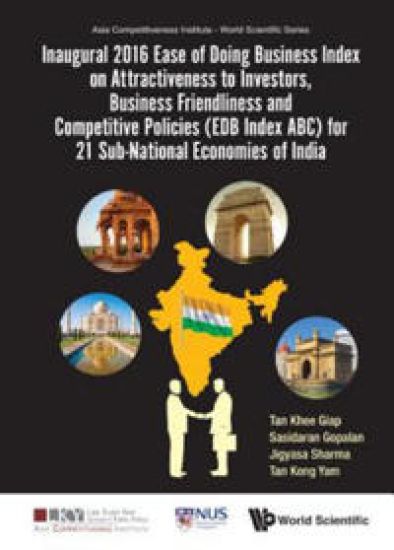
Inaugural 2016 Ease Of Doing Business Index On Attractiveness To Investors, Business Friendliness And Competitive Policies (Edb Index Abc) For 21 Sub-national Economies Of India
This book produces the research findings of Asia Competitiveness Institute (ACI)'s inaugural attempt to construct an Ease of Doing Business (EDB) index on Attractiveness to Investors, Business Friendliness and Competitive Policies (ABC), which is applied to 21 sub-national economies of India.
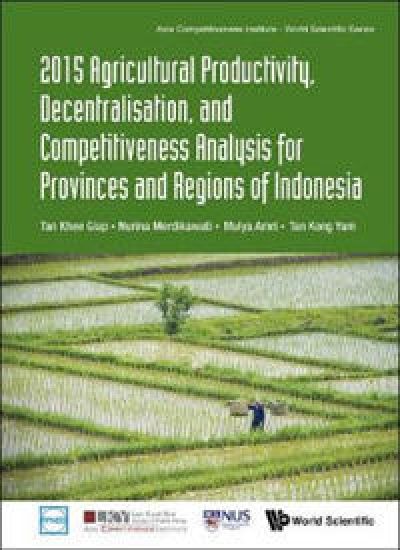
2015 Agricultural Productivity, Decentralisation, And Competitiveness Analysis For Provinces And Regions Of Indonesia

2015 Agricultural Productivity, Decentralisation, And Competitiveness Analysis For Provinces And Regions Of Indonesia

Khee Giap Tan; Nurina Merdikawati; Mulya Amri; Kong Yam Tan

World Scientific Publishing Co Pte Ltd
2017
sidottu
This book is the only annual study that dissects Indonesia's sub-national competitiveness at both the provincial level (covering 34 provinces) and the regional level (covering six major island groups). Based on a rich dataset of 103 indicators, the study covers four environments of competitiveness: (1) Macroeconomic Stability, (2) Government and Institutional Setting, (3) Financial, Businesses, and Manpower Conditions, and (4) Quality of Life and Infrastructure Development. It also presents each province and region's comparative strengths and weaknesses, and conducts 'what-if' policy simulations to propose policy suggestions.
2014 Provincial And Inaugural Regional Competitiveness Analysis: Safeguarding Indonesia's Growth Momentum

2014 Provincial And Inaugural Regional Competitiveness Analysis: Safeguarding Indonesia's Growth Momentum

Khee Giap Tan; Nurina Merdikawati; Mulya Amri; Kong Yam Tan

World Scientific Publishing
2015
sidottu
This book is a world-class report by the Asian Competitiveness Institute (ACI), updated annually to analyse Indonesia's competitiveness at both the 33 provincial levels and six regional groupings based on the central government's Master Plan for Acceleration and Expansion of Indonesia's Economic Development (MP3EI). With 104 indicators covering four environments, the study's unique methodology incorporates comparative strengths and weaknesses as well as applies Geweke causality analysis to a subset of indicators. Apart from scores and rankings, what-if policy simulations offer various provinces practical prescriptions to improve overall competitiveness to accelerate economic growth and development in a balanced, fair and sustainable way. Such qualitative and quantitative analyses in collaboration with various stakeholders generates an exciting pathway for Indonesia to attain its rightful place in both the Asian region and global contexts.
2014 Regional Competitiveness Analysis And A Master Plan On Regional Development Strategies For India: Annual Competitiveness Update And Evidence On Economic Development Model For Selected States Of India
This book by the Asia Competitiveness Institute (ACI) presents the inaugural regional competitiveness analysis for the five regions of India as a basis for the Master Plan on Strategic Regional Economic Development using regional classifications as defined by the Confederation of Indian Industry. Potential strategic clusters are identified for intra-regional collaboration given each region's unique strengths and resource endowments to facilitate accelerated economic growth and development which is balanced, fair and sustainable. The book also presents an update of ACI's annual competitiveness analysis of India's 35 states and federal territories. States and federal territories are ranked by ACI's comprehensive methodology by employing 75 indicators across four environments. Going beyond the rankings, the what-if policy simulations offer states and federal territories relevant policy prescriptions based on their respective strengths and weaknesses. A subset of the competitiveness indicators are then utilised for Geweke Causality Analysis to highlight the impact of strong leadership on economic development in the states of Bihar and Tamil Nadu.
Annual Analysis Of Competitiveness, Simulation Studies And Development Perspective For 35 States And Federal Territories Of India: 2000-2010

Annual Analysis Of Competitiveness, Simulation Studies And Development Perspective For 35 States And Federal Territories Of India: 2000-2010

Khee Giap Tan; Linda Low; Kong Yam Tan; Vittal Kartik Rao

World Scientific Publishing Co Pte Ltd
2014
sidottu
India is emerging as one of the economic giants of the world, and is gaining international influence and global leadership as the world's largest democracy. India's performance will have far-reaching consequences on whether the economic awakening of the country, which began more than two decades ago, can become a good model to be emulated by other developing economies. This book is a collection of policy papers and data-sets for the 35 states and federal territories of India. With a comprehensive approach to competitiveness, the research done by Asia Competitiveness Institute (ACI) at the Lee Kuan Yew School of Public Policy, National University of Singapore takes into account different factors that collectively shape the ability of a nation to achieve substantial and inclusive economic development over a sustained period of time. ACI's methodology goes beyond rankings to conduct policy simulations on how each state or federal territory can improve its competitiveness. These policy simulations are a compelling value-added proposition enabling policymakers, industry leaders and administrators to identify relative challenges and opportunities, and to prioritise areas when crafting policies and development strategies.
Competitiveness Analysis And Development Strategies For 33 Indonesian Provinces

Competitiveness Analysis And Development Strategies For 33 Indonesian Provinces

Khee Giap Tan; Mulya Amri; Kong Yam Tan; Linda Low

World Scientific Publishing Co Pte Ltd
2013
sidottu
Indonesia is on the cusp of transformative take-off, poised to become a major economic power not just in Asia, but also on the global-stage. This book is a pioneering attempt in comprehensively assessing all attributes, conditions and policies for 33 Indonesian provinces and Indonesia's trajectory as an emerging middle power. It contains papers and data-sets presented in July 2012, at ACI's signature Annual Conference. The information that was shared at the conference and presented in the book posit a future where tens of millions of Indonesians will be lifted out of poverty to become a self-sustaining middle-class, which will in turn drive the country into a global leadership role in the 21st century. It is a compelling value-added proposition for policy simulations enabling policy-makers to identify relative weaknesses, strengths, threats and opportunities of individual 33 provinces, guiding them to prioritise areas in crafting policies and development strategies.
Ranking The Liveability Of The World's Major Cities: The Global Liveable Cities Index (Glci)

Ranking The Liveability Of The World's Major Cities: The Global Liveable Cities Index (Glci)

Khee Giap Tan; Wing Thye Woo; Kong Yam Tan; Linda Low; Grace Ee Ling Aw

World Scientific Publishing Co Pte Ltd
2012
sidottu
This unique volume aims to provide a first comprehensive assessment on attributes, conditions and characters which constitute a liveable city. The book posits that the degree of liveability depends on five themes: satisfaction with the freedom from want; satisfaction with the state of the natural environment and its management; satisfaction with freedom from fear; satisfaction with the socio-cultural conditions; and satisfaction with public governance. The authors attempt to be more constructive through performing policy simulations by first identifying relative weaknesses and strengths of 64 global cities across major continents including European, Asian, Middle Eastern, North and South American cities. The book also ranks and simulates 36 Asian cities separately, of which many are emerging third-world cities that are in need of policy guidance.