Kirjojen hintavertailu – 12 859 824 kirjaa ja 27 kauppaa
Kirjailija
Krista Romita Grocholski
Kirjat ja teokset yhdessä paikassa: 9 kirjaa, julkaisuja vuosilta 2019–2024, suosituimpiin kuuluu Proposed Analytical Products for the Air Force Warfighting Integration Capability. Vertaile teosten hintoja ja tarkista saatavuus suomalaisista kirjakaupoista.
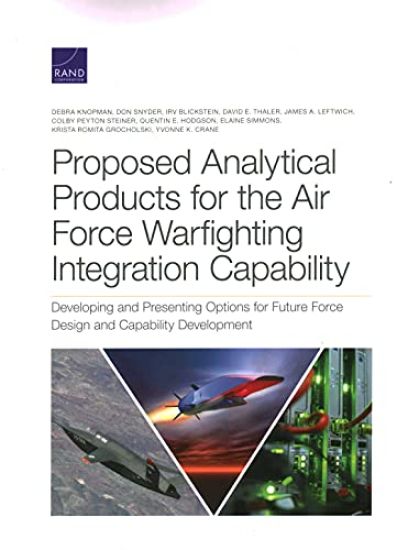
Debra Knopman; Don Snyder; Irv Blickstein; David E Thaler; James A Leftwich; Colby Peyton Steiner; Quentin E Hodgson; Elaine Simmons; Krista Romita Grocholski; Yvonne K Crane
The Air Force has long faced a challenge integrating force design and capability development planning with programming. RAND Project Air Force assisted the Air Force Warfighting Integration Capability (AFWIC) in conceptualizing analytical and other products to support concept development, force design options, and capability development planning. The authors present findings and recommendations for AFWIC's analytical processes and products.
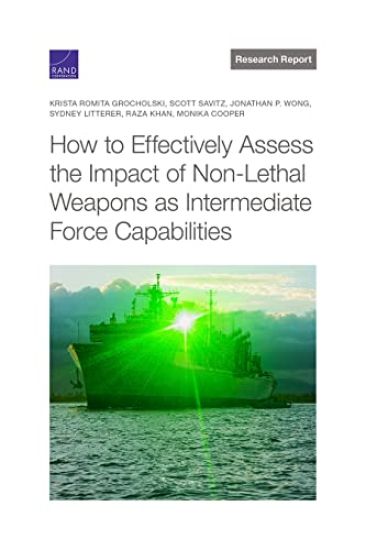
This report describes how non-lethal weapons (NLWs) can be used in diverse strategic and operational contexts by drawing on insights from psychology and group dynamics. Effective NLW usage is illustrated by vignettes in multiple domains involving gray-zone situations, encounters with civilians, and combat scenarios. The authors also recommend desirable future NLW capabilities to pursue.
Anu Narayanan; Scott R Stephenson; Michael T Wilson; Maria McCollester; Sarah Weilant; Emmi Yonekura; Sascha Ishikawa; Jay Balagna; Krista Romita Grocholski; Nihar Chhatiawala
Climate-driven natural hazards will continue to affect Department of the Air Force (DAF) installations and missions for the foreseeable future. There is a need for the DAF to consider how installation infrastructure projects that improve hazard resilience may be prioritized. A new approach allows comparison of infrastructure projects based on their ability to improve installation resilience to climate-related hazards.
The expanding commercial space industry offers new opportunities--such as technological advances, lower launch costs, and innovative satellite applications--that could help the U. S. military meet mission requirements more efficiently. RAND researchers evaluated two commercial space markets to understand opportunities and risks that the Department of the Air Force could encounter when making decisions to invest in commercial space capabilities.
This report describes how to evaluate the tactical, operational, and strategic impact of intermediate force capabilities (IFCs), which cause less-than-lethal effects; these include non-lethal weapons, electromagnetic warfare, cyber defense, and information operations. The authors also discuss how IFCs can be better integrated into wargaming, modeling, and simulation to facilitate their usage in U. S. and NATO-wide operations.
As the commercial space industry continues to grow in capability, capacity, and diversity, opportunities for the U. S. Space Force (USSF) and the U. S. Department of Defense to leverage commercial space capabilities are expanding. In this review of commercial space capabilities that could support the USSF's future space architecture and innovation ecosystem, the authors characterize capabilities and trends in the commercial market through mid-2020.
Bradley Martin; Michael E Linick; Laura Fraade-Blanar; Jacqueline Gardner Burns; Christy Foran; Krista Romita Grocholski; Katherine C Hastings; Sydney Jean Litterer; Kristin F Lynch; Jared Mondschein
The authors of this report explore a more expansive approach to readiness assessments--one that looks beyond the narrow lens of operational readiness more typical of readiness systems in use in the Department of Defense and considers a broader set of dimensions that could affect readiness outcomes. This more expansive perspective can lead to a better understanding of the root cause of readiness shortfalls.