Kirjojen hintavertailu – 12 859 824 kirjaa ja 27 kauppaa

Kirjailija

Kristin F. Lynch

Kirjat ja teokset yhdessä paikassa: 24 kirjaa, julkaisuja vuosilta 2004–2025, suosituimpiin kuuluu Command and Control of U.S. Air Force Combat Support in a High-End Fight. Vertaile teosten hintoja ja tarkista saatavuus suomalaisista kirjakaupoista.

Nimi esiintyy myös muodoissa: Kristin F Lynch

24 kirjaa

Kirjojen julkaisuvuodet: 2004–2025.

Command and Control of U.S. Air Force Combat Support in a High-End Fight

Command and Control of U.S. Air Force Combat Support in a High-End Fight

Don Snyder; Kristin F Lynch; Colby Peyton Steiner; John G Drew; Myron Hura; Miriam E Marlier; Theo Milonopoulos

RAND
2021
nidottu
A high-end fight places heavy demands on U. S. Air Force command and control of combat support. Policy has increasingly emphasized the need for new concepts, such as dynamic force employment, which stresses the need to maneuver and function in a communications degraded environment. The authors propose robust and resilient concepts for the command and control of logistics in such a situation.
Project Air Force Modeling Capabilities for Support of Combat Operations in Denied Environments

Project Air Force Modeling Capabilities for Support of Combat Operations in Denied Environments

Brent Thomas; Mahyar A. Amouzegar; Rachel Costello; Robert A. Guffey; Andrew Karode; Christopher Lynch; Kristin F. Lynch; Ken Munson; Chad J. R. Ohlandt; Daniel M. Romano; Ricardo Sanchez; Robert S. Tripp; Joseph V. Vesely

RAND
2015
pokkari
Authors present a framework for evaluating combat support requirements, basing posture vulnerabilities, operational resilience, and mitigation strategies to support combat operations in a denied environment. Analysts can assess combat support design vulnerabilities against attacks by near-peer or regional powers and the costs, effectiveness, and risks of alternative strategies to mitigate potential adversary anti-access/area-denial capabilities.
Air Force Materiel Command Reorganization Analysis

Air Force Materiel Command Reorganization Analysis

Robert S. Tripp; Kristin F. Lynch; Daniel M. Romano; William Shelton; John A. Ausink; Chelsea Kaihoi Duran; Robert G. DeFeo; David W. George; Raymond E. Conley; Bernard Fox; Jerry M. Sollinger

RAND
2012
pokkari
A congressionally mandated review of the proposed restructuring of Air Force Materiel Command examined the proposal and its effect on life-cycle management, weapon system sustainment, and overall support to the warfighter. It also presents process improvement options to improve warfighter support and product development/support system design and operations support efficiencies, and it suggests organizational changes to facilitate their implementation.
Advancing Combat Support to Sustain Agile Combat Employment Concepts

Advancing Combat Support to Sustain Agile Combat Employment Concepts

James A Leftwich; Katherine C Hastings; Vikram Kilambi; Kristin F Lynch; Shannon Prier; Ronald G McGarvey

RAND Corporation
2023
pokkari
As Pacific Air Forces pursues evolving operational concepts of employment designed to improve operational resiliency, questions about the fragility of the combat support (CS) enterprise persist. This report presents a framework to assess necessary elements of the CS enterprise--including base, theater, and global resources--for operating in a hybrid push-pull system as a means to mitigate uncertainty and adversary actions.
Organizing and Training Airfield Operations Capabilities for Emerging Expeditionary Operations

Organizing and Training Airfield Operations Capabilities for Emerging Expeditionary Operations

John A Ausink; Dwayne M Butler; Kristin F Lynch; John G Drew; Monica Rico; Ignacio A Lara; Will Shumate

RAND Corporation
2023
pokkari
The authors set out to identify ways to enable the airfield operations (AO) career fields to respond to the needs created by the Dynamic Force Employment concept and the USAF implementation of Agile Combat Employment by reviewing USAF and joint documents for background, interviewing experts to learn current challenges and the potential impact of new demands, and developing tools to analyze the ability of AO personnel to meet those demands.
Assessing the Effectiveness of Future Concepts in the U.S. Air Force

Assessing the Effectiveness of Future Concepts in the U.S. Air Force

Don Snyder; Kristin F Lynch; Alexis A Blanc; Jonathan L Brosmer; John G Drew; Kyle Haak; Myron Hura; Daniel Ish; Kelly Klima; Fabian Villalobos

RAND Corporation
2022
nidottu
Researchers present a Future Logistics Concept Assessment Framework, which is a disciplined, systematic way to assess proposed future logistics concepts to meet the requirements of the National Defense Strategy. The idea is to reveal the most-promising concepts and prune the least promising before significant resources are invested. The goal is not to predict the future, but to show how a concept would fare across various potential futures.
Measuring Strategic Readiness

Measuring Strategic Readiness

Bradley Martin; Michael E Linick; Laura Fraade-Blanar; Jacqueline Gardner Burns; Christy Foran; Krista Romita Grocholski; Katherine C Hastings; Sydney Jean Litterer; Kristin F Lynch; Jared Mondschein

RAND
2021
nidottu
The authors of this report explore a more expansive approach to readiness assessments--one that looks beyond the narrow lens of operational readiness more typical of readiness systems in use in the Department of Defense and considers a broader set of dimensions that could affect readiness outcomes. This more expansive perspective can lead to a better understanding of the root cause of readiness shortfalls.
Robust and Resilient Logistics Operations in a Degraded Information Environment

Robust and Resilient Logistics Operations in a Degraded Information Environment

Don Snyder; Elizabeth Bodine-Baron; Mahyar A Amouzegar; Kristin F Lynch; Mary Lee; John G Drew

RAND
2017
nidottu
The U. S. Air Force asked RAND Project AIR FORCE to determine where it is most fruitful to focus effort in making changes to tactics, techniques, and procedures to improve an airman's ability to detect, evaluate, and mitigate significant corruption of logistics data. The goal is to respond to errors in data before they have a significant negative effect on combat operations.
Articulating the Effects of Infrastructure Resourcing on Air Force Missions

Articulating the Effects of Infrastructure Resourcing on Air Force Missions

Patrick Mills; Muharrem Mane; Kenneth Kuhn; Anu Narayanan; James D. Powers; Peter Buryk; Jeremy M. Eckhause; John G. Drew; Kristin F. Lynch

RAND
2017
pokkari
This report explores the relationship between Air Force infrastructure management and mission capability and risk. The goal is to identify methodological approaches and data requirements for quantifying and articulating these links and enabling the Air Force to answer the question: What is the effect of funding infrastructure below stated requirements?
Implementation Actions for Improving Air Force Command and Control Through Enhanced Agile Combat Support Planning, Execution, Monitoring, and Control Processes
Using the architecture developed as a companion piece to this analysis, this report identifies and describes where shortfalls exist between current agile combat support (ACS) processes and the vision for integrating enhanced ACS processes into Air Force command and control (C2). It evaluates C2 nodes at each echelon of responsibility and across operational phases and suggests mitigation strategies needed to facilitate an efficient and effective global C2 network.
Assessment of the Air Force Material Command Reorganization

Assessment of the Air Force Material Command Reorganization

Don Snyder; Bernard Fox; Kristin F. Lynch; Raymond E. Conley; John A. Ausink; Laura Werber; William Shelton; Sarah A. Nowak; Michael Thirtle; Albert A. Robbert

RAND
2013
pokkari
This report assesses the FY 2012 reorganization of the Air Force Material Command (AFMC), which was undertaken as one of the initiatives to achieve mandated budget reductions by eliminating civilian manpower positions, thus achieving cost savings. One AFMC challenge was to absorb these cuts with minimal, if any, impact on its assigned missions in part by targeting staff positions.
Combat Support Execution Planning and Control
As part of a continuing effort to improve combat support execution planning and control (CSC2), a RAND-Air Force assessment team observed CSC2 activities during two command post exercises in 2004. The exercises revealed areas, such as organizational structure, systems and tools, and training and education.
A Common Operating Picture for Air Force Materiel Sustainment

A Common Operating Picture for Air Force Materiel Sustainment

Raymond A. Pyles; Robert S. Tripp; Kristin F. Lynch; Don Snyder; Patrick Mills; John G. Drew

RAND
2008
pokkari
This book describes a potential common operating system (COP) for the Air Force material sustainment system (MSS). The authors first develop a COP based on the principles of effects-based measures, schwerpunkt (organizational focus), decision rights, and a nonmarket economic framework, then they apply the COP to depot-level reparable component sustainment to illustrate how the COP would improve overall MSS efficiency and responsiveness. This book describes a common operating picture for the Air Force materiel sustainment system that, if implemented, would make the system more efficient and more responsive to changing operational needs.
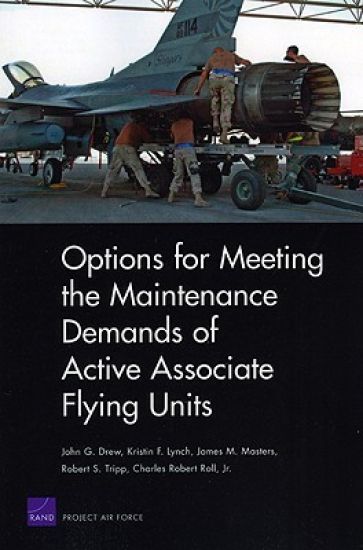
Options for Meeting the Maintenance Demands of Active Associate Flying Units

Options for Meeting the Maintenance Demands of Active Associate Flying Units

John G. Drew; Kristin F. Lynch; James M. Masters; Robert S. Tripp; Charles Robert Roll

RAND
2008
pokkari
RAND developed a methodology to help understand and explain the differences between U. S. Air National Guard and active component aircraft maintenance productivity. This research focuses on maintenance options for supporting associate units, where the goal of the associate unit is to produce trained pilots in the most efficient manner possible. It evaluates maintenance options for U. S. Air Force associate units, where the goal of the associate units is to produce trained pilots in the most efficient manner possible.
Supporting the Future Total Force
Given manpower reductions in the active-duty Air Force and a surplus of highly trained Air National Guard (ANG) personnel, some missions might be transferred from the active component to the ANG without significant cost to the total force. Predator operations and support, air mobility command and control, Commander of Air Force forces staffing, and base-level intermediate maintenance are potentially attractive missions for ANG participation.
Strategic Analysis of Air National Guard Combat Support and Reachback Functions

Strategic Analysis of Air National Guard Combat Support and Reachback Functions

Robert S Tripp; Kristin F Lynch; Ronald G McGarvey; Don Snyder; Raymond A Pyles

RAND
2006
pokkari
Evaluates options for Air National Guard combat support and reachback missions in four Air Force mission areas to support the Air and Space Expeditionary Force, investigates transformational opportunities for the ANG that would add the most value in achieving the desired operational effects, and considers how changes in unit and above-unit policies are likely to affect Total Force capabilities.
A Framework for Enhancing Airlift Planning and Execution Capabilities within the Joint Expeditionary Movement System

A Framework for Enhancing Airlift Planning and Execution Capabilities within the Joint Expeditionary Movement System

Robert S. Tripp; Kristin F. Lynch; Charles Robert Roll; John G. Drew; Patrick Mills

RAND
2005
pokkari
How can the Air Force improve the planning and execution activities associated with developing intratheater airlift operations within the military joint end-to-end multimodal movement system? Recent operations have shed light on shortfalls in Air Force intratheater airlift. Using an expanded strategies-to-tasks framework, the authors assess current intratheater airlift processes, organizations, doctrine, training, and systems. This report catalogues identified shortfalls and recommends options for improving the Theater Distribution System. The authors recommend separation of supply, demand, and integrator roles and adoption of a closed-loop planning and execution process.