Kirjojen hintavertailu – 12 903 725 kirjaa ja 27 kauppaa

Kirjailija

L. Berry

Kirjat ja teokset yhdessä paikassa: 4 kirjaa, julkaisuja vuosilta 1997–2013, suosituimpiin kuuluu African Environments and Resources. Vertaile teosten hintoja ja tarkista saatavuus suomalaisista kirjakaupoista.

4 kirjaa

Kirjojen julkaisuvuodet: 1997–2013.

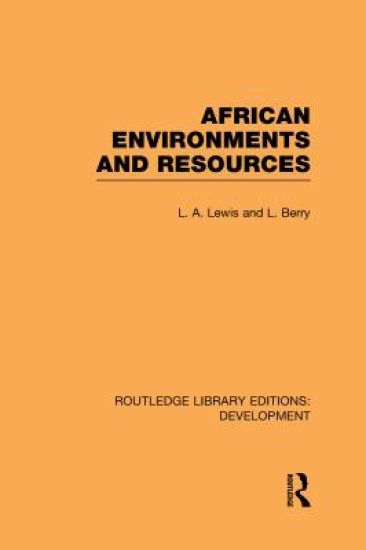
African Environments and Resources

African Environments and Resources

L. A. Lewis; L. Berry

Routledge
2013
nidottu
First published in 1988, this work provides a comprehensive picture of the range of physical environments in Africa, focusing upon those characteristics and issues central to the management of environmental resources. Beginning with an overview of the geographical and environmental history of Africa, the authors also provide to the evolution of the management of resources and then details a broadly defined ecosystem approach, in which major environmental resource issues are identified and addressed in the tropical rainforest, the Savannah dry-forest, the arid and semi-arid areas, the highlands, and the extra-tropical zones of Northern and Southern Africa. The book is designed to contribute to a better understanding of African environmental and resource-management problems and this reissue should be welcomed by students of Africa and of environmental resource management problems in general.
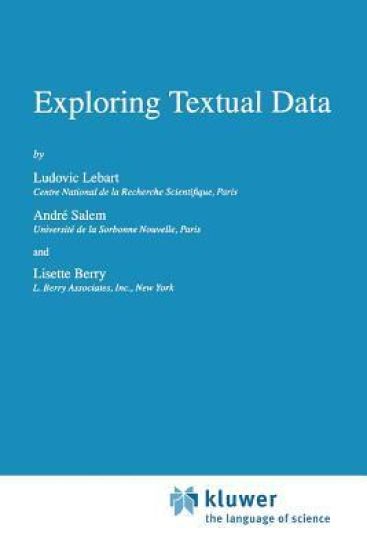
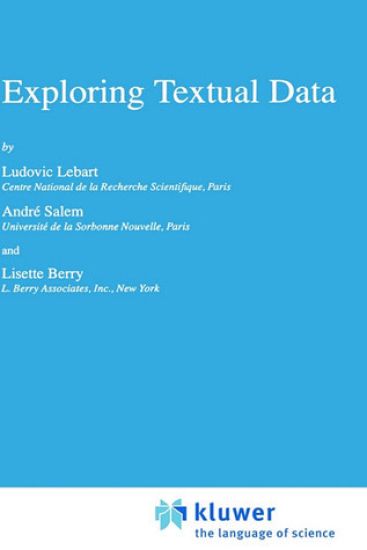
Exploring Textual Data

Exploring Textual Data

Ludovic Lebart; A. Salem; L. Berry

Springer
2010
nidottu
Researchers in a number of disciplines deal with large text sets requiring both text management and text analysis. Faced with a large amount of textual data collected in marketing surveys, literary investigations, historical archives and documentary data bases, these researchers require assistance with organizing, describing and comparing texts. Exploring Textual Data demonstrates how exploratory multivariate statistical methods such as correspondence analysis and cluster analysis can be used to help investigate, assimilate and evaluate textual data. The main text does not contain any strictly mathematical demonstrations, making it accessible to a large audience. This book is very user-friendly with proofs abstracted in the appendices. Full definitions of concepts, implementations of procedures and rules for reading and interpreting results are fully explored. A succession of examples is intended to allow the reader to appreciate the variety of actual and potential applications and the complementary processing methods. A glossary of terms is provided.
African Environments and Resources

African Environments and Resources

L. A. Lewis; L. Berry

Routledge
2010
sidottu
First published in 1988, this work provides a comprehensive picture of the range of physical environments in Africa, focusing upon those characteristics and issues central to the management of environmental resources. Beginning with an overview of the geographical and environmental history of Africa, the authors also provide to the evolution of the management of resources and then details a broadly defined ecosystem approach, in which major environmental resource issues are identified and addressed in the tropical rainforest, the Savannah dry-forest, the arid and semi-arid areas, the highlands, and the extra-tropical zones of Northern and Southern Africa. The book is designed to contribute to a better understanding of African environmental and resource-management problems and this reissue should be welcomed by students of Africa and of environmental resource management problems in general.
Exploring Textual Data

Exploring Textual Data

Ludovic Lebart; A. Salem; L. Berry

Springer
1997
sidottu
Researchers in a number of disciplines deal with large text sets requiring both text management and text analysis. Faced with a large amount of textual data collected in marketing surveys, literary investigations, historical archives and documentary data bases, these researchers require assistance with organizing, describing and comparing texts. Exploring Textual Data demonstrates how exploratory multivariate statistical methods such as correspondence analysis and cluster analysis can be used to help investigate, assimilate and evaluate textual data. The main text does not contain any strictly mathematical demonstrations, making it accessible to a large audience. This book is very user-friendly with proofs abstracted in the appendices. Full definitions of concepts, implementations of procedures and rules for reading and interpreting results are fully explored. A succession of examples is intended to allow the reader to appreciate the variety of actual and potential applications and the complementary processing methods. A glossary of terms is provided.