Kirjojen hintavertailu – 12 903 724 kirjaa ja 27 kauppaa

Kirjailija

Lactantius

Kirjat ja teokset yhdessä paikassa: 30 kirjaa, julkaisuja vuosilta 1998–2018, suosituimpiin kuuluu The Works of Lactantius. Vertaile teosten hintoja ja tarkista saatavuus suomalaisista kirjakaupoista.

30 kirjaa

Kirjojen julkaisuvuodet: 1998–2018.

God's Judgments Upon Tyrants

God's Judgments Upon Tyrants

Lactantius

Gale Ecco, Print Editions
2018
sidottu
The 18th century was a wealth of knowledge, exploration and rapidly growing technology and expanding record-keeping made possible by advances in the printing press. In its determination to preserve the century of revolution, Gale initiated a revolution of its own: digitization of epic proportions to preserve these invaluable works in the largest archive of its kind. Now for the first time these high-quality digital copies of original 18th century manuscripts are available in print, making them highly accessible to libraries, undergraduate students, and independent scholars. The Age of Enlightenment profoundly enriched religious and philosophical understanding and continues to influence present-day thinking. Works collected here include masterpieces by David Hume, Immanuel Kant, and Jean-Jacques Rousseau, as well as religious sermons and moral debates on the issues of the day, such as the slave trade. The Age of Reason saw conflict between Protestantism and Catholicism transformed into one between faith and logic -- a debate that continues in the twenty-first century.++++The below data was compiled from various identification fields in the bibliographic record of this title. This data is provided as an additional tool in helping to insure edition identification: ++++National Library of ScotlandN018148A translation of 'De mortibus persecutorum'. London: printed for J. Roberts, 1715. 95, 1]p.; 8
A Relation of the Death of the Primitive Persecutors. Written Originally in Latin by L. C. F. Lactantius. Englished by Gilbert Burnet, D.D. To Which is Prefixed a Discourse Concerning Persecution
The 18th century was a wealth of knowledge, exploration and rapidly growing technology and expanding record-keeping made possible by advances in the printing press. In its determination to preserve the century of revolution, Gale initiated a revolution of its own: digitization of epic proportions to preserve these invaluable works in the largest archive of its kind. Now for the first time these high-quality digital copies of original 18th century manuscripts are available in print, making them highly accessible to libraries, undergraduate students, and independent scholars. Western literary study flows out of eighteenth-century works by Alexander Pope, Daniel Defoe, Henry Fielding, Frances Burney, Denis Diderot, Johann Gottfried Herder, Johann Wolfgang von Goethe, and others. Experience the birth of the modern novel, or compare the development of language using dictionaries and grammar discourses. ++++The below data was compiled from various identification fields in the bibliographic record of this title. This data is provided as an additional tool in helping to insure edition identification: ++++Bodleian Library (Oxford)T168646Glasgow: printed by Robert and Andrew Foulis, 1766. 197, 1]p.; 18
A Relation of the Death of the Primitive Persecutors. Written Originally in Latin, by L.C.F. Lactantius. Made English by Gilbert Burnet, ... To Which is Added a Large Preface, Concerning Persecution. The Second Edition
The 18th century was a wealth of knowledge, exploration and rapidly growing technology and expanding record-keeping made possible by advances in the printing press. In its determination to preserve the century of revolution, Gale initiated a revolution of its own: digitization of epic proportions to preserve these invaluable works in the largest archive of its kind. Now for the first time these high-quality digital copies of original 18th century manuscripts are available in print, making them highly accessible to libraries, undergraduate students, and independent scholars. Western literary study flows out of eighteenth-century works by Alexander Pope, Daniel Defoe, Henry Fielding, Frances Burney, Denis Diderot, Johann Gottfried Herder, Johann Wolfgang von Goethe, and others. Experience the birth of the modern novel, or compare the development of language using dictionaries and grammar discourses. ++++The below data was compiled from various identification fields in the bibliographic record of this title. This data is provided as an additional tool in helping to insure edition identification: ++++British LibraryT135325London: printed for A. Baldwin, 1713. 95, 1]p.; 8
The Minor Works

The Minor Works

Lactantius

The Catholic University of America Press
2016
nidottu
Lactantius lived through one of the greatest turning points in the history of Europe. It has been aptly described as the moment when the old world of paganism was in travail, when against its will it gave birth to the Christian Empire. The writings of this author are, together with those of Eusebius, the principal sources for the period of the great persecution of Diocletian and for the first years of the peace of the Church after the Edict of Milan. For the period of the Council of Nicaea, there is somewhat more abundant source material, but for the years 312-324 reliance must be made upon Eusebius and Lactantius. Both may be considered to have written with considerable bias. They are too extravagant in praise of Constantine; Lactantius especially manifested an odium theologicum toward Galerius and the persecutors. Their works are still of high value, however, as historical sources. From the time of the studies of Maurice, moreover, the evidence of numismatics has verified the historical accounts of these contemporary sources. The writings of Lactantius, therefore, were composed in one of the most eventful epochs of ecclesiastical history. The Church, after suffering the most sever of despotic persecutions, was suddenly received under state protection and began to enjoy, not merely tranquility and legal status, but even a considerable portion of political influence. The fourth century saw the great fusion of the Christian Church with the Roman state and Hellenistic culture, the fusion which was to spell out Western civilization and determine its achievements. Perhaps no other writer is more completely revealing of his own times. As pagan rhetoricians were abandoning the schools and the philosophers, the culture of the world was bring saved in the very Church that was charged with its destruction. Lactantius is a sharer of Minucius Felix' attitude toward traditional culture. He believed that it possessed a vitality, that its treasure should be preserved, that the 'spoils of the Egyptians could become the pride of the despised Galilaeans.' In the very act of despoiling them, however, he assigned himself the task of addressing those Egyptians and, in a number of essential features, accepted their own literature and learning. In this way, he saved much of their culture for the Church and became thereby one of the founders of Christian humanism.
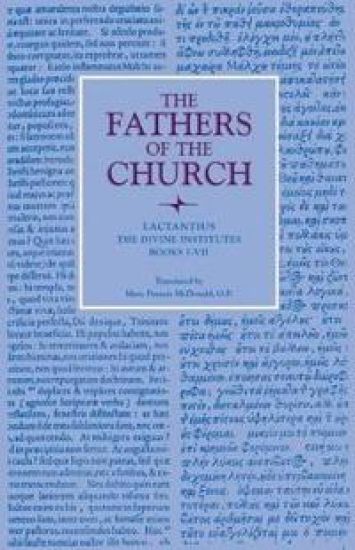
The Divine Institutes, Books I-VII

The Divine Institutes, Books I-VII

Lactantius

The Catholic University of America Press
2008
nidottu
Biographical data on Lactantius are meager. In his catalogue of illustrious men St. Jerome informs us that Lactantius studied under Arnobius. Accepting an imperial invitation Lactantius taught rhetoric at Nicomedia but relinquished this professorship after the outbreak of the Diocletian persecution. In 317 Constantine summoned Lactantius to Trier to supervise the education of his son Crispus. The principal work of Lactantius is the Divine Institutes (Divinae institutions) which was written over a period of years (304-313). It is an apologetic work in seven books which bear the following titles: On False Religion, The Origin of Error, On False Philosophy, True Wisdom and Religion, Concerning Justice, On True Worship, and On the Blessed Life. From the viewpoint of literary criticism the diction of these books flows gently and pleasantly and is so reminiscent of the style of Cicero that Lactantius has frequently been styled the "Christian Cicero". This encomium can be traced back to the days of St. Jerome who wrote in a letter to Paulinus the Presbyter that Lactantius' works were like rivers of "Tullian eloquence" that demolished pagan beliefs.