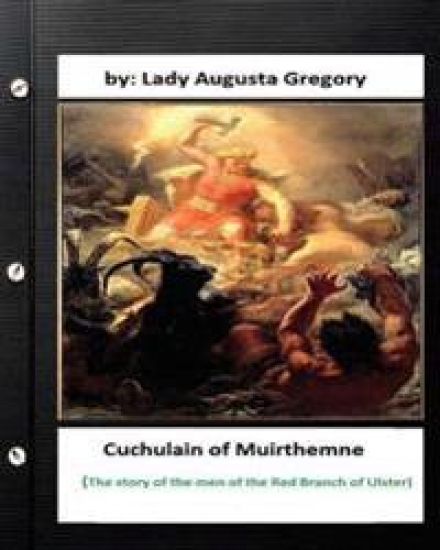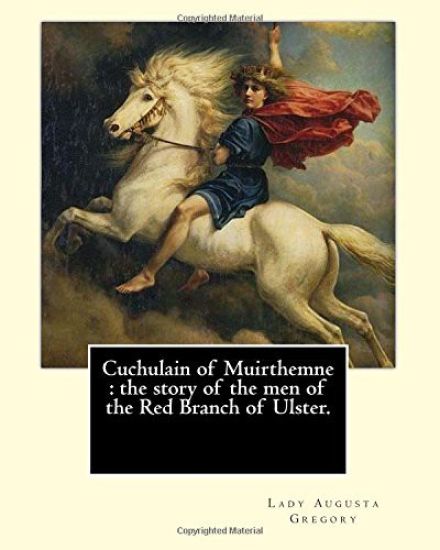
Cuchulain of Muirthemne: the story of the men of the Red Branch of Ulster. By: Lady (Augusta) Gregory, with preface By: W. B. Yeats: William Bu
W. B. Yeats; Lady (Augusta) Gregory
Createspace Independent Publishing Platform
2017
nidottu
Isabella Augusta, Lady Gregory ( 15 March 1852 - 22 May 1932) was an Irish dramatist, folklorist and theatre manager. With William Butler Yeats and Edward Martyn, she co-founded the Irish Literary Theatre and the Abbey Theatre, and wrote numerous short works for both companies. Lady Gregory produced a number of books of retellings of stories taken from Irish mythology. Born into a class that identified closely with British rule, her conversion to cultural nationalism, as evidenced by her writings, was emblematic of many of the political struggles to occur in Ireland during her lifetime. Lady Gregory is mainly remembered for her work behind the Irish Literary Revival. Her home at Coole Park, County Galway, served as an important meeting place for leading Revival figures, and her early work as a member of the board of the Abbey was at least as important for the theatre's development as her creative writings. Lady Gregory's motto was taken from Aristotle: "To think like a wise man, but to express oneself like the common people." Early life and marriage: Gregory was born at Roxborough, County Galway, the youngest daughter of the Anglo-Irish gentry family Persse. Her mother, Frances Barry, was related to Viscount Guillamore, and her family home, Roxborough, was a 6,000-acre (24 km ) estate located between Gort and Loughrea, the main house of which was later burnt down during the Irish Civil War. 2] She was educated at home, and her future career was strongly influenced by the family nurse (i.e. nanny), Mary Sheridan, a Catholic and a native Irish speaker, who introduced the young Augusta to the history and legends of the local area. She married Sir William Henry Gregory, a widower with an estate at Coole Park, near Gort, on 4 March 1880 in St Matthias' Church, Dublin. Sir William, who was 35 years her elder, had just retired from his position as Governor of Ceylon (now Sri Lanka), having previously served several terms as Member of Parliament for County Galway. He was a well-educated man with many literary and artistic interests, and the house at Coole Park housed a large library and extensive art collection, both of which Lady Gregory was eager to explore. He also had a house in London, where the couple spent a considerable amount of time, holding weekly salons frequented by many leading literary and artistic figures of the day, including Robert Browning, Lord Tennyson, John Everett Millais and Henry James. Their only child, Robert Gregory, was born in 1881. He was killed during the First World War, while serving as a pilot, an event which inspired Yeats's poems "An Irish Airman Foresees His Death," "In Memory of Major Robert Gregory," and "Shepherd and Goatherd."..................... William Butler Yeats ( 13 June 1865 - 28 January 1939) was an Irish poet and one of the foremost figures of 20th-century literature. A pillar of both the Irish and British literary establishments, he helped to found the Abbey Theatre, and in his later years served as an Irish Senator for two terms. Yeats was a driving force behind the Irish Literary Revival along with Lady Gregory, Edward Martyn and others. He was born in Sandymount, Ireland and educated there and in London. He spent childhood holidays in County Sligo and studied poetry from an early age when he became fascinated by Irish legends and the occult. These topics feature in the first phase of his work, which lasted roughly until the turn of the 20th century. His earliest volume of verse was published in 1889, and its slow-paced and lyrical poems display Yeats's debts to Edmund Spenser, Percy Bysshe Shelley, and the poets of the Pre-Raphaelite Brotherhood. From 1900, his poetry grew more physical and realistic. He largely renounced the transcendental beliefs of his youth, though he remained preoccupied with physical and spiritual masks, as well as with cyclical theories of life. In 1923, he was awarded the Nobel Prize in Literature.