Kirjojen hintavertailu – 12 903 725 kirjaa ja 27 kauppaa

Kirjailija

Lambert Zuidervaart

Kirjat ja teokset yhdessä paikassa: 25 kirjaa, julkaisuja vuosilta 1993–2024, suosituimpiin kuuluu To Sing Once More. Vertaile teosten hintoja ja tarkista saatavuus suomalaisista kirjakaupoista.

25 kirjaa

Kirjojen julkaisuvuodet: 1993–2024.

Artistic Truth

Artistic Truth

Lambert Zuidervaart

Cambridge University Press
2009
pokkari
It is unfashionable to talk about artistic truth. Yet the issues traditionally addressed under that term have not disappeared. Indeed, questions concerning the role of the artist in society, the relationship between art and knowledge and the validity of cultural interpretation have intensified. Lambert Zuidervaart challenges intellectual fashions. He proposes a new critical hermeneutics of artistic truth that engages with both analytic and continental philosophies and illuminates the contemporary cultural scene. People turn to the arts as a way of finding orientation in their lives, communities and institutions. But philosophers, hamstrung by their own theories of truth, have been unsuccessful in accounting for this common feature in our lives. This book portrays artistic truth as a process of imaginative disclosure in which expectations of authenticity, significance and integrity prevail. Understood in this way, truth becomes central to the aesthetic and social value of the arts.
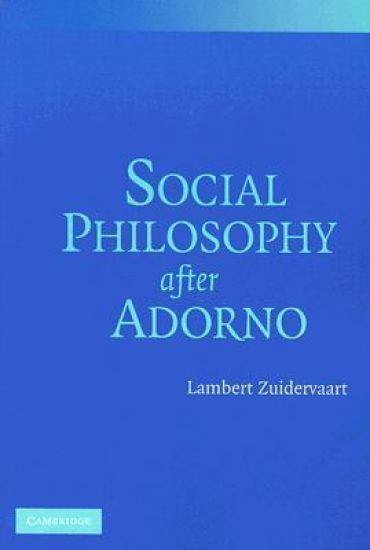
Social Philosophy after Adorno

Social Philosophy after Adorno

Lambert Zuidervaart

Cambridge University Press
2007
sidottu
Lambert Zuidervaart examines what is living and what is dead in the social philosophy of Theodor W. Adorno, the most important philosopher and social critic in Germany after World War II. When he died in 1969, Adorno's successors abandoned his critical-utopian passions. Habermas in particular, rejected or ignored Adorno's central insights on the negative effects of capitalism and new technologies upon nature and human life. Zuidervaart reclaims Adorno's insights from Habermasian neglect while taking up legitimate Habermasian criticisms. He also addresses the prospects for radical and democratic transformations of an increasingly globalized world. The book proposes a provocative social philosophy 'after Adorno'.
Social Philosophy after Adorno

Social Philosophy after Adorno

Lambert Zuidervaart

Cambridge University Press
2007
pokkari
Lambert Zuidervaart examines what is living and what is dead in the social philosophy of Theodor W. Adorno, the most important philosopher and social critic in Germany after World War II. When he died in 1969, Adorno's successors abandoned his critical-utopian passions. Habermas in particular, rejected or ignored Adorno's central insights on the negative effects of capitalism and new technologies upon nature and human life. Zuidervaart reclaims Adorno's insights from Habermasian neglect while taking up legitimate Habermasian criticisms. He also addresses the prospects for radical and democratic transformations of an increasingly globalized world. The book proposes a provocative social philosophy 'after Adorno'.
Artistic Truth

Artistic Truth

Lambert Zuidervaart

Cambridge University Press
2004
sidottu
It is unfashionable to talk about artistic truth. Yet the issues traditionally addressed under that term have not disappeared. Indeed, questions concerning the role of the artist in society, the relationship between art and knowledge, and the validity of cultural interpretation have intensified. Lambert Zuidervaart challenges current intellectual fashions by proposing a new hermeneutic theory of artistic truth that engages with both analytic and continental philosophies and illuminates the contemporary cultural scene. People turn to the arts as a way of finding orientation in their lives, communities and institutions. However, as the author shows, philosophers, hamstrung by their own theories of truth, have been unsuccessful in accounting for this common feature in our lives. This book portrays artistic truth as a process of imaginative disclosure in which expectations of authenticity, significance and integrity prevail. Understood in this way, truth becomes central to the aesthetic and social value of the arts.
Adorno's Aesthetic Theory

Adorno's Aesthetic Theory

Lambert Zuidervaart

MIT Press
1993
pokkari
This is the first book to put Aesthetic Theory into context and outline the main ideas and relevant debates, offering readers a valuable guide through this huge, difficult, but revelatory work. Theodor Adorno's Aesthetic Theory is a vast labyrinth that anyone interested in modern aesthetic theory must at some time enter. Because of his immense difficulty of the same order as Derrida - Adorno's reception has been slowed by the lack of a comprehensive and comprehensible account of the intentions of his aesthetics. This is the first book to put Aesthetic Theory into context and outline the main ideas and relevant debates, offering readers a valuable guide through this huge, difficult, but revelatory work. Its extended argument is that, despite Adorno's assumptions of autonomism, cognitivism, and aesthetic modernism, his idea of artistic truth content offers crucial insights for contemporary philosophical aesthetics. The eleven chapters are divided into three parts: Context, Content, and Critique. The first part offers a brief biography, describes Adorno's debates with Benjamin, Brecht, and Lukacs, and outlines his philosophical program. The second part is an interpretation of Adorno's aesthetics, examining how he situates art in society, production, politics, and history and uncovering the social, political, and historical dimensions of his idea of artistic truth. The third part evaluates Adorno's contribution by confronting it with the critiques of Peter Burger, Frederic Jameson, and Albrecht Wellmer.