Kirjojen hintavertailu – 12 903 725 kirjaa ja 27 kauppaa

Kirjailija

Lani Guinier

Kirjat ja teokset yhdessä paikassa: 5 kirjaa, julkaisuja vuosilta 1995–2003, suosituimpiin kuuluu Becoming Gentlemen: Women, Law School, and Institutional Change. Vertaile teosten hintoja ja tarkista saatavuus suomalaisista kirjakaupoista.

5 kirjaa

Kirjojen julkaisuvuodet: 1995–2003.

The Miner’s Canary

The Miner’s Canary

Lani Guinier; Gerald Torres

Harvard University Press
2003
nidottu
Like the canaries that alerted miners to a poisonous atmosphere, issues of race point to underlying problems in society that ultimately affect everyone, not just minorities. Addressing these issues is essential. Ignoring racial differences--race blindness--has failed. Focusing on individual achievement has diverted us from tackling pervasive inequalities. Now, in a powerful and challenging book, Lani Guinier and Gerald Torres propose a radical new way to confront race in the twenty-first century. Given the complex relationship between race and power in America, engaging race means engaging standard winner-take-all hierarchies of power as well. Terming their concept "political race," Guinier and Torres call for the building of grass-roots, cross-racial coalitions to remake those structures of power by fostering public participation in politics and reforming the process of democracy. Their illuminating and moving stories of political race in action include the coalition of Hispanic and black leaders who devised the Texas Ten Percent Plan to establish equitable state college admissions criteria, and the struggle of black workers in North Carolina for fair working conditions that drew on the strength and won the support of the entire local community. The aim of political race is not merely to remedy racial injustices, but to create truly participatory democracy, where people of all races feel empowered to effect changes that will improve conditions for everyone. In a book that is ultimately not only aspirational but inspirational, Guinier and Torres envision a social justice movement that could transform the nature of democracy in America.

Who's Qualified?

Who's Qualified?

Lani Guinier; Susan Sturm

Beacon Press
2001
pokkari
Affirmative action originated as a plan to correct the historical disadvantage of women and people of color -- to make the system more fair. For over twenty years, it has been repeatedly attacked for being unfair to whites, and even un-American. Guinier and Sturm critique affirmative action as too modest a remedy, arguing that it doesn't go far enough -- either for the people it includes or the people it leaves out. They expose the failure of tests to predict success, and ask us to rethink how we evaluate qualification for everyone, not just the beneficiaries of affirmative action. Offering a model of selection based on performance, not prediction, the authors' vision of an old ideal is at once a smart business practice and a step toward the promise of democratic opportunity. A lively debate including Claude M. Steele. Howard Gardner, Derrick Bell, and Peter Sacks ensues.
Lift Every Voice

Lift Every Voice

Lani Guinier

Simon Schuster
1998
pokkari
In 1993, shortly after his inauguration, new President Bill Clinton nominated his old friend and classmate Lani Guinier to the prestigious and crucial post of Assistant Attorney General for Civil Rights. That nomination sparked an immediate firestorm of criticism from the right, labeling Professor Guinier the "Quota Queen" and assailing her for the ideas expressed in her publications, most of which her opponents had not read, or had taken out of context and misunderstood. In the face of this concerted opposition -- what one friend of Guinier's called "a low-tech lynching" -- Clinton backed down, not only withdrawing her nomination, but having refused throughout to give her an opportunity to speak out in her own defense (and his). The result was a civil rights setback of monumental proportions. Now, in this remarkable and important book, at once a memoir and insider's account of what really happened behind the closed doors of the Oval Office, the Justice Department, and the U. S. Senate, and an insightful look at the past, present, and future of civil rights in America, Lani Guinier at last breaks her silence. Unsparing of her own mistakes and shrewdly perceptive about the overt and hidden agendas of those who opposed her, Professor Guinier shows how the president promptly abandoned his ambitious agenda for civil rights at the first hint of criticism from the media and Congress -- and how the civil rights movement suffered a major setback as a result. More important, this book, in Professor Guinier's own words, is about "the battles fought in the belief that our racial history and our commitment to equality and democracy are essential parts of the same story. It has not always been a pretty story, nor one that follows an inevitable path. "This book is not, however, an effort to settle scores. It's a story of the efforts of men and women who believe fundamentally in the promise of the American creed and who act on that belief in their everyday lives. These are people whose lives are without notoriety or fame, but in whose willingness to take risks we see the honor of real heroism." Above all, Guinier goes on to describe how her experience at the hands of the press, the White House, and her congressional enemies has given her both a new voice and a renewed faith in the ongoing struggle for civil rights. Her book is an extraordinary account of just how the civil rights movement acquired its strength, drawn from the courage of "ordinary" people standing up against fearful odds for what was right, and from the commitment to make change happen from the bottom up, relying on the wisdom and common sense of those at grassroots level. Using her own nomination as a symbolic point of reference, she shows just how weak and divided the cause of civil rights has become, as its leaders have all too often been silenced by the very people they should be challenging. Finally, she explains, in her own words, the truth about her political ideas -- which are rooted in "democracy" and its principles, not in quotas and affirmative action -- and examines the state of current race relations. Renewing her call for a national conversation on the issue of civil rights and social justice, this thought-provoking book is certain to spark a new and much-needed debate.
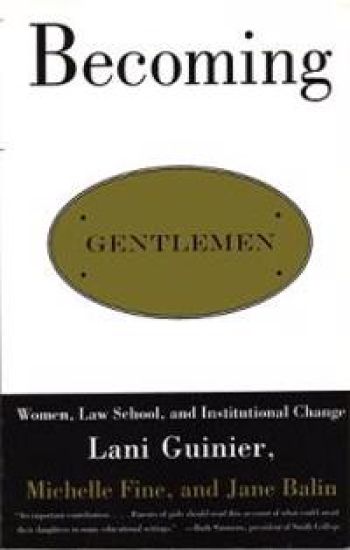
Becoming Gentlemen: Women, Law School, and Institutional Change

Becoming Gentlemen: Women, Law School, and Institutional Change

Lani Guinier; Michelle Fine; Jane Balin

BEACON PRESS
1997
nidottu
"The challenge, then, is not to invent new victims or new scapegoats but to mobilize America for the future. What would it take to ensure that all of us can succeed at getting the job done, the problem solved, and the future more secure?" As a student at Yale Law School in 1974, Lani Guinier attended a class with a white male professor who addressed all the students, male and female, as "gentlemen." To him the greeting was a form of honorific, evoking the values of traditional legal education. To her it was profoundly alienating. Years later Guinier began a study of female law students with her colleagues, Michelle Fine and Jane Balin, to try to understand the frustrations of women law students in male-dominated schools. Women are now entering law schools in large numbers, but too often many still do not feel welcome. As one says, "I used to be very driven, competitive. Then I started to realize that all my effort was getting me nowhere. I just stopped caring. I am scarred forever." After interviewing hundreds of women with similar stories, the authors conclude that conventional one-size-fits-all approaches to legal education discourage many women who could otherwise succeed and, even more, fail to help all students realize their full potential as legal problem-solvers. In Becoming Gentlemen Guinier, Fine, and Balin dare us to question what it means to become qualified, what a fair goal in education might be, and what we can learn from the experience of women law students about teaching and evaluating students in general. Including the authors' original study and two essays and a personal afterword by Lani Guinier, the book challenges us to work toward a more just society, based on ideals of cooperation, the resources of diversity, and the values of teamwork.
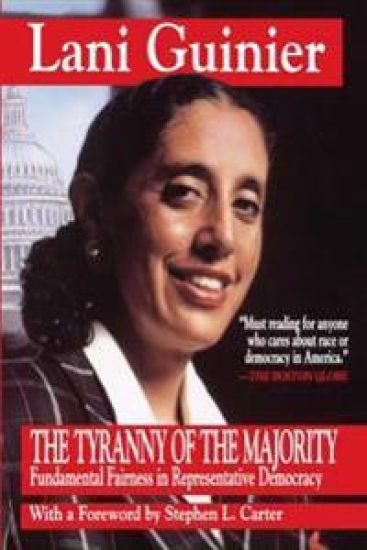
Tyranny of the Majority

Tyranny of the Majority

Lani Guinier

The Free Press
1995
pokkari
At last...the public hearing she was denied... These essays reveal keen powers of analysis applied to some of the most obdurate problems that bedevil electoral politics. Anyone who cares about the mechanisms of democracy should be engaged by her tough-minded explorations. It doesn't matter where you think you stand: it's all here, to argue or agree with. -- Henry Louis Gates, Jr. Lani Guinier's fascinating book is a prophetic intervention into a public conversation we desperately need to rejuvenate. There is no doubt that her powerful voice will produce good consequences for our nation and world. -- Cornel West, Author of Race Matters Intriguing and desperately needed... -- The San Francisco Chronicle