Kirjojen hintavertailu – 12 859 818 kirjaa ja 27 kauppaa
Kirjailija
Larry Alexander
Kirjat ja teokset yhdessä paikassa: 27 kirjaa, julkaisuja vuosilta 1988–2025, suosituimpiin kuuluu Kõrgem kutse. Vertaile teosten hintoja ja tarkista saatavuus suomalaisista kirjakaupoista.
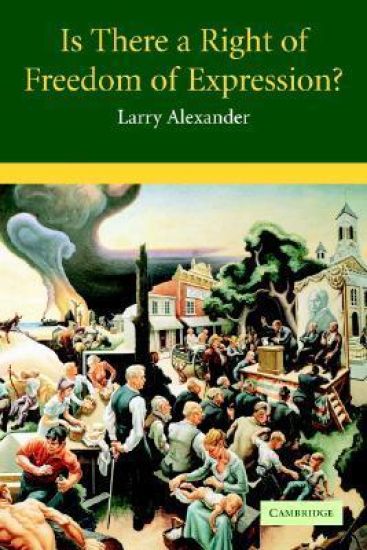
In this provocative book, Alexander offers a sceptical appraisal of the claim that freedom of expression is a human right. He examines the various contexts in which a right to freedom of expression might be asserted and concludes that such a right cannot be supported in any of these contexts. He argues that some legal protection of freedom of expression is surely valuable, though the form such protection will take will vary with historical and cultural circumstances and is not a matter of human right. Written in a clear and accessible style, this book will appeal to students and professionals in political philosophy, law, political science, and human rights.
Publisher's Note: Products purchased from Third Party sellers are not guaranteed by the publisher for quality, authenticity, or access to any online entitlements included with the product. This is an essential text and reference for optometrists treating patients with problems of the retina, vitreous body, and optic nerve. The Third Edition has been updated with new information on pathophysiology, clinical management guidelines, treatment algorithms, and front index of signs and symptoms.
Rules perform a moral function by restating moral principles in concrete terms, so as to reduce the uncertainty, error, and controversy that result when individuals follow their own unconstrained moral judgment. Although reason dictates that we must follow rules to avoid destructive error and controversy, rules-and hence laws-are imperfect, and reason also dictates that we ought not follow them when we believe they produce the wrong result in a particular case. In The Rule of Rules Larry Alexander and Emily Sherwin examine this dilemma. Once the importance of this moral and practical conflict is acknowledged, the authors argue, authoritative rules become the central problems of jurisprudence. The inevitable gap between rules and background morality cannot be bridged, they claim, although many contemporary jurisprudential schools of thought are misguided attempts to do so. Alexander and Sherwin work through this dilemma, which lies at the heart of such ongoing jurisprudential controversies as how judges should reason in deciding cases, what effect should be given to legal precedent, and what status, if any, should be accorded to “legal principles.” In the end, their rigorous discussion sheds light on such topics as the nature of interpretation, the ancient dispute among legal theorists over natural law versus positivism, the obligation to obey law, constitutionalism, and the relation between law and coercion. Those interested in jurisprudence, legal theory, and political philosophy will benefit from the edifying discussion in The Rule of Rules.
This Major Reference series brings together a wide range of key international articles in law and legal theory. Many of these essays are not readily accessible, and their presentation in these volumes will provide a vital new resource for both research and teaching. Each volume is edited by leading international authorities who explain the significance and context of articles in an informative and complete introduction.
This Major Reference series brings together a wide range of key international articles in law and legal theory. Many of these essays are not readily accessible, and their presentation in these volumes will provide a vital new resource for both research and teaching. Each volume is edited by leading international authorities who explain the significance and context of articles in an informative and complete introduction.
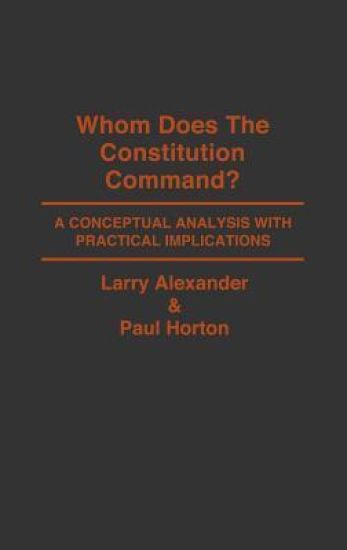
Alexander and Horton have attempted to untangle one of the most difficult and potentially far-reaching questions in constitutional law: at what point does constitutional law leave off and `plain old law' remain to occupy the US legal system's field of play? In addressing this question the authors take on two of the most murky concepts in constitutional law, `state action; and `under color of law.' In their attempt to make sense of these notions they develop models that potentially could provide coherent, principled answers to the problems created by the Supreme Court in its decisions in this area. . . . This work, the first monographic treatment of this question, is written purposely at a fairly high level of abstraction and is clearly intended for advanced students and judicial decision makers. Recommended for advanced students. ChoiceDespite the guidelines provided in the Constitution, many fundamental constitutional issues remain open to debate after two centuries. One of the thorniest centers on the division of authority. Who is actually mandated by the U. S. Constitution to carry out the duties it imposes? Alexander and Horton address this question by developing several models of constitutional interpretation and applying them to state action, under color of law, and other complex doctrines in constitutional jurisprudence that have been created to deal with problems of distinguishing unconstitutional from merely illegal authority. Presenting three basic analytical models--legalist, naturalist, and governmental--together with several possible permutations, the authors clarify the assumptions underlying these current doctrinal tangles and illuminate many conflicts and inner inconsistencies of modern constitutional law. They examine the implications of each model in terms of its application to relevant court precedent and the way it would deal with specific constitutional provisions such as the Thirteenth and Fourth Amendments and the Commerce Clause. The authors conclude that only two of the possible models can be considered to be principled.