Kirjojen hintavertailu – 12 859 819 kirjaa ja 27 kauppaa

Kirjailija

Larry Schweikart

Kirjat ja teokset yhdessä paikassa: 15 kirjaa, julkaisuja vuosilta 1982–2026, suosituimpiin kuuluu How Trump Won. Vertaile teosten hintoja ja tarkista saatavuus suomalaisista kirjakaupoista.

15 kirjaa

Kirjojen julkaisuvuodet: 1982–2026.

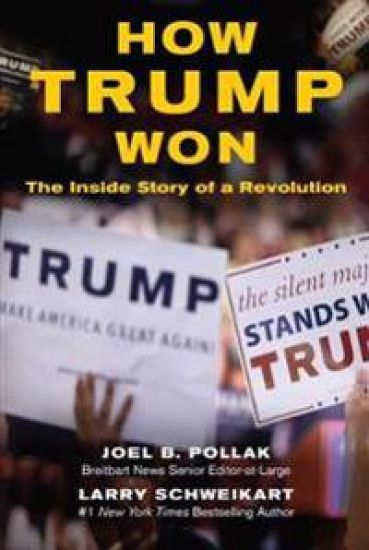
How Trump Won

How Trump Won

Joel Pollak; Larry Schweikart

Regnery Publishing Inc
2017
pokkari
From the moment Donald Trump announced his candidacy for the White House until very late on Election Night 2016, media and pollsters kept insisting Trump wouldn't--couldn't--be president. But for Larry Schweikart-one of a ragtag group of amateur politicos called "the Deplorables" who had been publishing shockingly accurate polls and predictions-and Joel Pollak-a Breitbart News senior editor following Trump on the campaign trail-Trump's win was a near certainty. Schweikart and Pollak watched the Trump campaign build a powerful coalition between working Americans from both parties; they saw the momentum that the mainstream media and pollsters completely missed; and now, in How Trump Won, they tell the whole incredible story: from the early poll predictions of "the Deplorables" to the campaign trail to Election Night.

America in the 21st Century

America in the 21st Century

Larry Schweikart

Post Hill Press
2026
sidottu
A sweeping political, economic, and social history of the United States from 2000 to 2025. America’s 21st century began with a bug—and nearly ended with another. Having survived the Y2k scare, the United States, having ended the Soviet Empire, expected to settle down into a period of quiet, if uninspiring, growth. What followed was anything but calm. After the 9/11 attacks, Americans were pulled inexorably into a pair of wars in the Middle East that saw President George W. Bush’s popularity go from nearly universal to nearly the worst in history. Bush’s presidency was finished off by the “Subprime Mortgage Crisis,” which in part enabled the rise of a young Barack Obama to the presidency. Instead of uniting America, Obama divided it further as Congress descended into years of futility while the American working class collapsed and American industry left. In 2016, Donald Trump ran on the platform of restoring the American dream, but was hamstrung by “resist” and “lawfare,” two relatively new political strategies that limited his achievements. A second “bug,” COVID-19, struck America in Trump’s final year, building enough dissatisfaction that, under questionable circumstances, Joe Biden was elected. A dissatisfied America boomeranged to make Trump only the second president in history to win an election, lose it, then win it again. Throughout, America’s economy, technology, and social structure changed in volcanic ways.
A Patriot's History of Globalism

A Patriot's History of Globalism

Larry Schweikart; Stephen K Bannon

Skyhorse Publishing
2024
sidottu

Halvin toimitettuna 28,50 €

Larry Schweikart has won wide acclaim for his number one New York Times bestseller, A Patriot’s History of the United States. Now, with A Patriot's History of Globalism, Schweikart shows that globalism, or the attempt to form a one-world government is nothing new. In the wake of Napoleon's defeat in 1814, the globalists of the day (mostly monarchs) sought to create a governing arrangement for Europe. Within forty years, three of the major participants were at war with each other. After World War I, they tried again at Versailles, this time even more aggressively changing boundaries of nations and moving populations. That attempt only lasted twenty years before another major war between the participants. Yet again, after World War II, globalists used the threat of the atomic bomb to try to form an international government with the United Nations. Most recently, the World Economic Forum and World Health Organization are attempting to minimise nationalities with global control of money and medicine. But there are signs this tide has been reversed and is finally in decline. A Patriot's History of Globalism is the gold standard text for the history of globalism.
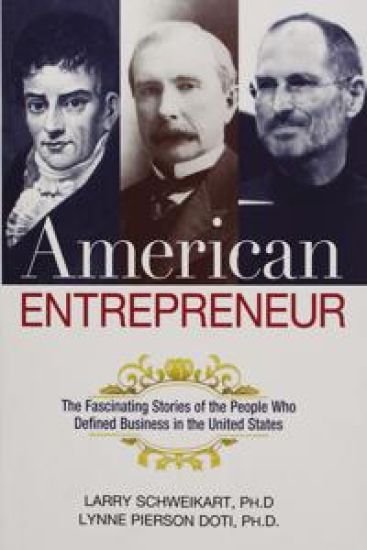
American Entrepreneur

American Entrepreneur

Larry Schweikart; Lynne Doti

Amacom
2018
nidottu
This book vividly illustrates the history of business in the United States from the point of view of the enterprising men and women who made it happen. Ever since the first colonists landed in the New World, Americans have forged ahead in their quest to make good on promises of capitalism and independence. Weaving stirring narrative with economic analysis, this historical deep dive recounts the successes and failures of some of the most iconic business people to grace our history books--from the founding of our country to the present day. In American Entrepreneur, you’ll learn about how:Eli Whitney changed the shape of the American business landscape;the Civil War impacted the economy, and how it was renewed by the subsequent dominance of Andrew Carnegie and J. P. Morgan;Asa Candler, W. K. Kellogg, Henry Ford, and J. C. Penney led the rise of the consumer marketplace;and Warren Buffett’s, Michael Milken’s, and Martha Stewart’s experience in the “New Economy” in the 1990s--and how that economy continues today. It is an adventure to start a business, and the greatest risk takers in that adventure are entrepreneurs. This is the epic story of America’s entrepreneurs and how they created the economy we enjoy today.
The Politically Incorrect Guide to the American Revolution

The Politically Incorrect Guide to the American Revolution

Larry Schweikart; Dave Dougherty

Regnery Publishing Inc
2017
pokkari
The truth about the American Revolution is under attack. Despite what you may have learned in school, it wasn't a rich slaveholder's war fought to "maintain white privilege." In fact, the War of Independence wasn't about maintaining any status quo—it was the world's first successful bottom-up revolution by the people, ushering in a new dawn of liberty that history had never seen before. But with left-wingers dominating the teaching of history, where can you go for the true story of the unprecedented events that made the United States the worlds greatest nation? Now bestselling historian Larry Schweikart has teamed up with author Dave Dougherty to write the ground-breaking patriotic history you've always wanted to read about the foundation of our unique nation. The Politically Incorrect Guide to the American Revolution reveals: Four key factors that applied only in America, making it impossible to replicate the Revolution anywhere else Why it matters that the Patriot ghting force was overwhelmingly Scotch-Irish The key role of Protestantism: which denominations tended to become Patriots, and which Tories How Americans were different from the Europeans and English even at the outset of the Revolution How the casualties of the deadliest war in American history are routinely underreported How our Revolution became a model for hundreds of others—that all failed Schweikart and Dougherty take on the left-wing myths—starting with the Marxist narrative of the Revolution in Howard Zinn's nearly ubiquitous A People's History of the United States—and uncover the truth about America's beginning.
The Politically Incorrect Guide to the Presidents, Part 1

The Politically Incorrect Guide to the Presidents, Part 1

Larry Schweikart

Regnery Publishing Inc
2017
pokkari
? If you love American history, as I do, you’ll love Professor Schweikart’s provocative profiles? A great book.” --David Limbaugh, New York Times bestselling author Larry Schweikart, a retired history professor, is ready to set the record straight on the American presidents. He goes through each of the first 26 presidents from Washington to Taft and debunks myths, lies, and fake news made fact by the uninformed. Discover why George Washington favored American isolationism; James Madison supported states' rights; what Lincoln promised to Southerners about fugitive slaves; and why nineteenth-century presidents were the last to understand the true role of government. So what made these presidents so much better than the ones America has now? Schweikart argues that recent commanders-in-chief have welcomed crises to advance their own partisan agenda, defied the separation of powers the Founders carefully constructed to preserve the Republic, and given us every reason to doubt they take the country’s interests to heart.
Partisan Journalism

Partisan Journalism

Jim A. Kuypers; Larry Schweikart

Rowman Littlefield
2015
nidottu
In Partisan Journalism: A History of Media Bias in the United States, Jim A. Kuypers guides readers on a journey through American journalistic history, focusing on the warring notions of objectivity and partisanship. Kuypers shows how the American journalistic tradition grew from partisan roots and, with only a brief period of objectivity in between, has returned to those roots today. The book begins with an overview of newspapers during Colonial times, explaining how those papers openly operated in an expressly partisan way; he then moves through the Jacksonian era’s expansion of both the press and its partisan nature. After detailing the role of the press during the War Between the States, Kuypers demonstrates that it was the telegraph, not professional sentiment, that kicked off the movement toward objective news reporting. The conflict between partisanship and professionalization/objectivity continued through the muckraking years and through World War II, with newspapers in the 1950s often being objective in their reporting even as their editorials leaned to the right. This changed rapidly in the 1960s when newspaper editorials shifted from right to left, and progressive advocacy began to slowly erode objective content. Kuypers follows this trend through the early 1980s, and then turns his attention to demonstrating how new communication technologies have changed the very nature of news writing and delivery. In the final chapters covering the Bush and Obama presidencies, he traces the growth of the progressive and partisan nature of the mainstream news, while at the same time explores the rapid rise of alternative news sources, some partisan, some objective, that are challenging the dominance of the mainstream press. This book steps beyond a simple charge-counter-charge of political bias in the news in that it offers an argument that the press in America, except for a brief period, was essentially partisan from its inception and has returned with a vengeance to its original roots. The final argument presented in the book is that this new development may actually be healthy for American Democracy.
Patriot's History Of Us-Revisd

Patriot's History Of Us-Revisd

Larry Schweikart

Sentinel
2014
nidottu
The revised, 10th anniversary edition of the #1 New York Times bestseller Over the past decade, A Patriot's History of the United States has become the definitive conservative history of our country, correcting the biases of historians and other intellectuals who downplay the greatness of America's patriots. Professors Schweikart and Allen have now revised, updated, and expanded their book, which covers America's long history with an appreciation for the values that made this nation uniquely successful. For the past three decades, many history professors have allowed their biases to distort the way America's past is taught. These intellectuals have searched for instances of racism, sexism, and bigotry in our history while downplaying the greatness of America's patriots and the achievements of "dead white men." As a result, more emphasis is placed on Harriet Tubman than on George Washington; more about the internment of Japanese Americans during World War II than about D-Day or Iwo Jima; more on the dangers we faced from Joseph McCarthy than those we faced from Josef Stalin. A Patriot's History of the United States corrects those doctrinaire biases. In this groundbreaking book, America's discovery, founding, and development are reexamined with an appreciation for the elements of public virtue, personal liberty, and private property that make this nation uniquely successful. This book offers a long-overdue acknowledgment of America's true and proud history.
Partisan Journalism

Partisan Journalism

Jim A. Kuypers; Larry Schweikart

Rowman Littlefield
2013
sidottu
In Partisan Journalism: A History of Media Bias in the United States Jim A. Kuypers guides readers on a journey through American journalistic history, focusing on the warring notions of objectivity and partisanship. Kuypers shows how the American journalistic tradition grew from partisan roots and, with only a brief period of objectivity in between, has returned to those roots today. The book begins with an overview of newspapers during Colonial times, explaining how those papers openly operated in an expressly partisan way; he then moves through the Jacksonian era’s expansion of both the press and its partisan nature. After detailing the role of the press during the War Between the States, Kuypers demonstrates that it was the telegraph, not professional sentiment, that kicked off the movement toward objective news reporting. The conflict between partisanship and professionalization/objectivity continued through the muckraking years and through World War II, with newspapers in the 1950s often being objective in their reporting even as their editorials leaned to the right. This changed rapidly in the 1960s when newspaper editorials shifted from right to left, and progressive advocacy began to slowly erode objective content. Kuypers follows this trend through the early 1980s, and then turns his attention to demonstrating how new communication technologies have changed the very nature of news writing and delivery. In the final chapters covering the Bush and Obama presidencies, he traces the growth of the progressive and partisan nature of the mainstream news, while at the same time explores the rapid rise of alternative news sources, some partisan, some objective, that are challenging the dominance of the mainstream press. This book steps beyond a simple charge-counter-charge of political bias in the news in that it offers an argument that the press in America, except for a brief period, was essentially partisan from its inception and has returned with a vengeance to its original roots. The final argument presented in the book is that this new development may actually be healthy for American Democracy.