Kirjojen hintavertailu – 12 903 725 kirjaa ja 27 kauppaa
Kirjailija
Larry V. Hedges
Kirjat ja teokset yhdessä paikassa: 4 kirjaa, julkaisuja vuosilta 1985–2027, suosituimpiin kuuluu Introduction to Meta-Analysis. Vertaile teosten hintoja ja tarkista saatavuus suomalaisista kirjakaupoista.
This text describes how to design and analyze small efficacy or evaluation studies, typically carried out as part of the development of programs or interventions in areas such as education. The authors provide guidance on designs for small, randomized trials, and also non-randomized causal designs. The final section compares research designs, discusses approaches to choosing a design, and provides guidance on reporting.
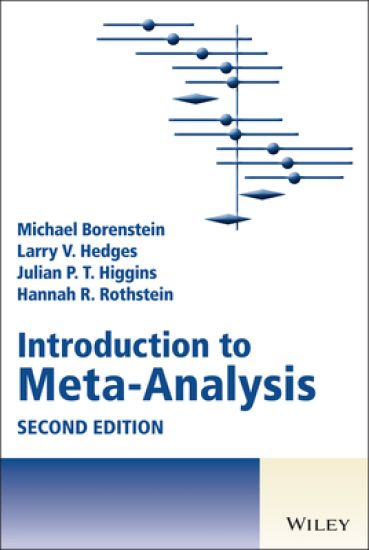
A clear and thorough introduction to meta-analysis, the process of synthesizing data from a series of separate studies The first edition of this text was widely acclaimed for the clarity of the presentation, and quickly established itself as the definitive text in this field. The fully updated second edition includes new and expanded content on avoiding common mistakes in meta-analysis, understanding heterogeneity in effects, publication bias, and more. Several brand-new chapters provide a systematic "how to" approach to performing and reporting a meta-analysis from start to finish. Written by four of the world's foremost authorities on all aspects of meta-analysis, the new edition: Outlines the role of meta-analysis in the research processShows how to compute effects sizes and treatment effectsExplains the fixed-effect and random-effects models for synthesizing dataDemonstrates how to assess and interpret variation in effect size across studiesExplains how to avoid common mistakes in meta-analysisDiscusses controversies in meta-analysisIncludes access to a companion website containing videos, spreadsheets, data files, free software for prediction intervals, and step-by-step instructions for performing analyses using Comprehensive Meta-Analysis (CMA) Download videos, class materials, and worked examples at www. Introduction-to-Meta-Analysis.com "This book offers the reader a unified framework for thinking about meta-analysis, and then discusses all elements of the analysis within that framework. The authors address a series of common mistakes and explain how to avoid them. As the editor-in-chief of the American Psychologist and former editor of Psychological Bulletin, I can say without hesitation that the quality of manuscript submissions reporting meta-analyses would be vastly better if researchers read this book."—Harris Cooper, Hugo L. Blomquist Distinguished Professor Emeritus of Psychology and Neuroscience, Editor-in-chief of the American Psychologist, former editor of Psychological Bulletin "A superb combination of lucid prose and informative graphics, the authors provide a refreshing departure from cookbook approaches with their clear explanations of the what and why of meta-analysis. The book is ideal as a course textbook or for self-study. My students raved about the clarity of the explanations and examples." —David Rindskopf, Distinguished Professor of Educational Psychology, City University of New York, Graduate School and University Center, & Editor of the Journal of Educational and Behavioral Statistics "The approach taken by Introduction to Meta-analysis is intended to be primarily conceptual, and it is amazingly successful at achieving that goal. The reader can comfortably skip the formulas and still understand their application and underlying motivation. For the more statistically sophisticated reader, the relevant formulas and worked examples provide a superb practical guide to performing a meta-analysis. The book provides an eclectic mix of examples from education, social science, biomedical studies, and even ecology. For anyone considering leading a course in meta-analysis, or pursuing self-directed study, Introduction to Meta-analysis would be a clear first choice." —Jesse A. Berlin, ScD
The main purpose of this book is to address the statistical issues for integrating independent studies. There exist a number of papers and books that discuss the mechanics of collecting, coding, and preparing data for a meta-analysis , and we do not deal with these. Because this book concerns methodology, the content necessarily is statistical, and at times mathematical. In order to make the material accessible to a wider audience, we have not provided proofs in the text. Where proofs are given, they are placed as commentary at the end of a chapter. These can be omitted at the discretion of the reader. Throughout the book we describe computational procedures whenever required. Many computations can be completed on a hand calculator, whereas some require the use of a standard statistical package such as SAS, SPSS, or BMD. Readers with experience using a statistical package or who conduct analyses such as multiple regression or analysis of variance should be able to carry out the analyses described with the aid of a statistical package.