Kirjojen hintavertailu – 12 903 725 kirjaa ja 27 kauppaa

Kirjailija

Laszlo Györfi

Kirjat ja teokset yhdessä paikassa: 4 kirjaa, julkaisuja vuosilta 1996–2013, suosituimpiin kuuluu A Probabilistic Theory of Pattern Recognition. Vertaile teosten hintoja ja tarkista saatavuus suomalaisista kirjakaupoista.

Nimi esiintyy myös muodoissa: László Györfi

4 kirjaa

Kirjojen julkaisuvuodet: 1996–2013.

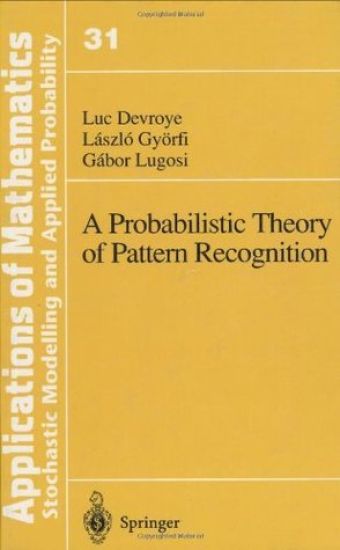
A Probabilistic Theory of Pattern Recognition

A Probabilistic Theory of Pattern Recognition

Luc Devroye; Laszlo Györfi; Gabor Lugosi

Springer-Verlag New York Inc.
2013
nidottu
Pattern recognition presents one of the most significant challenges for scientists and engineers, and many different approaches have been proposed. The aim of this book is to provide a self-contained account of probabilistic analysis of these approaches. The book includes a discussion of distance measures, nonparametric methods based on kernels or nearest neighbors, Vapnik-Chervonenkis theory, epsilon entropy, parametric classification, error estimation, free classifiers, and neural networks. Wherever possible, distribution-free properties and inequalities are derived. A substantial portion of the results or the analysis is new. Over 430 problems and exercises complement the material.
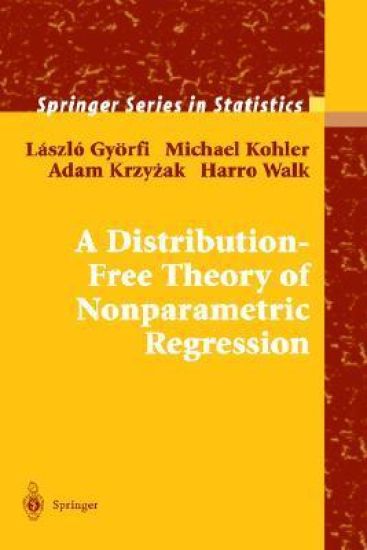
A Distribution-Free Theory of Nonparametric Regression

A Distribution-Free Theory of Nonparametric Regression

László Györfi; Michael Kohler; Adam Krzyzak; Harro Walk

Springer-Verlag New York Inc.
2010
nidottu
The regression estimation problem has a long history. Already in 1632 Galileo Galilei used a procedure which can be interpreted as ?tting a linear relationship to contaminated observed data. Such ?tting of a line through a cloud of points is the classical linear regression problem. A solution of this problem is provided by the famous principle of least squares, which was discovered independently by A. M. Legendre and C. F. Gauss and published in 1805 and 1809, respectively. The principle of least squares can also be applied to construct nonparametric regression estimates, where one does not restrict the class of possible relationships, and will be one of the approaches studied in this book. Linear regression analysis, based on the concept of a regression function, was introduced by F. Galton in 1889, while a probabilistic approach in the context of multivariate normal distributions was already given by A. B- vais in 1846. The ?rst nonparametric regression estimate of local averaging type was proposed by J. W. Tukey in 1947. The partitioning regression - timate he introduced, by analogy to the classical partitioning (histogram) density estimate, can be regarded as a special least squares estimate.
A Distribution-Free Theory of Nonparametric Regression

A Distribution-Free Theory of Nonparametric Regression

László Györfi; Michael Kohler; Adam Krzyzak; Harro Walk

Springer-Verlag New York Inc.
2002
sidottu
The regression estimation problem has a long history. Already in 1632 Galileo Galilei used a procedure which can be interpreted as ?tting a linear relationship to contaminated observed data. Such ?tting of a line through a cloud of points is the classical linear regression problem. A solution of this problem is provided by the famous principle of least squares, which was discovered independently by A. M. Legendre and C. F. Gauss and published in 1805 and 1809, respectively. The principle of least squares can also be applied to construct nonparametric regression estimates, where one does not restrict the class of possible relationships, and will be one of the approaches studied in this book. Linear regression analysis, based on the concept of a regression function, was introduced by F. Galton in 1889, while a probabilistic approach in the context of multivariate normal distributions was already given by A. B- vais in 1846. The ?rst nonparametric regression estimate of local averaging type was proposed by J. W. Tukey in 1947. The partitioning regression - timate he introduced, by analogy to the classical partitioning (histogram) density estimate, can be regarded as a special least squares estimate.
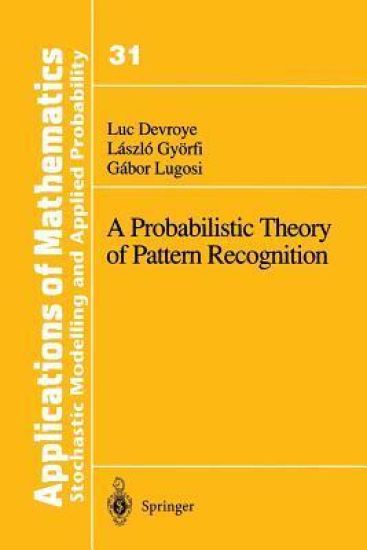
A Probabilistic Theory of Pattern Recognition

A Probabilistic Theory of Pattern Recognition

Luc Devroye; Laszlo Györfi; Gabor Lugosi

Springer-Verlag New York Inc.
1996
sidottu
Pattern recognition presents one of the most significant challenges for scientists and engineers, and many different approaches have been proposed. The aim of this book is to provide a self-contained account of probabilistic analysis of these approaches. The book includes a discussion of distance measures, nonparametric methods based on kernels or nearest neighbors, Vapnik-Chervonenkis theory, epsilon entropy, parametric classification, error estimation, free classifiers, and neural networks. Wherever possible, distribution-free properties and inequalities are derived. A substantial portion of the results or the analysis is new. Over 430 problems and exercises complement the material.