
Kirjailija
Laszlo Lovasz
Kirjat ja teokset yhdessä paikassa: 10 kirjaa, julkaisuja vuosilta 1986–2012, suosituimpiin kuuluu Diskrete Mathematik. Vertaile teosten hintoja ja tarkista saatavuus suomalaisista kirjakaupoista.
Nimi esiintyy myös muodoissa: László Lovász
10 kirjaa
Kirjojen julkaisuvuodet: 1986–2012.

Greedoids
Bernhard Korte; Laszlo Lovasz; Rainer Schrader
Springer-Verlag Berlin and Heidelberg GmbH Co. K
2012
nidottu
Oh cieca cupidigia, oh ira folie, Che si ci sproni nella vita corta, E nell' eterna poi si mal c'immolle! o blind greediness and foolish rage, That in our fleeting life so goads us on And plunges us in boiling blood for ever! Dante, The Divine Comedy Inferno, XII, 17, 49/51. On an afternoon hike during the second Oberwolfach conference on Mathematical Programming in January 1981, two of the authors of this book discussed a paper by another two of the authors (Korte and Schrader [1981]) on approximation schemes for optimization problems over independence systems and matroids. They had noticed that in many proofs the hereditary property of independence systems and matroids is not needed: it is not required that every subset of a feasible set is again feasible. A much weaker property is sufficient, namely that every feasible set of cardinality k contains (at least) one feasible subset of cardinality k - 1. We called this property accessibility, and that was the starting point of our investigations on greedoids.
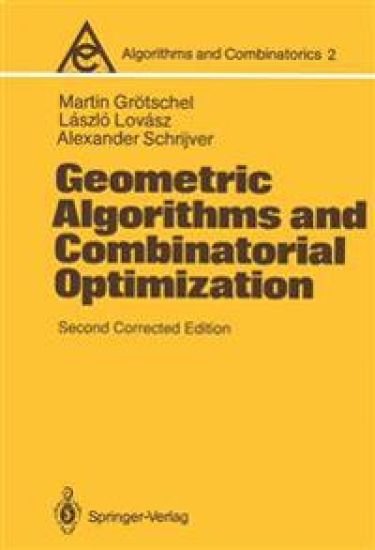
Geometric Algorithms and Combinatorial Optimization
Martin Grötschel; Laszlo Lovasz; Alexander Schrijver
Springer-Verlag Berlin and Heidelberg GmbH Co. K
2011
nidottu
Since the publication of the first edition of our book, geometric algorithms and combinatorial optimization have kept growing at the same fast pace as before. Nevertheless, we do not feel that the ongoing research has made this book outdated. Rather, it seems that many of the new results build on the models, algorithms, and theorems presented here. For instance, the celebrated Dyer-Frieze-Kannan algorithm for approximating the volume of a convex body is based on the oracle model of convex bodies and uses the ellipsoid method as a preprocessing technique. The polynomial time equivalence of optimization, separation, and membership has become a commonly employed tool in the study of the complexity of combinatorial optimization problems and in the newly developing field of computational convexity. Implementations of the basis reduction algorithm can be found in various computer algebra software systems. On the other hand, several of the open problems discussed in the first edition are still unsolved. For example, there are still no combinatorial polynomial time algorithms known for minimizing a submodular function or finding a maximum clique in a perfect graph. Moreover, despite the success of the interior point methods for the solution of explicitly given linear programs there is still no method known that solves implicitly given linear programs, such as those described in this book, and that is both practically and theoretically efficient. In particular, it is not known how to adapt interior point methods to such linear programs.
The main purpose of this book is to provide help in learning existing techniques in combinatorics. The most effective way of learning such techniques is to solve exercises and problems. This book presents all the material in the form of problems and series of problems (apart from some general comments at the beginning of each chapter). In the second part, a hint is given for each exercise, which contains the main idea necessary for the solution, but allows the reader to practice the techniques by completing the proof. In the third part, a full solution is provided for each problem. This book will be useful to those students who intend to start research in graph theory, combinatorics or their applications, and for those researchers who feel that combinatorial techniques might help them with their work in other branches of mathematics, computer science, management science, electrical engineering and so on. For background, only the elements of linear algebra, group theory, probability and calculus are needed.
Diskrete Mathematik
László Lovász; József Pelikan; Katalin Vesztergombi
Springer-Verlag Berlin and Heidelberg GmbH Co. K
2005
nidottu
Die diskrete Mathematik ist im Begriff, zu einem der wichtigsten Gebiete der mathematischen Forschung zu werden mit Anwendungen in der Kryptographie, der linearen Programmierung, der Kodierungstheorie und Informatik. Dieses Buch richtet sich an Studenten der Mathematik und Informatik, die ein Gefühl dafür entwickeln möchten, worum es in der Mathematik geht, wobei Mathematik hilfreich sein kann, und mit welcher Art Fragen sich Mathematiker auseinandersetzen. Die Autoren stellen eine Anzahl ausgewählter Ergebnisse und Methoden der diskreten Mathematik vor, hauptsächlich aus den Bereichen Kombinatorik und Graphentheorie, teilweise aber auch aus der Zahlentheorie, der Wahrscheinlichkeitsrechnung und der kombinatorischen Geometrie. Wo immer es möglich war, haben die Autoren Beweise und Problemlösungen verwendet, um den Studenten zu helfen, die Lösungen der Fragestellungen zu verstehen. Zusätzlich ist eine Vielzahl von Beispielen, Bildern und Übungsaufgaben über das Buch verteilt. László Lovász ist einer der Leiter der theoretischen Forschungsabteilung der Microsoft Corporation. Er hat 1999 den Wolf-Preis sowie den Gödel-Preis für die beste wissenschaftliche Veröffentlichung in der Informatik erhalten. József Pelikán ist Professor am Institut für Algebra und Zahlentheorie der Eötvös Loránd Universität in Budapest. Katalin Vesztergombi ist Senior Lecturer am Fachbereich Mathematik der Universität von Washington in Seattle.
Discrete Mathematics
László Lovász; József Pelikán; Katalin Vesztergombi
Springer-Verlag New York Inc.
2003
nidottu
Discrete mathematics is quickly becoming one of the most important areas of mathematical research, with applications to cryptography, linear programming, coding theory and the theory of computing. This book is aimed at undergraduate mathematics and computer science students interested in developing a feeling for what mathematics is all about, where mathematics can be helpful, and what kinds of questions mathematicians work on. The authors discuss a number of selected results and methods of discrete mathematics, mostly from the areas of combinatorics and graph theory, with a little number theory, probability, and combinatorial geometry. Wherever possible, the authors use proofs and problem solving to help students understand the solutions to problems. In addition, there are numerous examples, figures and exercises spread throughout the book. Laszlo Lovasz is a Senior Researcher in the Theory Group at Microsoft Corporation. He is a recipient of the 1999 Wolf Prize andthe Godel Prize for the top paper in Computer Science. Jozsef Pelikan is Professor of Mathematics in the Department of Algebra and Number Theory at Eotvos Lorand University, Hungary. In 2002, he was elected Chairman of the Advisory Board of the International Mathematical Olympiad. Katalin Vesztergombi is Senior Lecturer in the Department of Mathematics at the University of Washington.
Discrete Mathematics
László Lovász; József Pelikán; Katalin Vesztergombi
Springer-Verlag New York Inc.
2003
sidottu
Discrete mathematics is quickly becoming one of the most important areas of mathematical research, with applications to cryptography, linear programming, coding theory and the theory of computing. This book is aimed at undergraduate mathematics and computer science students interested in developing a feeling for what mathematics is all about, where mathematics can be helpful, and what kinds of questions mathematicians work on. The authors discuss a number of selected results and methods of discrete mathematics, mostly from the areas of combinatorics and graph theory, with a little number theory, probability, and combinatorial geometry. Wherever possible, the authors use proofs and problem solving to help students understand the solutions to problems. In addition, there are numerous examples, figures and exercises spread throughout the book. Laszlo Lovasz is a Senior Researcher in the Theory Group at Microsoft Corporation. He is a recipient of the 1999 Wolf Prize andthe Godel Prize for the top paper in Computer Science. Jozsef Pelikan is Professor of Mathematics in the Department of Algebra and Number Theory at Eotvos Lorand University, Hungary. In 2002, he was elected Chairman of the Advisory Board of the International Mathematical Olympiad. Katalin Vesztergombi is Senior Lecturer in the Department of Mathematics at the University of Washington.

An Algorithmic Theory of Numbers, Graphs, and Convexity
Laszlo Lovasz
Society for Industrial Applied Mathematics,U.S.
1986
pokkari
A study of how complexity questions in computing interact with classical mathematics in the numerical analysis of issues in algorithm design. Algorithmic designers concerned with linear and nonlinear combinatorial optimization will find this volume especially useful. Two algorithms are studied in detail: the ellipsoid method and the simultaneous diophantine approximation method. Although both were developed to study, on a theoretical level, the feasibility of computing some specialized problems in polynomial time, they appear to have practical applications. The book first describes use of the simultaneous diophantine method to develop sophisticated rounding procedures. Then a model is described to compute upper and lower bounds on various measures of convex bodies. Use of the two algorithms is brought together by the author in a study of polyhedra with rational vertices. The book closes with some applications of the results to combinatorial optimization.