Kirjojen hintavertailu – 12 859 824 kirjaa ja 27 kauppaa

Kirjailija

Latifur Khan

Kirjat ja teokset yhdessä paikassa: 9 kirjaa, julkaisuja vuosilta 2009–2024, suosituimpiin kuuluu Design and Implementation of Data Mining Tools. Vertaile teosten hintoja ja tarkista saatavuus suomalaisista kirjakaupoista.

9 kirjaa

Kirjojen julkaisuvuodet: 2009–2024.

Secure Data Science

Secure Data Science

Bhavani Thuraisingham; Murat Kantarcioglu; Latifur Khan

TAYLOR FRANCIS LTD
2024
nidottu
Secure data science, which integrates cyber security and data science, is becoming one of the critical areas in both cyber security and data science. This is because the novel data science techniques being developed have applications in solving such cyber security problems as intrusion detection, malware analysis, and insider threat detection. However, the data science techniques being applied not only for cyber security but also for every application area—including healthcare, finance, manufacturing, and marketing—could be attacked by malware. Furthermore, due to the power of data science, it is now possible to infer highly private and sensitive information from public data, which could result in the violation of individual privacy. This is the first such book that provides a comprehensive overview of integrating both cyber security and data science and discusses both theory and practice in secure data science. After an overview of security and privacy for big data services as well as cloud computing, this book describes applications of data science for cyber security applications. It also discusses such applications of data science as malware analysis and insider threat detection. Then this book addresses trends in adversarial machine learning and provides solutions to the attacks on the data science techniques. In particular, it discusses some emerging trends in carrying out trustworthy analytics so that the analytics techniques can be secured against malicious attacks. Then it focuses on the privacy threats due to the collection of massive amounts of data and potential solutions. Following a discussion on the integration of services computing, including cloud-based services for secure data science, it looks at applications of secure data science to information sharing and social media. This book is a useful resource for researchers, software developers, educators, and managers who want to understand both the high level concepts and the technical details on the design and implementation of secure data science-based systems. It can also be used as a reference book for a graduate course in secure data science. Furthermore, this book provides numerous references that would be helpful for the reader to get more details about secure data science.
Secure Data Science

Secure Data Science

Bhavani Thuraisingham; Murat Kantarcioglu; Latifur Khan

TAYLOR FRANCIS LTD
2022
sidottu
Secure data science, which integrates cyber security and data science, is becoming one of the critical areas in both cyber security and data science. This is because the novel data science techniques being developed have applications in solving such cyber security problems as intrusion detection, malware analysis, and insider threat detection. However, the data science techniques being applied not only for cyber security but also for every application area—including healthcare, finance, manufacturing, and marketing—could be attacked by malware. Furthermore, due to the power of data science, it is now possible to infer highly private and sensitive information from public data, which could result in the violation of individual privacy. This is the first such book that provides a comprehensive overview of integrating both cyber security and data science and discusses both theory and practice in secure data science. After an overview of security and privacy for big data services as well as cloud computing, this book describes applications of data science for cyber security applications. It also discusses such applications of data science as malware analysis and insider threat detection. Then this book addresses trends in adversarial machine learning and provides solutions to the attacks on the data science techniques. In particular, it discusses some emerging trends in carrying out trustworthy analytics so that the analytics techniques can be secured against malicious attacks. Then it focuses on the privacy threats due to the collection of massive amounts of data and potential solutions. Following a discussion on the integration of services computing, including cloud-based services for secure data science, it looks at applications of secure data science to information sharing and social media. This book is a useful resource for researchers, software developers, educators, and managers who want to understand both the high level concepts and the technical details on the design and implementation of secure data science-based systems. It can also be used as a reference book for a graduate course in secure data science. Furthermore, this book provides numerous references that would be helpful for the reader to get more details about secure data science.
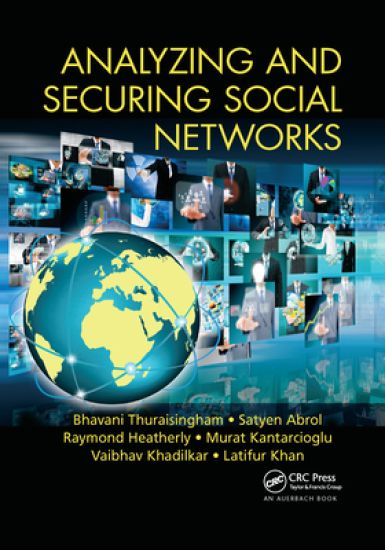
Analyzing and Securing Social Networks

Analyzing and Securing Social Networks

Bhavani Thuraisingham; Satyen Abrol; Raymond Heatherly; Murat Kantarcioglu; Vaibhav Khadilkar; Latifur Khan

CRC Press
2020
nidottu
Analyzing and Securing Social Networks focuses on the two major technologies that have been developed for online social networks (OSNs): (i) data mining technologies for analyzing these networks and extracting useful information such as location, demographics, and sentiments of the participants of the network, and (ii) security and privacy technologies that ensure the privacy of the participants of the network as well as provide controlled access to the information posted and exchanged by the participants. The authors explore security and privacy issues for social media systems, analyze such systems, and discuss prototypes they have developed for social media systems whose data are represented using semantic web technologies. These experimental systems have been developed at The University of Texas at Dallas. The material in this book, together with the numerous references listed in each chapter, have been used for a graduate-level course at The University of Texas at Dallas on analyzing and securing social media. Several experimental systems developed by graduate students are also provided. The book is divided into nine main sections: (1) supporting technologies, (2) basics of analyzing and securing social networks, (3) the authors’ design and implementation of various social network analytics tools, (4) privacy aspects of social networks, (5) access control and inference control for social networks, (6) experimental systems designed or developed by the authors on analyzing and securing social networks, (7) social media application systems developed by the authors, (8) secure social media systems developed by the authors, and (9) some of the authors’ exploratory work and further directions.
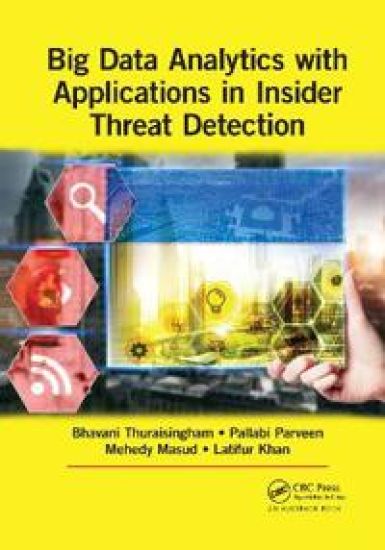
Big Data Analytics with Applications in Insider Threat Detection

Big Data Analytics with Applications in Insider Threat Detection

Bhavani Thuraisingham; Pallabi Parveen; Mohammad Mehedy Masud; Latifur Khan

CRC Press
2020
nidottu
Today's malware mutates randomly to avoid detection, but reactively adaptive malware is more intelligent, learning and adapting to new computer defenses on the fly. Using the same algorithms that antivirus software uses to detect viruses, reactively adaptive malware deploys those algorithms to outwit antivirus defenses and to go undetected. This book provides details of the tools, the types of malware the tools will detect, implementation of the tools in a cloud computing framework and the applications for insider threat detection.
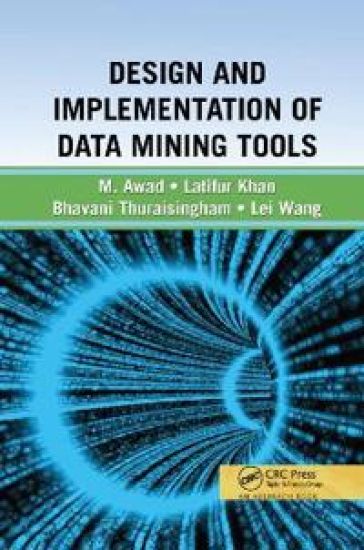
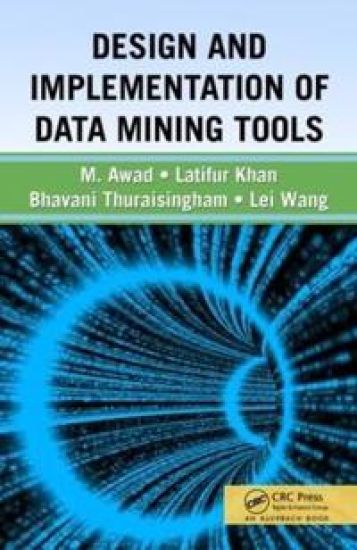
Design and Implementation of Data Mining Tools

Design and Implementation of Data Mining Tools

Bhavani Thuraisingham; Latifur Khan; Mamoun Awad; Lei Wang

CRC Press
2019
nidottu
Focusing on three applications of data mining, Design and Implementation of Data Mining Tools explains how to create and employ systems and tools for intrusion detection, Web page surfing prediction, and image classification. Mainly based on the authors’ own research work, the book takes a practical approach to the subject. The first part of the book reviews data mining techniques, such as artificial neural networks and support vector machines, as well as data mining applications. The second section covers the design and implementation of data mining tools for intrusion detection. It examines various designs and performance results, along with the strengths and weaknesses of the approaches. The third part presents techniques to solve the WWW prediction problem. The final part describes models that the authors have developed for image classification. Showing step by step how data mining tools are developed, this hands-on guide discusses the performance results, limitations, and unique contributions of data mining systems. It provides essential information for technologists to decide on the tools to select for a particular application, for developers to focus on alternative designs if an approach is unsuitable, and for managers to choose whether to proceed with a data mining project.
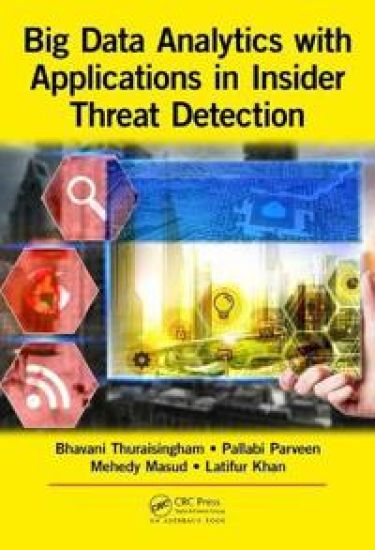
Big Data Analytics with Applications in Insider Threat Detection

Big Data Analytics with Applications in Insider Threat Detection

Bhavani Thuraisingham; Pallabi Parveen; Mohammad Mehedy Masud; Latifur Khan

Productivity Press
2017
sidottu
Today's malware mutates randomly to avoid detection, but reactively adaptive malware is more intelligent, learning and adapting to new computer defenses on the fly. Using the same algorithms that antivirus software uses to detect viruses, reactively adaptive malware deploys those algorithms to outwit antivirus defenses and to go undetected. This book provides details of the tools, the types of malware the tools will detect, implementation of the tools in a cloud computing framework and the applications for insider threat detection.
Analyzing and Securing Social Networks

Analyzing and Securing Social Networks

Bhavani Thuraisingham; Satyen Abrol; Raymond Heatherly; Murat Kantarcioglu; Vaibhav Khadilkar; Latifur Khan

Apple Academic Press Inc.
2016
sidottu
Analyzing and Securing Social Networks focuses on the two major technologies that have been developed for online social networks (OSNs): (i) data mining technologies for analyzing these networks and extracting useful information such as location, demographics, and sentiments of the participants of the network, and (ii) security and privacy technologies that ensure the privacy of the participants of the network as well as provide controlled access to the information posted and exchanged by the participants. The authors explore security and privacy issues for social media systems, analyze such systems, and discuss prototypes they have developed for social media systems whose data are represented using semantic web technologies. These experimental systems have been developed at The University of Texas at Dallas. The material in this book, together with the numerous references listed in each chapter, have been used for a graduate-level course at The University of Texas at Dallas on analyzing and securing social media. Several experimental systems developed by graduate students are also provided. The book is divided into nine main sections: (1) supporting technologies, (2) basics of analyzing and securing social networks, (3) the authors’ design and implementation of various social network analytics tools, (4) privacy aspects of social networks, (5) access control and inference control for social networks, (6) experimental systems designed or developed by the authors on analyzing and securing social networks, (7) social media application systems developed by the authors, (8) secure social media systems developed by the authors, and (9) some of the authors’ exploratory work and further directions.
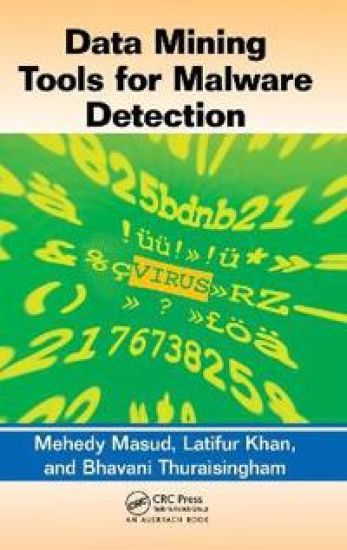
Data Mining Tools for Malware Detection

Data Mining Tools for Malware Detection

Mehedy Masud; Latifur Khan; Bhavani Thuraisingham

Taylor Francis Inc
2011
sidottu
Although the use of data mining for security and malware detection is quickly on the rise, most books on the subject provide high-level theoretical discussions to the near exclusion of the practical aspects. Breaking the mold, Data Mining Tools for Malware Detection provides a step-by-step breakdown of how to develop data mining tools for malware detection. Integrating theory with practical techniques and experimental results, it focuses on malware detection applications for email worms, malicious code, remote exploits, and botnets. The authors describe the systems they have designed and developed: email worm detection using data mining, a scalable multi-level feature extraction technique to detect malicious executables, detecting remote exploits using data mining, and flow-based identification of botnet traffic by mining multiple log files. For each of these tools, they detail the system architecture, algorithms, performance results, and limitations. Discusses data mining for emerging applications, including adaptable malware detection, insider threat detection, firewall policy analysis, and real-time data miningIncludes four appendices that provide a firm foundation in data management, secure systems, and the semantic webDescribes the authors’ tools for stream data miningFrom algorithms to experimental results, this is one of the few books that will be equally valuable to those in industry, government, and academia. It will help technologists decide which tools to select for specific applications, managers will learn how to determine whether or not to proceed with a data mining project, and developers will find innovative alternative designs for a range of applications.
Design and Implementation of Data Mining Tools

Design and Implementation of Data Mining Tools

Bhavani Thuraisingham; Latifur Khan; Mamoun Awad; Lei Wang

Auerbach Publishers Inc.
2009
sidottu
Focusing on three applications of data mining, Design and Implementation of Data Mining Tools explains how to create and employ systems and tools for intrusion detection, Web page surfing prediction, and image classification. Mainly based on the authors’ own research work, the book takes a practical approach to the subject. The first part of the book reviews data mining techniques, such as artificial neural networks and support vector machines, as well as data mining applications. The second section covers the design and implementation of data mining tools for intrusion detection. It examines various designs and performance results, along with the strengths and weaknesses of the approaches. The third part presents techniques to solve the WWW prediction problem. The final part describes models that the authors have developed for image classification. Showing step by step how data mining tools are developed, this hands-on guide discusses the performance results, limitations, and unique contributions of data mining systems. It provides essential information for technologists to decide on the tools to select for a particular application, for developers to focus on alternative designs if an approach is unsuitable, and for managers to choose whether to proceed with a data mining project.