Kirjojen hintavertailu – 12 903 724 kirjaa ja 27 kauppaa

Kirjailija

Laurence B. McCullough

Kirjat ja teokset yhdessä paikassa: 10 kirjaa, julkaisuja vuosilta 1996–2023, suosituimpiin kuuluu Historical Dictionary of Medical Ethics. Vertaile teosten hintoja ja tarkista saatavuus suomalaisista kirjakaupoista.

10 kirjaa

Kirjojen julkaisuvuodet: 1996–2023.

Thomas Percival’s Medical Ethics and the Invention of Medical Professionalism

Thomas Percival’s Medical Ethics and the Invention of Medical Professionalism

Laurence B. McCullough

Springer Nature Switzerland AG
2023
nidottu
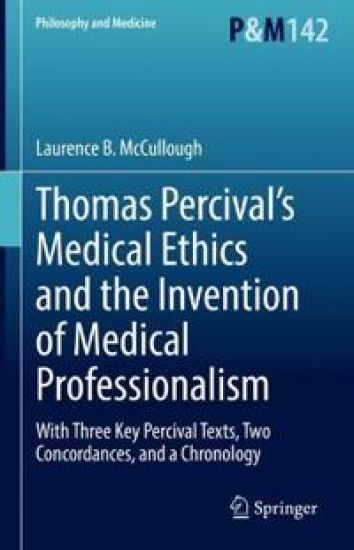
This book provides the first comprehensive, historically based, philosophical interpretations of two texts of Thomas Percival’s professional ethics in medicine set in the context of his intellectual biography. Preceded by his privately published and circulated Medical Jurisprudence of 1794, Thomas Percival (1740-1804) published Medical Ethics in 1803, the first book thus titled in the global histories of medicine and medical ethics. From his days as a student at the Warrington Academy and the medical schools of the universities of Edinburgh and Leyden, Percival steeped himself in the scientific method of Francis Bacon (1561-1626). McCullough shows how Percival became a Baconian moral scientist committed to Baconian deism and Dissent. Percival also drew on and significantly expanded the work of his predecessor in professional ethics in medicine, John Gregory (1724-1773). The result is that Percival should be credited with co-inventing professionalism in medicine with Gregory. To aid and encourage future scholarship, this book brings together the first time three essential Percival texts, Medical Jurisprudence, Medical Ethics, and Extracts from the Medical Ethics of Dr. Percival of 1823, the bridge from Medical Ethics to the 1847 Code of Medical Ethics on the American Medical Association. To support comparative reading, this book provides concordances of Medical Jurisprudence to Medical Ethics and of Medical Ethics to Extracts. Finally, this book includes the first Chronology of Percival’s life and works.
Thomas Percival’s Medical Ethics and the Invention of Medical Professionalism

Thomas Percival’s Medical Ethics and the Invention of Medical Professionalism

Laurence B. McCullough

Springer Nature Switzerland AG
2022
sidottu
This book provides the first comprehensive, historically based, philosophical interpretations of two texts of Thomas Percival’s professional ethics in medicine set in the context of his intellectual biography. Preceded by his privately published and circulated Medical Jurisprudence of 1794, Thomas Percival (1740-1804) published Medical Ethics in 1803, the first book thus titled in the global histories of medicine and medical ethics. From his days as a student at the Warrington Academy and the medical schools of the universities of Edinburgh and Leyden, Percival steeped himself in the scientific method of Francis Bacon (1561-1626). McCullough shows how Percival became a Baconian moral scientist committed to Baconian deism and Dissent. Percival also drew on and significantly expanded the work of his predecessor in professional ethics in medicine, John Gregory (1724-1773). The result is that Percival should be credited with co-inventing professionalism in medicine with Gregory. To aid and encourage future scholarship, this book brings together the first time three essential Percival texts, Medical Jurisprudence, Medical Ethics, and Extracts from the Medical Ethics of Dr. Percival of 1823, the bridge from Medical Ethics to the 1847 Code of Medical Ethics on the American Medical Association. To support comparative reading, this book provides concordances of Medical Jurisprudence to Medical Ethics and of Medical Ethics to Extracts. Finally, this book includes the first Chronology of Percival’s life and works.
Professional Ethics in Obstetrics and Gynecology

Professional Ethics in Obstetrics and Gynecology

Laurence B. McCullough; John H. Coverdale; Frank A. Chervenak

Cambridge University Press
2019
pokkari
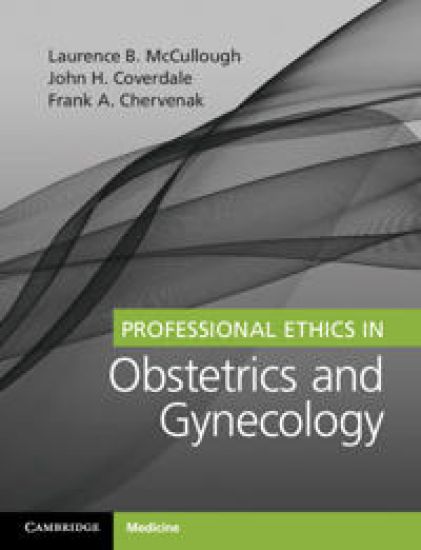
A comprehensive, accessible approach to the everyday ethical challenges faced in obstetric and gynecological practice. Offering practical guidance for practitioners at all levels, the text also provides a sustained exploration of professional ethics in the intersection of obstetrics and gynecology with psychiatry. Drawing on their award-winning teaching, the authors start each chapter with goals, objectives, topics, and a list of key concepts, which are defined in a separate section. Chapters cover a multitude of topics, from pregnancy and the quest for the 'perfect' baby to end-of-life care - all underpinned by the need for professionally responsible research, advocacy, and health policy. Professional Ethics in Obstetrics and Gynecology is an indispensable resource for both trainee and practicing obstetricians and gynecologists. A chapter devoted solely to pedagogy in professional ethics in obstetrics and gynecology supports the readers' learning and those with or without formal training in ethics to teach students, residents, and colleagues.
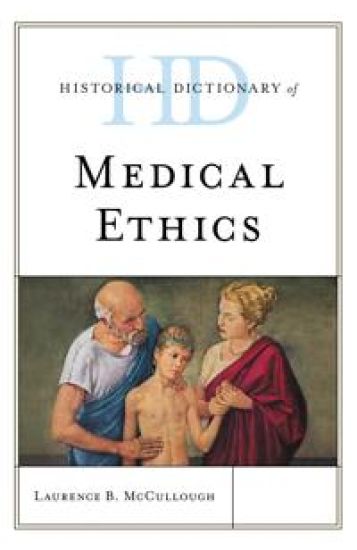
Historical Dictionary of Medical Ethics

Historical Dictionary of Medical Ethics

Laurence B. McCullough

Rowman Littlefield
2018
sidottu
Medical ethics is the disciplined study of medical morality, with two goals: critically appraising current medical morality and identifying how it should be improved. Medical morality has three components. Physicians, patients, communities, and policy makers have beliefs about what is good and bad character, and right and wrong behavior, in patient care, biomedical research, medical education, and health policy. On the basis of these beliefs, physicians, patients, communities, and policy makers make judgments about how physicians ought to conduct themselves in patient care, research, education, and the formation and implementation of health policy. They then act on their judgments. This second edition of Historical Dictionary of Medical Ethics contains a chronology, an introduction, and an extensive bibliography. The dictionary section has over 1,000 cross-referenced entries on ethical reasoning and its key components; medical ethics, professional medical ethics, and bioethics; and topics in clinical ethics, research ethics, and healthcare policy ethics. This book is an excellent resource for students, researchers, and anyone wanting to know more about medical ethics.
The Professional Responsibility Model of Perinatal Ethics

The Professional Responsibility Model of Perinatal Ethics

Frank A. Chervenak; Laurence B. McCullough

De Gruyter
2014
sidottu
This book provides the first clinically comprehensive and practical approach to ethical challenges in perinatal medicine. The first chapter introduces and explains the professional responsibility model of perinatal ethics. The professional responsibility model is based on the medical ethics of two major physician-ethics in the history of Western medical ethics, Dr. John Gregory (1724-1773) of Scotland and Dr. Thomas Percival (1740-1804) of England. The professional responsibility model is used to articulate the ethical concept of the fetus as a patient and to operationalize the ethical principles of beneficence and respect for autonomy. The book provides practical guidance for clinical judgment and decision making with patients about the responsible clinical management of the wide range of issues encountered by perinatologists in clinical practice and research. Topics included: periviability; feticide; intrapartum management; maternal-fetal conflict; innovation for fetal benefit; research for fetal benefit; non-aggressive obstetric management; managing the transition from pregnancy to birth; destructive procedures such as cephalocentesis; critical care for the pregnant patient; home birth; patient-choice cesarean delivery; neonatal care as a trial of management; and setting limits on neonatal care on the basis of clinical judgments of futility.
John Gregory and the Invention of Professional Medical Ethics and the Profession of Medicine
The best things in my Ufe have come to me by accident and this book results from one such accident: my having the opportunity, out of the blue, to go to work as H. Tristram Engelhardt, Jr. 's, research assistant at the Institute for the Medical Humanities in the University of Texas Medi­ cal Branch at Galveston, Texas, in 1974, on the recommendation of our teacher at the University of Texas at Austin, Irwin C. Lieb. During that summer Tris "lent" me to Chester Bums, who has done important schol­ arly work over the years on the history of medical ethics. I was just finding out what bioethics was and Chester sent me to the rare book room of the Medical Branch Library to do some work on something called "medical deontology. " I discovered that this new field of bioethics had a history. This string of accidents continued, in 1975, when Warren Reich (who in 1979 made the excellent decisions to hire me to the faculty in bioethics at the Georgetown University School of Medicine and to persuade Andre Hellegers to appoint me to the Kennedy Institute of Ethics) took Tris Engelhardt's word for it that I could write on the history of modem medical ethics for Warren's major new project, the Encyclopedia of Bioethics. Warren then asked me to write on eighteenth-century British medical ethics.
Leibniz on Individuals and Individuation

Leibniz on Individuals and Individuation

Laurence B. McCullough

Springer
2010
nidottu
Leibniz's earliest philosophy and its importance for his mature philosophy have not been examined in detail, particularly in the level of detail that one can achieve by placing Leibniz's philosophy in the context of the sources for two of the most basic concerns of his philosophical career: his metaphysics of individuals and the principle oftheir individuation. In this book I provide for the first time a detailed examination of these two Leibnizian themes and trace its implications for how we should interpret other major Leibnizian themes and for how we should read Leibniz and other philosophers of the sixteenth and later centuries as 'modem' philosophers. Leibniz began his philosophical career more than 300 years ago, a fact that shapes fundamentally my attempt in the pages that follow to come to terms now with the texts that he left us. Leibniz's did not do philosophy in a way wholly congenial to twentieth century philosophical methodologies, especially those that have enjoyed some prominence in recent Anglo-American philosophy. Moreover, as we shall see, Leibniz is not a modem philosopher, when 'modem' is understood to mean making a sharp break with medieval philosophy. Indeed, I shall argue, scholars should discard such terms as 'modem' from historical philosophical scholarship, so that old texts can be allowed to remain old - to stand on their own in and from times now long past.
The Ethics of Surgical Practice

The Ethics of Surgical Practice

James W. Jones; Laurence B. McCullough; Bruce W. Richman

Oxford University Press Inc
2008
sidottu
Surgical ethics is the application of ethics to issues specific to surgery. This volume provides a collection of clinical case studies representing a wide range of the ethical issues surgeons confront today. It is an excellent text for teaching surgical ethics to surgical residents and medical students and a fascinating read for practicing surgeons. It is intended to engage the reader into participating in evidence-based ethical conflicts. The authors escort us through 71 brief, realistic, and ethically complex problems, offering a series of five possible resolutions to each and guiding us through the relative benefits and weaknesses of the options until a best ethical choice is defended. The volume includes sections on Consent and Disclosure, Self-Regulation, Research and Innovation, Conflicts of Interest, Business Dealings, and End of Life Issues, each with a brief introduction by the authors.
John Gregory and the Invention of Professional Medical Ethics and the Profession of Medicine
The best things in my Ufe have come to me by accident and this book results from one such accident: my having the opportunity, out of the blue, to go to work as H. Tristram Engelhardt, Jr. 's, research assistant at the Institute for the Medical Humanities in the University of Texas Medi­ cal Branch at Galveston, Texas, in 1974, on the recommendation of our teacher at the University of Texas at Austin, Irwin C. Lieb. During that summer Tris "lent" me to Chester Bums, who has done important schol­ arly work over the years on the history of medical ethics. I was just finding out what bioethics was and Chester sent me to the rare book room of the Medical Branch Library to do some work on something called "medical deontology. " I discovered that this new field of bioethics had a history. This string of accidents continued, in 1975, when Warren Reich (who in 1979 made the excellent decisions to hire me to the faculty in bioethics at the Georgetown University School of Medicine and to persuade Andre Hellegers to appoint me to the Kennedy Institute of Ethics) took Tris Engelhardt's word for it that I could write on the history of modem medical ethics for Warren's major new project, the Encyclopedia of Bioethics. Warren then asked me to write on eighteenth-century British medical ethics.
Leibniz on Individuals and Individuation

Leibniz on Individuals and Individuation

Laurence B. McCullough

Springer
1996
sidottu
Leibniz's earliest philosophy and its importance for his mature philosophy have not been examined in detail, particularly in the level of detail that one can achieve by placing Leibniz's philosophy in the context of the sources for two of the most basic concerns of his philosophical career: his metaphysics of individuals and the principle oftheir individuation. In this book I provide for the first time a detailed examination of these two Leibnizian themes and trace its implications for how we should interpret other major Leibnizian themes and for how we should read Leibniz and other philosophers of the sixteenth and later centuries as 'modem' philosophers. Leibniz began his philosophical career more than 300 years ago, a fact that shapes fundamentally my attempt in the pages that follow to come to terms now with the texts that he left us. Leibniz's did not do philosophy in a way wholly congenial to twentieth century philosophical methodologies, especially those that have enjoyed some prominence in recent Anglo-American philosophy. Moreover, as we shall see, Leibniz is not a modem philosopher, when 'modem' is understood to mean making a sharp break with medieval philosophy. Indeed, I shall argue, scholars should discard such terms as 'modem' from historical philosophical scholarship, so that old texts can be allowed to remain old - to stand on their own in and from times now long past.