Kirjojen hintavertailu – 12 859 828 kirjaa ja 27 kauppaa
Kirjailija
Laurence Steinberg
Kirjat ja teokset yhdessä paikassa: 11 kirjaa, julkaisuja vuosilta 2005–2025, suosituimpiin kuuluu Adolescence ISE. Vertaile teosten hintoja ja tarkista saatavuus suomalaisista kirjakaupoista.
As a well-respected researcher, Laurence Steinberg connects current scholarship with real-world applications, helping students see the similarities and differences in adolescent development across different social, economic, and cultural backgrounds. The Guide to Diversity, Equity and Inclusion, found in the preface, highlights the many updates the author has made in these critical areas. McGraw Hill Connect's® digital learning tools are invaluable in helping students synthesize and master the content of the course.
A “wonderfully innovative” (Jennifer Senior, New York Times bestseller All Joy and No Fun), much-needed guide for parents of people in their twenties and thirties from one of the world’s leading developmental psychologists. Your child is now an adult, but your job as a parent is far from over. Instead, your role must evolve to meet their ongoing, changing needs. But what exactly are these new needs? And why are they so different now than they were when you were a young adult? This is the first comprehensive guide written for parents whose children are in two of the most crucial decades of life. Steinberg discusses topics as various as whether you should be involved in your child’s college education, how to behave when they unexpectedly must move back home, how to state your opinion on their romantic partners, what to do when you disagree with the way they are raising their own child, and what parameters to apply if you want to give them money for a home or startup. He answers such challenging questions as: When do I express my opinion and when should I bite my tongue? How do I know if my son is floundering? Is it okay to help my daughter with her grad school application? What should I do if my kid is getting seriously involved with someone I think is dangerous? We have been helping our twenty-five-year-old financially for the last few years, but how long is too long? How can I help my adult child through a difficult psychological time? Leading psychologist Laurence Steinberg has devoted his forty-five-year career to researching parent-child relationships. Here, he provides some “must-read” (Martin Seligman, PhD, author of The Hope Circuit) principles to help parents with adult children think more intelligently about common issues, avoid minefields, weather the inevitable ups and downs, and create a stronger, happier, more effective bond with their child.
Maailma ühe tuntuima arengupsühholoogi nõuanded vanematele, kelle lapsed on jõudnud täiskasvanuikka. Teie lapsed on suureks kasvanud, aga vanemapõli sellega ei lõppe. Lapse vajadused on muutunud ning koos sellega peab muutuma ka teie roll. Ent kuidas neid uusi vajadusi mõista? Ja miks on need nii erinevad sellest, mida te oma nooruspõlvest mäletate? Tegemist on põhjaliku käsiraamatuga vanematele, kelle lapsed on jõudnud murrangulistesse elukümnenditesse. Autor käsitleb kõikvõimalikke teemasid alates sellest, kuidas reageerida, kui laps äkitselt koju tagasi kolib; kuidas avaldada arvamust lapse partnerivaliku üle; kuidas käituda, kui te ei nõustu laste vanemlike otsustega, ning lõpetades küsimustega, mis puudutavad laste rahalist toetamist pärast kooli lõpetamist, abistamist kodu soetamisel ning omaenese rahaasjade arutamist nendega. Siit leiab vastuseid mitmele keerukale küsimusele, näiteks millal avaldada arvamust ja millal keel hammaste taga hoida. Kuidas aru saada, kas lastel läheb tööl, koolis, suhetes ja koduses elus hästi? Mida teha, kui laps on püsisuhtes inimesega, keda peate ohtlikuks? Olete oma 25-aastast last siiani rahaliselt toetanud - millal see küll lõppeb? Kuidas aidata täisealisel lapsel psühholoogiliselt keerulisest ajast üle saada? Psühholoog Laurence Steinberg on suurema osa oma 45 aasta pikkusest karjäärist pühendanud vanemate ja laste vaheliste suhete uurimisele. Siin raamatus jagab ta lihtsaid näpunäiteid, et aidata täiskasvanud laste vanematel lahendada levinud probleeme, vältida libedale teele sattumist, tulla toime paratamatute tõusude-mõõnadega ning luua oma lapsega lähedasemat ja soojemat sidet.
A much-needed guide for parents of people in their twenties and thirties from one of the world's leading developmental psychologists. Your child is now an adult, but your job as a parent is far from over. Instead, your role must evolve to meet their ongoing, changing needs. But what exactly are these new needs? And why are they so different now than they were when you were a young adult? This is the first comprehensive guide written for parents whose children are in two of the most crucial decades of life. Steinberg discusses topics as varied as whether and how you should be involved in your child's college education, how to behave when they unexpectedly must move back home, how to state your opinion on their romantic partners, what to do when you disagree with the way they are raising their own child, and what parameters to apply if you want to give them money for a home or startup. He answers such challenging questions as: When do I express my opinion and when should I bite my tongue? How do I know if my son is floundering? Is it okay to help my daughter with her grad school application? What should I do if my kid is getting seriously involved with someone I think is dangerous? We have been helping our twenty-five-year-old financially for the last few years, but how long is too long? How can I help my adult child through a difficult psychological time? Leading psychologist Laurence Steinberg has devoted his forty-five-year career to researching parent-child relationships. Here, he provides some basic principles to help parents with adult children think more intelligently about common issues, avoid minefields, weather the inevitable ups and downs, and create a stronger, happier, more effective bond with their child.
In this eleventh edition of Adolescence, Laurence Steinberg continues to utilize an effective combination of a friendly writing style, thorough research, and a contextual approach that emphasizes adolescence in contemporary society. The text's careful organization ensures maximum teaching flexibility that allows the chapters to work together to be covered in sequence or to stand alone. Ethnicity and minority issues are thoroughly discussed in a way that enables students to see how the adolescent experience is shaped by class and culture. The strong pedagogical framework helps students organize and integrate material. Thoroughly updated to reflect current findings in the field of adolescent development, Adolescence is based on solid research and theory, yet it has a distinctively "real world" feel that emphasizes the reality of being an adolescent in today's society.
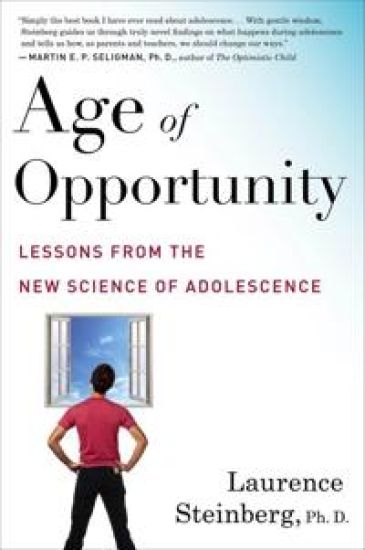
Adolescence now lasts longer than ever before. And as world-renowned expert on adolescent psychology Dr. Laurence Steinberg argues, this makes these years the key period in determining individuals' life outcomes, demanding that we change the way we parent, educate, and understand young people. In Age of Opportunity, Steinberg leads readers through a host of new findings - including groundbreaking original research - that reveal what the new timetable of adolescence means for parenting 13-year-olds (who may look more mature than they really are) versus 20-somethings (who may not be floundering even when it looks like they are). He also explains how the plasticity of the adolescent brain, rivaling that of years 0 through 3, suggests new strategies for instilling self-control during the teenage years. Packed with useful knowledge, Age of Opportunity is sweeping book in the tradition of Reviving Ophelia, and an essential guide for parents and educators of teenagers.
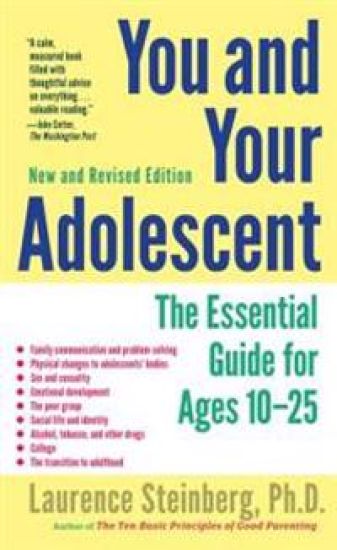
One of the foremost authorities on adolescence provides parents with an authoritative, reassuring guidebook to this challenging period of development. "Relax The horror stories you have heard about adolescence are false." This is Dr. Laurence Steinberg's reassuring message to parents in this newly revised edition of his classic book You and Your Adolescent, which Publishers Weekly says is "filled with solid advice for the parents of adolescents." Among the new topics in this updated edition: -An expanded definition of adolescence to age twenty-five, recognizing that college graduates often remain dependent on their parents for an extended period, creating a new parent-child dynamic -A discussion of social media that addresses whether parents of preteens and young teens should monitor use of these new communication tools -What new research into the adolescent brain tells us about teenage behavior As Dr. Steinberg writes, "Most books written for parents of teenagers were survival guides (many still are). Nowadays, adolescence is too long--fifteen years in some families--for mere survival. Knowledge, not fortitude, is what today's parents need. That's where this book comes in."
What should we do with teenagers who commit crimes? Are they children whose offenses are the result of immaturity and circumstances, or are they in fact criminals?“Adult time for adult crime” has been the justice system’s mantra for the last twenty years. But locking up so many young people puts a strain on state budgets—and ironically, the evidence suggests it ultimately increases crime. In this bold book, two leading scholars in law and adolescent development offer a comprehensive and pragmatic way forward. They argue that juvenile justice should be grounded in the best available psychological science, which shows that adolescence is a distinctive state of cognitive and emotional development. Although adolescents are not children, they are also not fully responsible adults. Elizabeth Scott and Laurence Steinberg outline a new developmental model of juvenile justice that recognizes adolescents’ immaturity but also holds them accountable. Developmentally based laws and policies would make it possible for young people who have committed crimes to grow into responsible adults, rather than career criminals, and would lighten the present burden on the legal and prison systems. In the end, this model would better serve the interests of justice, and it would also be less wasteful of money and lives than the harsh and ineffective policies of the last generation.
Temperament has been a central element of the on-going effort to describe the distinctiveness of persons at every stage of development. Many researchers have examined the relations of temperament to emotions, behavior, and adjustment generally. Fewer studies have focused primarily on the nature and structure of temperament, however, and even fewer have examined the developmental course of temperament. This Monograph reports a significant exception. The authors undertook theoretically relevant behavioral, biological, and self-report assessments of a sample of 14-to-17 year olds who had been classified into one of four temperamental groups at 4 months of age. Infant temperamental categories were based on observed behavior to a battery of unfamiliar stimuli. The infants classified as high reactive (20 percent of the sample) displayed vigorous motor activity and frequent crying. Those classified as low reactive (40 percent) displayed minimal motor activity and crying. About 25 percent of the infants, called distressed, showed minimal motor activity but cried frequently, and 10 percent, characterized by vigorous motoricity but little crying, were called aroused. Previous evaluations of these children at 14 and 21 months, and 4, 7, and 11 years had revealed that those children initially classified as high reactive were most likely to be avoidant of unfamiliar events at the early ages and emotionally subdued, cautious, and wary of new situations at the later ages. By contrast, initially low-reactive children had been the least avoidant of unfamiliarity in the second year and most emotionally spontaneous and sociable at the later ages. At age 11 years, assessments also had revealed that initially high-reactive children were more likely than the low-reactive participants to display right hemisphere activation in the EEG, a larger evoked potential from the inferior colliculus, larger event related waveforms to discrepant scenes, and greater sympathetic tone in the cardiovascular system. In the follow-up of these individuals reported here, adolescents (14-17 years of age) who had been classified as high reactive in infancy were more likely than initially low reactive participants to display sympathetic tone in the cardiovascular system, to combine a fast latency with a large magnitude of the evoked potential from the inferior colliculus, and to show shallower habituation of the event-related potential to discrepant visual events. Moreover, compared to their low-reactive agemates, initially high reactive adolescents more often reported being subdued in unfamiliar situations, experiencing a dour mood and anxiety over the future, and being religious. An important finding is that behavior and biology were more clearly dissociated in adolescence than at earlier ages. However, infant temperamental category at 4 months remained a powerful predictor of behavior in adolescence, suggesting that the features that characterize the two temperamental biases by initially high- and low-reactive are not completely malleable to the profound effects of brain growth and experience.
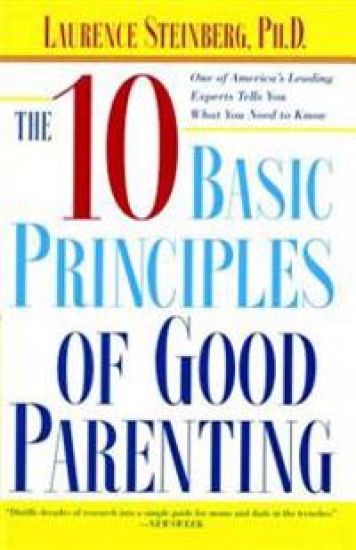
Most parents do a pretty good job of raising kids, says psychologist Laurence Steinberg, but truly effective parenting means not just relying on natural instincts but also on knowing what works and why. In The Ten Basic Principles of Good Parenting, Dr. Steinberg distills decades of research into a parenting book that explains the fundamentals of raising happy, healthy children, giving readers an invaluable map to help them navigate parenthood from infancy to adolescence. Dr. Steinberg found that the basic principles for effective parenting are simple and universal, and apply to all parents and children regardless of background. He explains each principle and shows how to put it into action, using anecdotes and examples: from "What You Do Matters" (parents make an enormous difference; children are not simply the product of their genes) to "Establish Rules and Limits" (how to provide structure in your child's life, and how to handle conflicts over rules) and "Help Foster Your Child's Independence" (help your child think through decisions instead of making them for him or her). Concise and authoritative, written with warmth and compassion, The Ten Basic Principles of Good Parenting is an intelligent guide to raising a happy, healthy child and to becoming a happier, more confident parent in the process.