Kirjojen hintavertailu – 12 903 725 kirjaa ja 27 kauppaa
Kirjailija
Laurent Mazliak
Kirjat ja teokset yhdessä paikassa: 6 kirjaa, julkaisuja vuosilta 2002–2020, suosituimpiin kuuluu Martingales and Markov Chains. Vertaile teosten hintoja ja tarkista saatavuus suomalaisista kirjakaupoista.
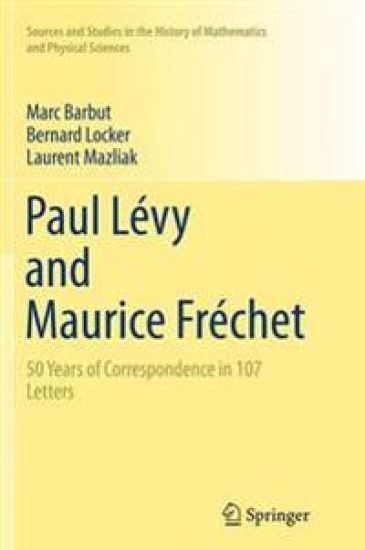
The fascinating correspondence between Paul Lévy and Maurice Fréchet spans an extremely active period in French mathematics during the twentieth century. The letters of these two Frenchmen show their vicissitudes of research and passionate enthusiasm for the emerging field of modern probability theory. The letters cover various topics of mathematical importance including academic careers and professional travels, issues concerning students and committees, and the difficulties both mathematicians met to be elected to the Paris Academy of Sciences. The technical questions that occupied Lévy and Fréchet on almost a daily basis are the primary focus of these letters, which are charged with elation, frustration and humour. Their mathematical victories and setbacks unfolded against the dramatic backdrop of the two World Wars and the occupation of France, during which Lévy was obliged to go into hiding. The clear and persistent desire of these mathematicians to continue their work whatever the circumstance testifies to the enlightened spirit of their discipline which was persistent against all odds. The book contains a detailed and comprehensive introduction to the central topics of the correspondence. The original text of the letters is also annotated by numerous footnotes for helpful guidance. Paul Lévy and Maurice Fréchet will be useful to anybody interested in the history of mathematics in the twentieth century and, in particular, the birth of modern probability theory.
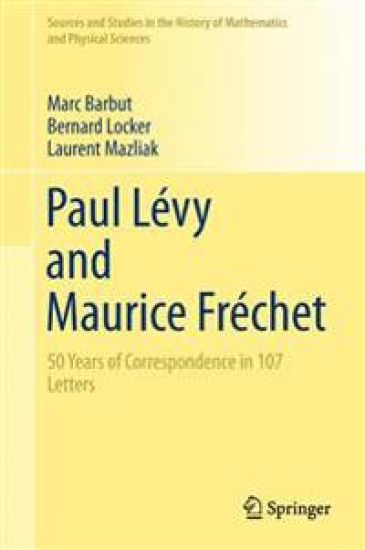
The fascinating correspondence between Paul Lévy and Maurice Fréchet spans an extremely active period in French mathematics during the twentieth century. The letters of these two Frenchmen show their vicissitudes of research and passionate enthusiasm for the emerging field of modern probability theory. The letters cover various topics of mathematical importance including academic careers and professional travels, issues concerning students and committees, and the difficulties both mathematicians met to be elected to the Paris Academy of Sciences. The technical questions that occupied Lévy and Fréchet on almost a daily basis are the primary focus of these letters, which are charged with elation, frustration and humour. Their mathematical victories and setbacks unfolded against the dramatic backdrop of the two World Wars and the occupation of France, during which Lévy was obliged to go into hiding. The clear and persistent desire of these mathematicians to continue their work whatever the circumstance testifies to the enlightened spirit of their discipline which was persistent against all odds. The book contains a detailed and comprehensive introduction to the central topics of the correspondence. The original text of the letters is also annotated by numerous footnotes for helpful guidance. Paul Lévy and Maurice Fréchet will be useful to anybody interested in the history of mathematics in the twentieth century and, in particular, the birth of modern probability theory.
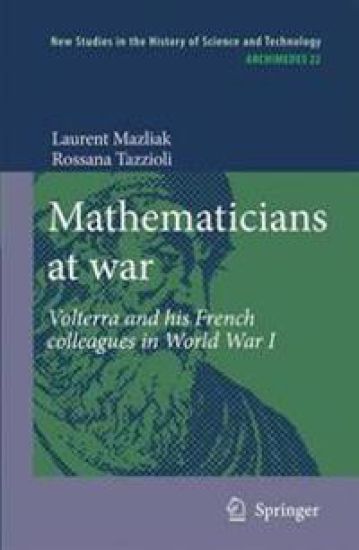
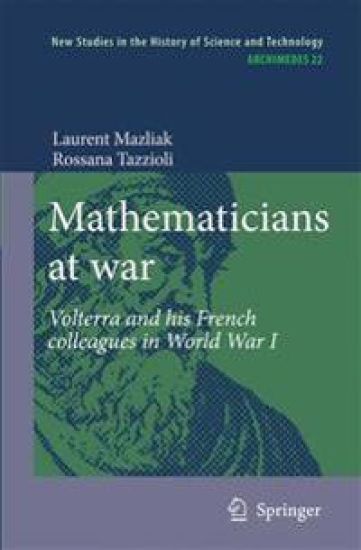
Numerous scientists have taken part in the war effort during World War I, but few gave it the passionate energy of the prominent Italian mathematician Volterra. As a convinced supporter of the cause of Britain and France, he struggled vigorously to carry Italy into the war in May 1915 and then developed a frenetic activity to support the war effort, going himself to the front, even though he was 55. This activity found an adequate echo with his French colleagues Borel, Hadamard and Picard. The huge correspondence they exchanged during the war, gives an extraordinary view of these activities, and raises numerous fundamental questions about the role of a scientist, and particularly a mathematician during WW I. It also offers a vivid documentation about the intellectual life of the time ; Volterra’s and Borel’s circles in particular were extremely wide and the range of their interests was not limited to their field of specialization. The book proposes the complete transcription of the aforementioned correspondence, annotated with numerous footnotes to give details on the contents. It also offers a general historical introduction to the context of the letters and several complements on themes related to the academic exchanges between France and Italy during the war.
Numerous scientists have taken part in the war effort during World War I, but few gave it the passionate energy of the prominent Italian mathematician Volterra. As a convinced supporter of the cause of Britain and France, he struggled vigorously to carry Italy into the war in May 1915 and then developed a frenetic activity to support the war effort, going himself to the front, even though he was 55. This activity found an adequate echo with his French colleagues Borel, Hadamard and Picard. The huge correspondence they exchanged during the war, gives an extraordinary view of these activities, and raises numerous fundamental questions about the role of a scientist, and particularly a mathematician during WW I. It also offers a vivid documentation about the intellectual life of the time ; Volterra’s and Borel’s circles in particular were extremely wide and the range of their interests was not limited to their field of specialization. The book proposes the complete transcription of the aforementioned correspondence, annotated with numerous footnotes to give details on the contents. It also offers a general historical introduction to the context of the letters and several complements on themes related to the academic exchanges between France and Italy during the war.
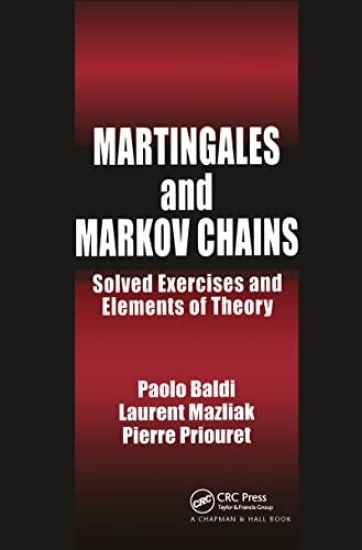
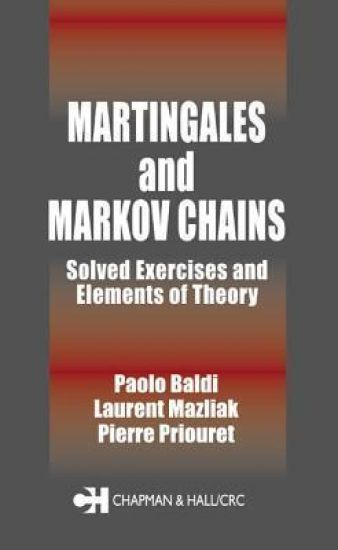
A thorough grounding in Markov chains and martingales is essential in dealing with many problems in applied probability, and is a gateway to the more complex situations encountered in the study of stochastic processes. Exercises are a fundamental and valuable training tool that deepen students' understanding of theoretical principles and prepare them to tackle real problems. In addition to a quick but thorough exposition of the theory, Martingales and Markov Chains: Solved Exercises and Elements of Theory presents, more than 100 exercises related to martingales and Markov chains with a countable state space, each with a full and detailed solution. The authors begin with a review of the basic notions of conditional expectations and stochastic processes, then set the stage for each set of exercises by recalling the relevant elements of the theory. The exercises range in difficulty from the elementary, requiring use of the basic theory, to the more advanced, which challenge the reader's initiative. Each section also contains a set of problems that open the door to specific applications. Designed for senior undergraduate- and graduate level students, this text goes well beyond merely offering hints for solving the exercises, but it is much more than just a solutions manual. Within its solutions, it provides frequent references to the relevant theory, proposes alternative ways of approaching the problem, and discusses and compares the arguments involved.