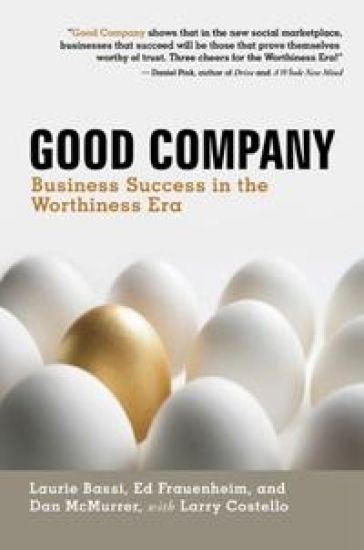
Good Company: Business Success in the Worthiness Era
Laurie Bassi; Ed Frauenheim; Dan McMurrer; Larry Costello
Berrett-Koehler
2011
sidottu
In recent decades, corporate PR departments and business books like Good to Great promised a new era of value-based leadership, but as recent events have shown, actual corporate behavior still follows the old "whatever you can get away with" standard. But Laurie Bassi and her co-authors have news: the "bad boy" days are over. As a result of a convergence of forces, ranging from the explosion of online information-sharing to the emergence of the ethical consumer and arrival of civic-minded Millennials, we're in a new era, which they dub "the Worthiness Era." To succeed, businesses must now prove to consumers, employees, and investors that they have earned their respect-that they are good company. For the first time, Bassi, a noted economist, has the research to prove that good behavior is good business. The authors have compiled a groundbreaking "Good Company Index" that directly ties business results to stakeholder relationships. Not only do the authors have the hard evidence to prove that good behavior pays, they have used the principles of the index at their own investment firm to delivery market-beating results. Finally, the authors provide senior executives with the principles and tools to adapt to the new road rules for business.