
Kirjailija
Laurie Champion
Kirjat ja teokset yhdessä paikassa: 5 kirjaa, julkaisuja vuosilta 1991–2009, suosituimpiin kuuluu American Women Writers, 1900-1945. Vertaile teosten hintoja ja tarkista saatavuus suomalaisista kirjakaupoista.
5 kirjaa
Kirjojen julkaisuvuodet: 1991–2009.
Women writers have been traditionally excluded from literary canons and not until recently have scholars begun to rediscover or discover for the first time neglected women writers and their works. This reference includes alphabetically arranged entries on 58 American women authors who wrote between 1900 and 1945. Each entry is written by an expert contributor and discusses a particular author's biography, her major works and themes, and the critical response to her writings. The entries close with extensive primary and secondary bibliographies, and the volume concludes with a list of works for further reading. The period surveyed by this reference is rich and diverse. Modernism and the Harlem Renaissance, two major artistic movements, occurred between 1900 and 1945, and the entries included here demonstrate the significant contributions women made to these movements. The volume as a whole strives to reflect the diversity of American culture and includes entries for African American, Native American, Mexican American, and Chinese American women. It includes well known writers such as Willa Cather and Eudora Welty, along with more neglected ones such as Anita Scott Coleman and Sui Sin Far.
In this novel, first published by Doubleday in 1985, Texas novelist Elmer Kelton returns to the Civil War period, once again examining, as he first did in Texas Rifles, the effect of the war on Texans at home. Even while the conflict raged to the east, several groups of Texan Union loyalists hid out across the state, trying to avoid the anger and violence of the confederate-sympathizing “home guard.” Kelton bases this story on a group who lived in a then-huge thicket on the Colorado River near present-day Columbus, although the characters, incidents and town of the book are of Kelton’s invention. As he always says, fiction writers are liars and thieves. Owen Danforth, a wounded Confederate soldier, comes home to Texas to recover, intending to return to his regiment. His family is torn apart by the war—two brothers dead, one uncle, a Union sympathizer, shot in the back by the home guard. His father—also a Unionist—hides out in the thicket with his remaining family because the home guard, led by “Captain” Phineas Shattuck, has sworn revenge on the Danforth clan. Torn between duty and family loyalty, Owen Danforth faces difficult decisions until a violent encounter leaves him only one choice.
Eudora Welty holds a prominent position among Southern writers, receiving critical attention in publications that scan a wide range of interests. Journals that specialize in American literature, journals that publish general essays, and journals that focus on Southern literature frequently include articles about her works. Her writings have been included in anthologies and have been adapted for the stage and television. This book traces the evolving critical response to her fiction. In a lucid introductory essay, Champion presents an overview and summarizes the body of criticism on Welty's fiction. The rest of the volume presents representative selections of criticism from the initial reception of Welty's work to the present day. The selections are grouped in chapters devoted to Welty's principal writings. Her fiction is treated chronologically, and the selections within each chapter are also arranged in chronological order. Thus the book charts the development of Welty criticism over an extended period of time. A bibliography of works for further reading completes the volume.
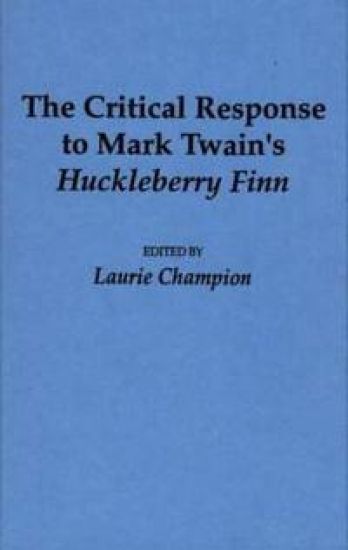
Proclaimed by H. L. Mencken as one of the great masterpieces of the world and by Ernest Hemingway as the source of all modern American literature, Adventures of Huckleberry Finn remains firmly established in both the American and world literary canons as a classic work of literature. Yet it continues to have its critical detractors and still arouses the kind of impassioned controversy that banned it from the Concord, Massachusetts, Public Library on publication as trashy and vicious. The Critical Response to Mark Twain's Huckleberry Finn contains newspaper articles, book reviews, and scholarly essays spanning the period from the early response in the 1880s, through the centennial celebration, to the present. The collection reflects the major literary trends and issues of response to Huckleberry Finn, such as the persistent attempts to ban the book, the literary criticism concerning the book's ending, and the many thematic interpretations. Among the essayists included are literary figures such as T. S. Eliot and Twain specialist scholars such as Walter Blair, Leo Marx, and James Cox. The text of an ABC-TV Nightline News Special on the centennial, Huckleberry Finn: Literature or Racist Trash is printed. Editor Champion provides an introductory overview on the range and issues of critical response, a feature on the various adaptations of Huckleberry Finn, and a bibliography of additional scholarship. Of interest to any scholar or researcher of Mark Twain, the collection would be valuable to teachers and students reading Huckleberry Finn at any level from high school upward.