Kirjojen hintavertailu – 12 859 828 kirjaa ja 27 kauppaa

Kirjailija

Lawrence R. Jones

Kirjat ja teokset yhdessä paikassa: 6 kirjaa, julkaisuja vuosilta 2000–2007, suosituimpiin kuuluu From Bureaucracy to Hyperarchy in Netcentric and Quick Learning Organizations. Vertaile teosten hintoja ja tarkista saatavuus suomalaisista kirjakaupoista.

6 kirjaa

Kirjojen julkaisuvuodet: 2000–2007.

Budgeting, Financial Management, and Acquisition Reform in the U.S. Department of Defense

Budgeting, Financial Management, and Acquisition Reform in the U.S. Department of Defense

Lawrence R. Jones; Jerry L. McCaffery

Information Age Publishing
2007
nidottu
In this book we introduce the basics of the federal budget process, provide an historical background on the foundation and development of the budget process, indicate how defense spending may be measured and how it impacts the economy, describe and analyze how Planning, Programming, Budgeting, and Execution System (PPBES) operates and should function to produce the annual defense budget proposal to Congress, analyze the role of Congress in debating and deciding on defense appropriations and the politics of the budgetary process including the use of supplemental appropriations to fund national defense, analyze budget execution dynamics, identify the principal participants in the defense budget process in the Pentagon and military commands, assess federal and Department of Defense (DoD) financial management and business process challenges and issues, and describe the processes used to resource acquisition of defense war fighting assets, including reforms in acquisition and linkages between PPBES and the defense acquisition process.

Budgeting, Financial Management, and Acquisition Reform in the U.S. Department of Defense

Budgeting, Financial Management, and Acquisition Reform in the U.S. Department of Defense

Lawrence R. Jones; Jerry L. McCaffery

Information Age Publishing
2007
sidottu
In this book we introduce the basics of the federal budget process, provide an historical background on the foundation and development of the budget process, indicate how defense spending may be measured and how it impacts the economy, describe and analyze how Planning, Programming, Budgeting, and Execution System (PPBES) operates and should function to produce the annual defense budget proposal to Congress, analyze the role of Congress in debating and deciding on defense appropriations and the politics of the budgetary process including the use of supplemental appropriations to fund national defense, analyze budget execution dynamics, identify the principal participants in the defense budget process in the Pentagon and military commands, assess federal and Department of Defense (DoD) financial management and business process challenges and issues, and describe the processes used to resource acquisition of defense war fighting assets, including reforms in acquisition and linkages between PPBES and the defense acquisition process.

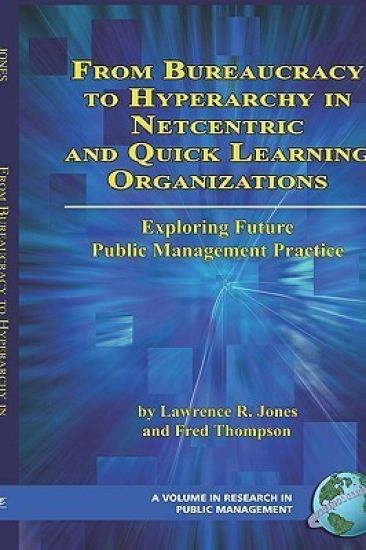
From Bureaucracy to Hyperarchy in Netcentric and Quick Learning Organizations

From Bureaucracy to Hyperarchy in Netcentric and Quick Learning Organizations

Lawrence R. Jones; Fred Thompson

Information Age Publishing
2007
nidottu
This book focuses on the inherent contradiction between bureaucracy, hierarchy, and the vision inspired by the architecture of modern information technology of a more egalitarian culture in public organizations. We agree with Evans and Wurster and others who have argued that, in the future, knowledge-based productive relationships will be designed around fluid, teambased collaborative communities, either within organizations (i.e., deconstructed value chains), or in collaborative alliances such as those with "amorphous and permeable corporate boundaries characteristic of companies in the Silicon Valley" that is, deconstructed supply chains. In such relationships everyone can communicate richly with everyone else on the basis of shared standards and, like the Internet itself, these relationships will eliminate the need to channel information, thereby eliminating the trade-off between information bandwidth and connectivity. "The possibility (or the threat) of random access and information symmetry," they conclude, "will destroy all hierarchies, whether of logic or power."
From Bureaucracy to Hyperarchy in Netcentric and Quick Learning Organizations

From Bureaucracy to Hyperarchy in Netcentric and Quick Learning Organizations

Lawrence R. Jones; Fred Thompson

Information Age Publishing
2007
sidottu
This book focuses on the inherent contradiction between bureaucracy, hierarchy, and the vision inspired by the architecture of modern information technology of a more egalitarian culture in public organizations. We agree with Evans and Wurster and others who have argued that, in the future, knowledge-based productive relationships will be designed around fluid, teambased collaborative communities, either within organizations (i.e., deconstructed value chains), or in collaborative alliances such as those with "amorphous and permeable corporate boundaries characteristic of companies in the Silicon Valley" that is, deconstructed supply chains. In such relationships everyone can communicate richly with everyone else on the basis of shared standards and, like the Internet itself, these relationships will eliminate the need to channel information, thereby eliminating the trade-off between information bandwidth and connectivity. "The possibility (or the threat) of random access and information symmetry," they conclude, "will destroy all hierarchies, whether of logic or power."
Budgeting and Financial Management for National Defense

Budgeting and Financial Management for National Defense

Jerry L. McCaffery; Lawrence R. Jones

Information Age Publishing
2000
sidottu
Budgeting for national defense is a complex endeavor, particularly for a nation like the U. S. that assumes global responsibility and strives to have the most advanced and lethal force on earth. It is necessary – and challenging – to balance the myriad requirements between current and future readiness, across warfare areas and military services, between having state of the art capability with sufficient capacity, and among people, hardware, and the activities people do with that hardware. As analytically difficult as that problem is, it is embedded in the political budgeting processes and national security must be balanced with every other function of government and there must also be cooperation across branches of government. This text explores that complex endeavor.
Budgeting and Financial Management for Naitional Defense

Budgeting and Financial Management for Naitional Defense

Jerry L. McCaffery; Lawrence R. Jones

Information Age Publishing
2000
nidottu
Budgeting for national defense is a complex endeavor, particularly for a nation like the U. S. that assumes global responsibility and strives to have the most advanced and lethal force on earth. It is necessary – and challenging – to balance the myriad requirements between current and future readiness, across warfare areas and military services, between having state of the art capability with sufficient capacity, and among people, hardware, and the activities people do with that hardware. As analytically difficult as that problem is, it is embedded in the political budgeting processes and national security must be balanced with every other function of government and there must also be cooperation across branches of government. This text explores that complex endeavor.