Kirjojen hintavertailu – 12 859 827 kirjaa ja 27 kauppaa

Kirjailija

Lee Heng

Kirjat ja teokset yhdessä paikassa: 6 kirjaa, julkaisuja vuosilta 2016–2020, suosituimpiin kuuluu Cosmic Ray Neutron Sensing: Estimation of Agricultural Crop Biomass Water Equivalent. Vertaile teosten hintoja ja tarkista saatavuus suomalaisista kirjakaupoista.

6 kirjaa

Kirjojen julkaisuvuodet: 2016–2020.

Guideline for Salinity Assessment, Mitigation and Adaptation Using Nuclear and Related Techniques

Guideline for Salinity Assessment, Mitigation and Adaptation Using Nuclear and Related Techniques

Lee Heng; Mohammad Zaman; Shabbir A Shahid

Saint Philip Street Press
2020
sidottu
This open access book is an outcome of the collaboration between the Soil and Water Management & Crop Nutrition Section, Joint FAO/IAEA Division of Nuclear Techniques in Food and Agriculture, Department of Nuclear Sciences and Applications, International Atomic Energy Agency (IAEA), Vienna, Austria, and Dr. Shabbir A Shahid, Senior Salinity Management Expert, Freelancer based in United Arab Emirates. The objective of this book is to develop protocols for salinity and sodicity assessment and develop mitigation and adaptation measures to use saline and sodic soils sustainably. The focus is on important issues related to salinity and sodicity and to describe these in an easy and user friendly way. The information has been compiled from the latest published literature and from the authors' publications specific to the subject matter. The book consists of six chapters. Chapter 1 introduces the terms salinity and sodicity and describes various salinity classification systems commonly used around the world. Chapter 2 reviews global distribution of salinization and socioeconomic aspects related to salinity and crop production. Chapters 3 covers comprehensively salinity and sodicity adaptation and mitigation options including physical, chemical, hydrological and biological methods. Chapter 4 discusses the efforts that have been made to demonstrate the development of soil salinity zones under different irrigation systems. Chapter 5 discusses the quality of irrigation water, boron toxicity and relative tolerance to boron, the effects of chlorides on crops. Chapter 6 introduces the role of nuclear techniques in saline agriculture. This work was published by Saint Philip Street Press pursuant to a Creative Commons license permitting commercial use. All rights not granted by the work's license are retained by the author or authors.
Guideline for Salinity Assessment, Mitigation and Adaptation Using Nuclear and Related Techniques

Guideline for Salinity Assessment, Mitigation and Adaptation Using Nuclear and Related Techniques

Lee Heng; Mohammad Zaman; Shabbir A Shahid

Saint Philip Street Press
2020
pokkari
This open access book is an outcome of the collaboration between the Soil and Water Management & Crop Nutrition Section, Joint FAO/IAEA Division of Nuclear Techniques in Food and Agriculture, Department of Nuclear Sciences and Applications, International Atomic Energy Agency (IAEA), Vienna, Austria, and Dr. Shabbir A Shahid, Senior Salinity Management Expert, Freelancer based in United Arab Emirates. The objective of this book is to develop protocols for salinity and sodicity assessment and develop mitigation and adaptation measures to use saline and sodic soils sustainably. The focus is on important issues related to salinity and sodicity and to describe these in an easy and user friendly way. The information has been compiled from the latest published literature and from the authors' publications specific to the subject matter. The book consists of six chapters. Chapter 1 introduces the terms salinity and sodicity and describes various salinity classification systems commonly used around the world. Chapter 2 reviews global distribution of salinization and socioeconomic aspects related to salinity and crop production. Chapters 3 covers comprehensively salinity and sodicity adaptation and mitigation options including physical, chemical, hydrological and biological methods. Chapter 4 discusses the efforts that have been made to demonstrate the development of soil salinity zones under different irrigation systems. Chapter 5 discusses the quality of irrigation water, boron toxicity and relative tolerance to boron, the effects of chlorides on crops. Chapter 6 introduces the role of nuclear techniques in saline agriculture. This work was published by Saint Philip Street Press pursuant to a Creative Commons license permitting commercial use. All rights not granted by the work's license are retained by the author or authors.
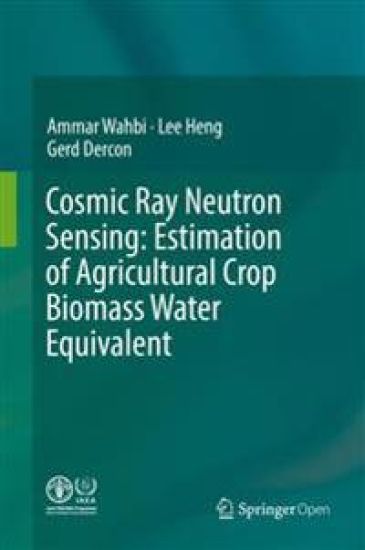
Cosmic Ray Neutron Sensing:  Estimation of Agricultural Crop Biomass Water Equivalent

Cosmic Ray Neutron Sensing: Estimation of Agricultural Crop Biomass Water Equivalent

Ammar Wahbi; Lee Heng; Gerd Dercon

Springer Nature Switzerland AG
2019
nidottu
This open access book provides methods for the estimation of Biomass Water Equivalent (BEW), an essential step for improving the accuracy of area-wide soil moisture by cosmic-ray neutron sensors (CRNS). Three techniques are explained in detail: (i) traditional in-situ destructive sampling, (ii) satellite based remote sensing of plant surfaces, and (iii) biomass estimation via the use of the CRNS itself. The advantages and disadvantages of each method are discussed along with step by step instructions on proper procedures and implementation.
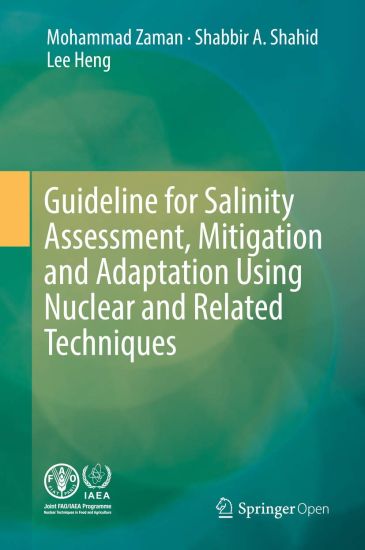
Guideline for Salinity Assessment, Mitigation and Adaptation Using Nuclear and Related Techniques

Guideline for Salinity Assessment, Mitigation and Adaptation Using Nuclear and Related Techniques

Mohammad Zaman; Shabbir A. Shahid; Lee Heng

Springer International Publishing AG
2018
sidottu
This open access book is an outcome of the collaboration between the Soil and Water Management & Crop Nutrition Section, Joint FAO/IAEA Division of Nuclear Techniques in Food and Agriculture, Department of Nuclear Sciences and Applications, International Atomic Energy Agency (IAEA), Vienna, Austria, and Dr. Shabbir A Shahid, Senior Salinity Management Expert, Freelancer based in United Arab Emirates. The objective of this book is to develop protocols for salinity and sodicity assessment and develop mitigation and adaptation measures to use saline and sodic soils sustainably. The focus is on important issues related to salinity and sodicity and to describe these in an easy and user friendly way. The information has been compiled from the latest published literature and from the authors’ publications specific to the subject matter. The book consists of six chapters. Chapter 1 introduces the terms salinity and sodicity and describes various salinity classification systems commonly used around the world. Chapter 2 reviews global distribution of salinization and socioeconomic aspects related to salinity and crop production. Chapters 3 covers comprehensively salinity and sodicity adaptation and mitigation options including physical, chemical, hydrological and biological methods. Chapter 4 discusses the efforts that have been made to demonstrate the development of soil salinity zones under different irrigation systems. Chapter 5 discusses the quality of irrigation water, boron toxicity and relative tolerance to boron, the effects of chlorides on crops. Chapter 6 introduces the role of nuclear techniques in saline agriculture.
Cosmic Ray Neutron Sensing:  Estimation of Agricultural Crop Biomass Water Equivalent

Cosmic Ray Neutron Sensing: Estimation of Agricultural Crop Biomass Water Equivalent

Ammar Wahbi; Lee Heng; Gerd Dercon

Springer International Publishing AG
2018
sidottu
This open access book provides methods for the estimation of Biomass Water Equivalent (BEW), an essential step for improving the accuracy of area-wide soil moisture by cosmic-ray neutron sensors (CRNS). Three techniques are explained in detail: (i) traditional in-situ destructive sampling, (ii) satellite based remote sensing of plant surfaces, and (iii) biomass estimation via the use of the CRNS itself. The advantages and disadvantages of each method are discussed along with step by step instructions on proper procedures and implementation.