Kirjojen hintavertailu – 12 875 478 kirjaa ja 26 kauppaa

Kirjailija

Lee McIntyre

Kirjat ja teokset yhdessä paikassa: 12 kirjaa, julkaisuja vuosilta 2012–2023, suosituimpiin kuuluu On Disinformation. Vertaile teosten hintoja ja tarkista saatavuus suomalaisista kirjakaupoista.

12 kirjaa

Kirjojen julkaisuvuodet: 2012–2023.

On Disinformation

On Disinformation

Lee McIntyre

MIT PRESS LTD
2023
nidottu
Learn how to fight against the disinformation campaigns imperiling American democracy in this empowering, pocket-sized guide from the author of How to Talk to a Science Denier. INSIDE THE WAR ON TRUTH: Explore the history of how disinformation has been weaponized to manipulate society. The effort to destroy facts and make America ungovernable didn’t come out of nowhere. It is the culmination of 70 years of strategic denialism. In On Disinformation, Lee McIntyre shows how the war on facts began, and how ordinary citizens can fight back against the scourge of disinformation that is now threatening the very fabric of our society. Drawing on his 20 years of experience as a scholar of science denial, McIntyre explains how autocrats wield disinformation to manipulate a populace and deny obvious realities; why the best way to combat disinformation is to disrupt its spread; and most importantly, how we can win the war on truth. McIntyre takes readers through the history of strategic denialism to show how we arrived at this precarious political moment and identifies the creators, amplifiers, and believers of disinformation. Along the way, he also demonstrates how today’s “reality denial” follows the same flawed blueprint of the “five steps of science denial” used by climate deniers and anti-vaxxers; shows how Trump has emulated disinformation tactics created by Russian and Soviet intelligence dating back to the 1920s; provides interviews with leading experts on information warfare, counterterrorism, and political extremism; and spells out the need for algorithmic transparency from Facebook, Twitter, and YouTube. On Disinformation lays out ten everyday practical steps that we can take as ordinary citizens—from resisting polarization to pressuring our Congresspeople to regulate social media—as well as the important steps our government (if we elect the right leaders) must take. Compact, easy-to-read (and then pass on to a friend), and never more urgent, On Disinformation does nothing less than empower us with the tools and knowledge needed to save our republic from autocracy before it is too late.

How to Talk to a Science Denier

How to Talk to a Science Denier

Lee McIntyre

MIT PRESS LTD
2022
nidottu
Can we change the minds of science deniers? Encounters with flat earthers, anti-vaxxers, coronavirus truthers, and others. "Climate change is a hoax--and so is coronavirus." "Vaccines are bad for you." These days, many of our fellow citizens reject scientific expertise and prefer ideology to facts. They are not merely uninformed--they are misinformed. They cite cherry-picked evidence, rely on fake experts, and believe conspiracy theories. How can we convince such people otherwise? How can we get them to change their minds and accept the facts when they don't believe in facts? In this book, Lee McIntyre shows that anyone can fight back against science deniers, and argues that it's important to do so. Science denial can kill. Drawing on his own experience--including a visit to a Flat Earth convention--as well as academic research, McIntyre outlines the common themes of science denialism, present in misinformation campaigns ranging from tobacco companies' denial in the 1950s that smoking causes lung cancer to today's anti-vaxxers. He describes attempts to use his persuasive powers as a philosopher to convert Flat Earthers; surprising discussions with coal miners; and conversations with a scientist friend about genetically modified organisms in food. McIntyre offers tools and techniques for communicating the truth and values of science, emphasizing that the most important way to reach science deniers is to talk to them calmly and respectfully--to put ourselves out there, and meet them face to face.
Totuudenjälkeinen

Totuudenjälkeinen

Lee McIntyre

Terra Cognita
2021
nidottu

Halvin toimitettuna 34,90 €

Elämämme totuudenjälkeistä aikaa. “Vaihtoehtoiet faktat” korvaavat faktat ja tunteet ovat päätöksenteossa todisteita tärkeämpiä. Touudenjälkeinen kertoo, miten nykytilaan edettiin tupakkateollisuuden aloittamasta totuuden epäilystä ja miten oikeisto kaappasi sen rinnalle postmodernin filosofian ajatuksen totuudesta sosiaalisena konstruktina. Tulokset näkyvät joka päivä uutisissa, mutta myös esimerkiksi sosiaalisessa mediassa, salaliittoteorioina ja rokottamisen vastustuksena Lee McIntyre on Boston Universityn filosofian ja historian tutkimuksen keskuksen luenttoisija ja Harvard Extension Schollin etiikan ohjaaja. Hän on kirjoittanut useita tähän asiaan liittyviä kirjoja
Wir lieben Wissenschaft

Wir lieben Wissenschaft

Lee McIntyre

Springer-Verlag Berlin and Heidelberg GmbH Co. K
2020
nidottu
Angriffe auf die Wissenschaft sind alltäglich geworden: Die Erforschung des Klimawandels sei keine „anständige“ Wissenschaft, die Evolution „nur eine Theorie“, die „Wahrheit“ über Impfstoffe werde vertuscht. In diesem Buch diskutiert Lee McIntyre, was Wissenschaft von Nicht-Wissenschaft unterscheidet: der Stellenwert der Evidenz und die Bereitschaft, Theorien auf Basis neuer Evidenz zu verwerfen. Diese beiden wesentlichen Eigenschaften nennt er die „wissenschaftliche Grundhaltung“. McIntyre führt Beispiele an, die sowohl den wissenschaftlichen Erfolg (eine Verringerung des Kindbettfiebers im 19. Jahrhundert) als auch das Scheitern (die fehlerhafte „Entdeckung“ der kalten Fusion im 20. Jahrhundert) veranschaulichen. Er beschreibt den Wandel der Medizin von einer weitgehend auf Vermutungen beruhenden Praxis zu einer Wissenschaft, die sich auf Beweise stützt; er betrachtet wissenschaftlichen Betrug und untersucht die Positionen von ideologiegetriebenen Leugnern, Pseudowissenschaftlern und „Skeptikern“, die wissenschaftliche Erkenntnisse ablehnen. Das Buch macht in einer Welt der „alternativen Fakten“ klar, dass die Beachtung von Fakten ein einzigartig wirkungsvolles Instrument zur Verteidigung der Wissenschaft selbst ist.
The Scientific Attitude

The Scientific Attitude

Lee McIntyre

MIT Press
2020
pokkari

Halvin toimitettuna 22,00 €

An argument that what makes science distinctive is its emphasis on evidence and scientists' willingness to change theories on the basis of new evidence. Attacks on science have become commonplace. Claims that climate change isn't settled science, that evolution is “only a theory,” and that scientists are conspiring to keep the truth about vaccines from the public are staples of some politicians' rhetorical repertoire. Defenders of science often point to its discoveries (penicillin! relativity!) without explaining exactly why scientific claims are superior. In this book, Lee McIntyre argues that what distinguishes science from its rivals is what he calls “the scientific attitude”—caring about evidence and being willing to change theories on the basis of new evidence. The history of science is littered with theories that were scientific but turned out to be wrong; the scientific attitude reveals why even a failed theory can help us to understand what is special about science. McIntyre offers examples that illustrate both scientific success (a reduction in childbed fever in the nineteenth century) and failure (the flawed “discovery” of cold fusion in the twentieth century). He describes the transformation of medicine from a practice based largely on hunches into a science based on evidence; considers scientific fraud; examines the positions of ideology-driven denialists, pseudoscientists, and “skeptics” who reject scientific findings; and argues that social science, no less than natural science, should embrace the scientific attitude. McIntyre argues that the scientific attitude—the grounding of science in evidence—offers a uniquely powerful tool in the defense of science.
Philosophy of Science

Philosophy of Science

Alex Rosenberg; Lee McIntyre

Routledge
2019
sidottu
Any serious student attempting to better understand the nature, methods, and justification of science will value Alex Rosenberg and Lee McIntyre’s updated and substantially revised fourth edition of Philosophy of Science: A Contemporary Introduction. Weaving lucid explanations with clear analyses, the volume is a much- used, thematically oriented introduction to the field. The fourth edition has been thoroughly rewritten based on instructor and student feedback, to improve readability and accessibility, without sacrificing depth. It retains, however, all of the logically structured, extensive coverage of earlier editions, which a review in the journal Teaching Philosophy called “the industry standard” and “essential reading.” Key Features of the Fourth Edition:Revised and rewritten for readability based on feedback from student and instructor surveys. Updated text on the problem of underdetermination, social science, and the realism/antirealism debate. Improved continuity between chapters. Revised and updated Study Questions and annotated Suggested Readings at the end of each chapter. Updated Bibliography. For a list of relevant online primary sources, please visit: www.routledge.com/9781138331518.
Philosophy of Science

Philosophy of Science

Alex Rosenberg; Lee McIntyre

Routledge
2019
nidottu

Halvin toimitettuna 63,90 €

Any serious student attempting to better understand the nature, methods, and justification of science will value Alex Rosenberg and Lee McIntyre’s updated and substantially revised fourth edition of Philosophy of Science: A Contemporary Introduction. Weaving lucid explanations with clear analyses, the volume is a much- used, thematically oriented introduction to the field. The fourth edition has been thoroughly rewritten based on instructor and student feedback, to improve readability and accessibility, without sacrificing depth. It retains, however, all of the logically structured, extensive coverage of earlier editions, which a review in the journal Teaching Philosophy called “the industry standard” and “essential reading.” Key Features of the Fourth Edition:Revised and rewritten for readability based on feedback from student and instructor surveys. Updated text on the problem of underdetermination, social science, and the realism/antirealism debate. Improved continuity between chapters. Revised and updated Study Questions and annotated Suggested Readings at the end of each chapter. Updated Bibliography. For a list of relevant online primary sources, please visit: www.routledge.com/9781138331518.
Post-Truth

Post-Truth

Lee McIntyre

MIT Press
2018
pokkari
How we arrived in a post-truth era, when "alternative facts" replace actual facts, and feelings have more weight than evidence. Are we living in a post-truth world, where "alternative facts" replace actual facts and feelings have more weight than evidence? How did we get here? In this volume in the MIT Press Essential Knowledge series, Lee McIntyre traces the development of the post-truth phenomenon from science denial through the rise of "fake news," from our psychological blind spots to the public's retreat into "information silos." What, exactly, is post-truth? Is it wishful thinking, political spin, mass delusion, bold-faced lying? McIntyre analyzes recent examples—claims about inauguration crowd size, crime statistics, and the popular vote—and finds that post-truth is an assertion of ideological supremacy by which its practitioners try to compel someone to believe something regardless of the evidence. Yet post-truth didn't begin with the 2016 election; the denial of scientific facts about smoking, evolution, vaccines, and climate change offers a road map for more widespread fact denial. Add to this the wired-in cognitive biases that make us feel that our conclusions are based on good reasoning even when they are not, the decline of traditional media and the rise of social media, and the emergence of fake news as a political tool, and we have the ideal conditions for post-truth. McIntyre also argues provocatively that the right wing borrowed from postmodernism—specifically, the idea that there is no such thing as objective truth—in its attacks on science and facts. McIntyre argues that we can fight post-truth, and that the first step in fighting post-truth is to understand it.
Respecting Truth

Respecting Truth

Lee McIntyre

Routledge
2015
sidottu
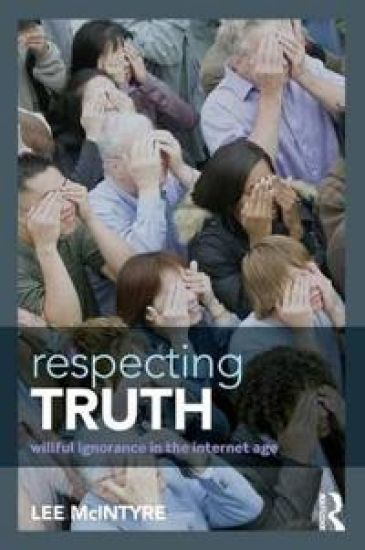
Throughout history, humans have always indulged in certain irrationalities and held some fairly wrong-headed beliefs. But in his newest book, philosopher Lee McIntyre shows how we've now reached a watershed moment for ignorance in the modern era, due to the volume of misinformation, the speed with which it can be digitally disseminated, and the savvy exploitation of our cognitive weaknesses by those who wish to advance their ideological agendas. In Respecting Truth: Willful Ignorance in the Internet Age, McIntyre issues a call to fight back against this slide into the witless abyss. In the tradition of Galileo, the author champions the importance of using tested scientific methods for arriving at true beliefs, and shows how our future survival is dependent on a more widespread, reasonable world.
Respecting Truth

Respecting Truth

Lee McIntyre

Routledge
2015
nidottu
Throughout history, humans have always indulged in certain irrationalities and held some fairly wrong-headed beliefs. But in his newest book, philosopher Lee McIntyre shows how we've now reached a watershed moment for ignorance in the modern era, due to the volume of misinformation, the speed with which it can be digitally disseminated, and the savvy exploitation of our cognitive weaknesses by those who wish to advance their ideological agendas. In Respecting Truth: Willful Ignorance in the Internet Age, McIntyre issues a call to fight back against this slide into the witless abyss. In the tradition of Galileo, the author champions the importance of using tested scientific methods for arriving at true beliefs, and shows how our future survival is dependent on a more widespread, reasonable world.
Explaining Explanation

Explaining Explanation

Lee McIntyre

University Press of America
2012
nidottu
Far from being inferior to physics, the special sciences are crucial to understanding what is distinctive about scientific explanation: that description is just as important as ontology and that having the right attitude toward empirical evidence is as necessary as having the right method. Explaining Explanation is a collection of Lee McIntyre’s most significant philosophical essays from over the last twenty years. The principle areas of concern are the philosophy of social science and the philosophy of chemistry, but essays also cover more general problems such as underdetermination, explanatory exclusion, the accommodation-prediction debate, and laws in biological science. Despite the disparate themes of each essay—complexity, laws, explanation, prediction, reduction, supervenience, emergence, and redescription—they all converge through the lens of the special sciences, focusing on what it means to “explain” in the sciences.