Kirjojen hintavertailu – 12 859 818 kirjaa ja 27 kauppaa
Kirjailija
Leo Lowenthal
Kirjat ja teokset yhdessä paikassa: 14 kirjaa, julkaisuja vuosilta 1983–2021, suosituimpiin kuuluu Prophets of Deceit. Vertaile teosten hintoja ja tarkista saatavuus suomalaisista kirjakaupoista.
A classic book that analyzes and defines media appeals specific to American pro-fascist and anti-Semite agitators of the 1940s, such as the application of psychosocial manipulation for political ends. The book details psychological deceits that idealogues or authoritarians commonly used. The techniques are grouped under the headings "Discontent", "The Opponent", "The Movement" and "The Leader". The authors demonstrate repetitive patterns commonly utilized, such as turning unfocused social discontent towards a targeted enemy. The agitator positions himself as a unifying presence: he is the ideal, the only leader capable of freeing his audience from the perceived enemy. Yet, as the authors demonstrate, he is a shallow person who creates social or racial disharmony, thereby reinforcing that his leadership is needed. The authors believed fascist tendencies in America were at an early stage in the 1940s, but warned a time might come when Americans could and would be "susceptible to ... [the] psychological manipulation" of a rabble rouser. A book once again relevant in the Trump era, as made clear by Corey Robin's new introduction.
This volume's predominant theme is bourgeois mentality and its historical development. The works of Lope de Vega, Calderon, Cervantes, and Shakespeare, among others, are analysed within the historical framework of the decline of feudalism and the rise of the absolute regimes. Those of Moliere and Goethe are set against the background of an evolving and consolidating bourgeois society in Western Europe.
This first volume of the collected writings of sociologist Leo Lowenthal contains his classic theoretical and historical writings on the relationship of art to mass culture. This book series presents Lowenthal's contributions to a theory of the role of communication in modern society. This volume lays out the basis for a theory of mass culture. Lowenthal demonstrates that the juxtaposition of a "low" mass culture and a "high" esoteric culture did not originate in contemporary industrial, bourgeois society but can be traced back to the Middle Ages and antiquity.
This volume's predominant theme is bourgeois mentality and its historical development. The works of Lope de Vega, Calderon, Cervantes, and Shakespeare, among others, are analysed within the historical framework of the decline of feudalism and the rise of the absolute regimes. Those of Moliere and Goethe are set against the background of an evolving and consolidating bourgeois society in Western Europe.
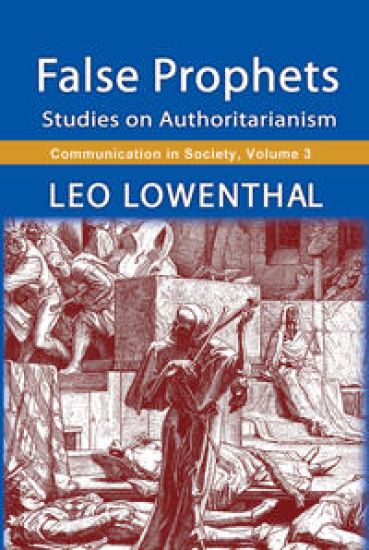
The studies in this volume deal with problems of authoritarianism and anti-Semitism. Lowenthal's book length contribution, "Prophets of Deceit," which begins this collection, is a classic of political psychology. This research study is followed by an essay, "Terror's Atomization of Man." Lowenthal uses this material for a theory of the psychological mechanisms operative under terrorist conditions and their significance for contemporary society.
The core of this volume is its presentation of Lowenthal's sixty-year-long intellectual career as a critical theorist and sociologist. The book includes some of his speeches on Theodor Adorno and Walter Benjamin and presents excerpts from conversations on his life as a scholar and teacher, as managing editor of the Institute for Social Research's famous journal, as government servant during and immediately after the war, and as observer and critic of contemporary culture and politics. Together these selections present an intriguing biographical panorama of a major intellectual figure.
The core of this volume is its presentation of Lowenthal's sixty-year-long intellectual career as a critical theorist and sociologist. The book includes some of his speeches on Theodor Adorno and Walter Benjamin and presents excerpts from conversations on his life as a scholar and teacher, as managing editor of the Institute for Social Research's famous journal, as government servant during and immediately after the war, and as observer and critic of contemporary culture and politics. Together these selections present an intriguing biographical panorama of a major intellectual figure.
The studies in this volume deal with problems of authoritarianism and anti-Semitism. Lowenthal's book length contribution, "Prophets of Deceit," which begins this collection, is a classic of political psychology. This research study is followed by an essay, "Terror's Atomization of Man. "Lowenthal uses this material for a theory of the psychological mechanisms operative under terrorist conditions and their significance for contemporary society.
This first volume of the collected writings of sociologist Leo Lowenthal contains his classic theoretical and historical writings on the relationship of art to mass culture. This book series presents Lowenthal's contributions to a theory of the role of communication in modern society. This volume lays out the basis for a theory of mass culture. Lowenthal demonstrates that the juxtaposition of a "low"mass culture and a "high"esoteric culture did not originate in contemporary industrial, bourgeois society but can be traced back to the Middle Ages and antiquity.