Kirjojen hintavertailu – 12 903 724 kirjaa ja 27 kauppaa

Kirjailija

Leo Strauss

Kirjat ja teokset yhdessä paikassa: 45 kirjaa, julkaisuja vuosilta 1965–2026, suosituimpiin kuuluu The Concept of the Political – Expanded Edition. Vertaile teosten hintoja ja tarkista saatavuus suomalaisista kirjakaupoista.

45 kirjaa

Kirjojen julkaisuvuodet: 1965–2026.

Leo Strauss on Maimonides

Leo Strauss on Maimonides

Leo Strauss

University of Chicago Press
2013
sidottu
Leo Strauss is widely recognized as one of the foremost interpreters of Maimonides. His studies of the medieval Jewish philosopher led to his rediscovery of esotericism and deepened his sense that the tension between reason and revelation was central to modern political thought. His writings throughout the twentieth century were chiefly responsible for restoring Maimonides as a philosophical thinker of the first rank. Yet, to appreciate the extent of Strauss' contribution to the scholarship on Maimonides, one has traditionally had to seek out essays he published separately spanning almost fifty years. With "Leo Strauss on Maimonides", Kenneth Hart Green presents for the first time a comprehensive, annotated collection of Strauss' writings on Maimonides, comprising sixteen essays, three of which appear in English for the first time. Green has also provided careful translations of materials originally quoted in Hebrew, Arabic, Latin, German, and French; written an informative introduction highlighting the contributions found in each essay; and brought references to out-of-print editions fully up to date. The result will become the standard edition of Strauss' writings on Maimonides.
Leo Strauss on Moses Mendelssohn

Leo Strauss on Moses Mendelssohn

Leo Strauss

University of Chicago Press
2012
sidottu
Moses Mendelssohn (1729-86) was the leading Jewish thinker of the German Enlightenment and the founder of modern Jewish philosophy. His writings, especially his attempt during the Pantheism Controversy to defend the philosophical legacies of Spinoza and Leibniz against F. H. Jacobi's philosophy of faith, captured the attention of a young Leo Strauss and played a critical role in the development of his thought on one of the fundamental themes of his life's work: the conflicting demands of reason and revelation. "Leo Strauss on Moses Mendelssohn" is a superbly annotated translation of ten introductions written by Strauss to a multivolume critical edition of Mendelssohn's work. Commissioned in Weimar Germany in the 1920s, the project was suppressed and nearly destroyed during Nazi rule and was not revived until the 1960s. In addition to Strauss' introductions, Martin D. Yaffe has translated various editorial annotations Strauss makes on key passages in Mendelssohn's texts. Yaffe has also contributed an extensive interpretive essay that both analyzes the introductions on their own terms and discusses what Strauss writes elsewhere about the broader themes broached in his Mendelssohnian studies. "Strauss' critique of Mendelssohn" represents one of the largest bodies of work by the young Strauss on a single thinker to be made available in English. It illuminates not only a formerly obscure phase in the emergence of his thought but also a critical moment in the history of the German Enlightenment.
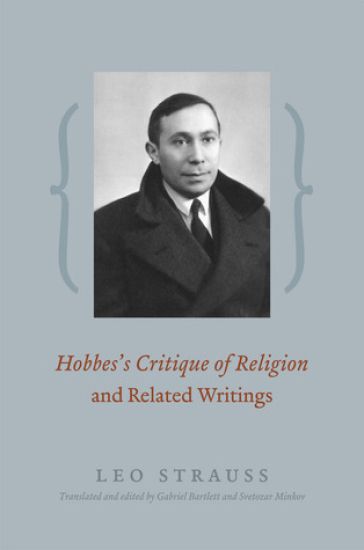
Hobbes's Critique of Religion and Related Writings

Hobbes's Critique of Religion and Related Writings

Leo Strauss

University of Chicago Press
2011
sidottu
Leo Strauss' "The Political Philosophy of Hobbes" deservedly ranks among his most widely acclaimed works. In it Strauss argues that the basis for Hobbes' natural and political science is his interest in 'self-knowledge of man as he really is.' The pieces collected in this book, each written prior to that classic volume, complement that account. Thus, at long last, this book allows us to have a complete picture of Strauss' interpretation of Hobbes, the thinker pivotal to the fundamental theme of his life's work: the conflicting demands of philosophy and revelation, or, as he termed it, 'the theologico-political problem.' It is no exaggeration to say that Strauss' work on Hobbes' critique of religion is essential to his analysis of Hobbes' political philosophy, and vice versa. This volume will spark new interest in Hobbes' explication of the Bible and in his understanding of religion by revealing previously neglected dimensions and motives of Hobbes' 'theology.' At the same time, scholars interested in the intellectual development of Leo Strauss will find in these writings the missing link, as it were, between his two early books, Spinoza's "Critique of Religion" and "The Political Philosophy of Hobbes". In addition, this volume makes avilable for the first time in English a letter, a book outline, an extended review, an engagement with legal positivism, and an account of Strauss' work on Hobbes by Heinrich Meier, all of which shed light on Strauss' concerns and his approach to Hobbes in particular, as well as to modern political thought and life.
Kunst des Schreibens

Kunst des Schreibens

Leo Strauss; Alexandre Kojève; Friedrich Kittler

Merve Verlag GmbH
2009
nidottu
Die Freundschaft von Alexandre Koj?ve und Leo Strauss reicht bis in die frühen 30er Jahre des letzten Jahrhunderts zurück. Sie äußerte sich, wie ihr Briefwechsel (1932-1965) zeigt, in erster Linie als intellektuelle Auseinandersetzung, die zuweilen auch publizistische Früchte, wie "Über Tyrannis" (1963), trug. Der vorliegende Band vereint zwei Texte zu einem anderen Thema: Die Kunst des Schreibens. Zum einen Alexandre Koj?ves Text "Kaiser Julian und die Kunst des Schreibens", der zuerst 1964 in englischer Übersetzung in einer Festschrift für Leo Strauss erschien, zum anderen den Aufsatz des Jubilars von 1941, auf den sich Koj?ve ausdrücklich bezieht: "Verfolgung und die Kunst des Schreibens". Es geht also um das Verhältnis von Exoterik und Esoterik, um das, was gesagt wird und das, was unausgesprochen bleibt. Und darum, ob es eine spezielle Schreibtechnik gibt, "eine Technik, an die wir denken, wenn wir vom Zwischen-den-Zeilen-Schreiben sprechen", die zu verstehen gibt, was nicht ausgesprochen wird. Abschließend stellt Friedrich Kittler Kaiser Julians so genannte Apostasie in ihren medien- und institutionsgeschichtlichen Kontext, in den jede "Kunst des Schreibens" eingebunden ist.
Leo Strauss On Plato's Symposium

Leo Strauss On Plato's Symposium

Leo Strauss

University of Chicago Press
2003
nidottu
The first major piece of unpublished work by Leo Strauss to appear in more than 30 years, this volume offers the public the unprecedented experience of encountering this renowned scholar as his students did. Given as a course in autumn 1959 under the title "Plato's Political Philosophy" these provocative lectures - until now, never published, but instead passed down from one generation of students to the next - show Strauss at his subtle and insightful best.
Leo Strauss On Plato's Symposium

Leo Strauss On Plato's Symposium

Leo Strauss

University of Chicago Press
2001
sidottu
In this volume Leo Strauss presents a coherent and complete interpretation of Plato's "Symposium", proceeding by meticulous reading, from beginning to end. Strauss, operating on the idea that commentary is an useful method of expounding the truth, sheds light on the meaning of the dialogue and its place in the Platonic corpus, and also on a host of other topics, including the nature of eros and its place in the overall economy of human life, the quarrel between poetry and philosophy, and the character of Socrates and the question of his trial.
The Argument and the Action of Plato's Laws

The Argument and the Action of Plato's Laws

Leo Strauss

University of Chicago Press
1998
nidottu
The posthumous publication of The Argument and the Action of Plato's "Laws" was compiled shortly before the death of Leo Strauss in 1973. Strauss offers an insightful and instructive reading through careful probing of Plato's classic text. "Strauss's The Argument and the Action of Plato's 'Laws' reflects his interest in political thought, his dogged method of following the argument of the Laws step by step, and his vigorous defense of this dialogue's integrity in respect to the ideals of the Republic."--Cross Currents "The unique characteristics of this commentary on the Laws reflect the care and precision which were the marks of Professor Strauss's efforts to understand the complex thoughts of other men."--Allan D. Nelson, Canadian Journal of Political Science "Thorough and provocative, an important addition to Plato scholarship."--Library Journal "The major purpose of the commentary is to provide a reading of the dialogue which displays its structural arrangement and the continuity of the argument."--J. W. Dy, Bibliographical Bulletin of Philosophy "The reader of Strauss's book is indeed guided closely through the whole text."-- M. J. Silverthorne, The Humanities Association Review Leo Strauss (1899-1973) was the Robert Maynard Hutchins Distinguished Service Professor Emeritus of political science at the University of Chicago.
Jewish Philosophy and the Crisis of Modernity

Jewish Philosophy and the Crisis of Modernity

Leo Strauss

State University of New York Press
1997
pokkari
Explores the impact on Jews and Judaism of the crisis of modernity, analyzing modern Jewish dilemmas and providing a prescription for their resolution. This is the first book to bring together the major essays and lectures of Leo Strauss in the field of modern Jewish thought. It contains some of his most famous published writings, as well as significant writings which were previously unpublished. Spanning almost 30 years of continuously deepening reflection, the book presents the full range of Strauss's contributions as a modern Jewish thinker. These essays and lectures also offer Strauss's mature considerations of some of the great figures in modern Jewish thought, such as Baruch Spinoza, Hermann Cohen, Franz Rosenzweig, Martin Buber, Theodor Herzl, and Sigmund Freud. They also encompass his incisive analyses and original explorations of modern Judaism (which he viewed as caught in the grip of the "theological-political crisis"): from German Jewry, anti-Semitism, and the Holocaust to Zionism and the State of Israel; from the question of assimilation to the meaning and value of Jewish history. In addition Strauss's two sustained interpretations of the Hebrew Bible are also reprinted. These essays and lectures cumulatively point toward the "postcritical" reconstruction of Judaism which Strauss envisioned, suggesting it rebuild along Maimonidean lines. Thus, the book lends credence to the view that Strauss was able to uncover and probe the crisis at the heart of modern Jewish thought and history, perhaps with greater profundity than any other contemporary Jewish thinker.
Spinoza's Critique of Religion

Spinoza's Critique of Religion

Leo Strauss

University of Chicago Press
1997
nidottu
In this text Leo Strauss articulates the conflict between reason and revelation as he explores Spinoza's scientific, comparative, and textual treatment of the Bible. He compares Spinoza's "Theologico-political Treatise" and the Epistles, showing their relation to critical controversy on religion from Epicurus and Lucretius through Uriel da Costa and Isaac Peyrere to Thomas Hobbes. An autobiographical preface to this book traces Strauss' dilemmas as a young liberal intellectual in Germany during the Weimar Republic, as a scholar in exile, and as a leader of American philosophical thought.
Socrates and Aristophanes

Socrates and Aristophanes

Leo Strauss

University of Chicago Press
1996
nidottu
In one of his last books, Leo Strauss examines the confrontation between Socrates and Aristophanes in Aristophanes' comedies. Looking at eleven plays, Strauss shows that this confrontation is essentially one between poetry and philosophy, and that poetry emerges as an autonomous wisdom capable of rivaling philosophy.
The Political Philosophy of Hobbes

The Political Philosophy of Hobbes

Leo Strauss

University of Chicago Press
1996
nidottu
In this classic analysis, Leo Strauss pinpoints what is original and innovative in the political philosophy of Thomas Hobbes. He argues that Hobbes's ideas arose not from tradition or science but from his own deep knowledge and experience of human nature. Tracing the development of Hobbes's moral doctrine from his early writings to his major work The Leviathan, Strauss explains contradictions in the body of Hobbes's work and discovers startling connections between Hobbes and the thought of Plato, Thucydides, Aristotle, Descartes, Spinoza, and Hegel. Leo Strauss (1899-1973) was Robert Maynard Hutchins Distinguished Service Professor Emeritus in political science at the University of Chicago. Among his works published by the University of Chicago Press are Thoughts on Machiavelli, The City and Man, and Natural Right and History.
Thoughts on Machiavelli

Thoughts on Machiavelli

Leo Strauss

University of Chicago Press
1995
nidottu
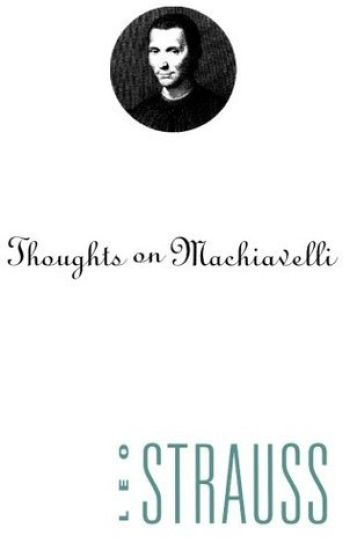
Leo Strauss argued that the most visible fact about Machiavelli's doctrine is also the most useful one: Machiavelli seems to be a teacher of wickedness. Strauss sought to incorporate this idea in his interpretation without permitting it to overwhelm or exhaust his exegesis of "The Prince" and the "Discourses on the First Ten Books of Livy". "We are in sympathy," he writes, "with the simple opinion about Machiavelli [namely, the wickedness of his teaching], not only because it is wholesome, but above all because a failure to take that opinion seriously prevents one from doing justice to what is truly admirable in Machiavelli: the intrepidity of his thought, the grandeur of his vision, and the graceful subtlety of his speech." This critique of the founder of modern political philosophy by this 20th-century scholar should be a valuable text for students of both authors.
Philosophy and Law

Philosophy and Law

Leo Strauss

State University of New York Press
1995
pokkari
A groundbreaking study of the political philosophy of Maimonides and his Islamic predecessors. Leo Strauss's Philosophy and Law contains a groundbreaking study of the political philosophy of Maimonides and his Islamic predecessors, and it offers an argument on behalf of that philosophy which is also a profound critique of modern philosophy. Here is an entirely new and complete English translation of Strauss's work, which takes as its ideal the exacting standards of accuracy that Strauss himself emphasized in his own work. It includes a prefatory essay introducing the argument of each of the four sections of Philosophy and Law. This is a fresh and challenging treatment of the perennial conflict between reason and revelation, or philosophy and religion. Strauss's key contention in this book is that the most influential modern approaches to this conflict have run aground in ways that reflect their loss of key insights developed by the medieval philosophers of Islam and their Jewish pupils, especially Maimonides. Strauss challenges the modern view that scientific enlightenment must ultimately amount to atheism, and that therefore there can be no such thing as enlightened religion. Through a careful, original, and detailed treatment of central works of the medieval Islamic-Jewish tradition, especially Maimonides' Guide of the Perplexed, Strauss aims to recover their key insights into this question.
Argument Et Action Des Lois de Platon

Argument Et Action Des Lois de Platon

Leo Strauss

Librarie Philosophique J. Vrin
1990
nidottu
Les Lois ne sont pas le dialogue de Platon le plus connu, ni a fortiori le plus commente. Strauss nous en donne ici un commentaire magistral: serre, il epouse toutes les sinuosites du texte et en revele toute la subtilite. Ce commentaire, publie apres la mort de l'auteur, mais entierement termine, est le fruit d'une vie entiere de meditation de l'oeuvre de Platon. A ce titre, il constitue un exemple privilegie de l' art de lire les textes de l'antiquite de Leo Strauss. Le dialogue des Lois, en tant qu'il traite les questions de la loi politique et de la loi divine, a tres tot alimente les reflexions de Strauss sur le probleme theologico-politique qui est central dans ses recherches.
An Introduction to Political Philosophy

An Introduction to Political Philosophy

Leo Strauss

Wayne State University Press
1989
sidottu
A reissue of the 1975 edition, with four added essays, this collection offers a clear introduction to Strauss' views regarding the nature of political philosophy, its chief contemporary antagonists, its classical forms, and its modern version. It gives the reader Strauss' thoughts on what political philosophy has been and should be again. Selected for their general interest and their accessibility, the essays in the book provide a solid foundation for understanding Leo Strauss and his political philosophy.
The Rebirth of Classical Political Rationalism

The Rebirth of Classical Political Rationalism

Leo Strauss

University of Chicago Press
1989
nidottu
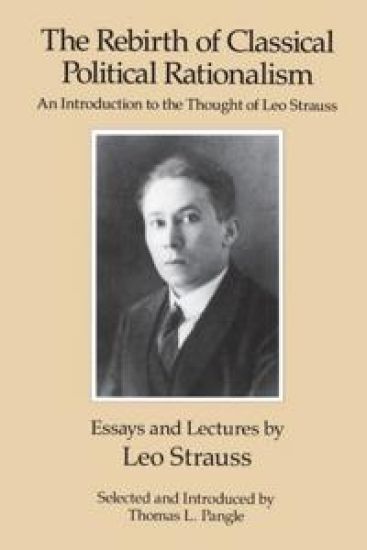
This concise and accessible introduction to Strauss's thought provides, for wider audience, a bridge to his more complex theoretical work. Editor Pangle has gathered five of Strauss's previously unpublished lectures and five hard-to-find published writings and has arranged them so as to demonstrate the systematic progression of the major themes that underlay Strauss's mature work. "[These essays] display the incomparable insight and remarkable range of knowledge that set Strauss's works apart from any other twentieth-century philosopher's."--Charles R. Kesler, National Review
What is Political Philosophy?

What is Political Philosophy?

Leo Strauss

University of Chicago Press
1988
nidottu
"What is Political Philosphy?" - a collection of ten essays and lectures and sixteen book reviews written between 1943 and 1957 - contains some of Leo Strauss's most famous writings and some of his most explicit statements of the themes that made him famous. The title essay records Strauss's sole extended articulation of the meaning of political philosophy itself. Other essays discuss the relation of political philosophy to history, give an account of the political philosophy of the non-Christian Middle Ages and of classic European modernity, and present his theory of esoteric writing.