Kirjojen hintavertailu – 12 859 829 kirjaa ja 27 kauppaa

Kirjailija

Leonid Yaroslavsky

Kirjat ja teokset yhdessä paikassa: 6 kirjaa, julkaisuja vuosilta 1996–2018, suosituimpiin kuuluu Fundamentals of Digital Optics. Vertaile teosten hintoja ja tarkista saatavuus suomalaisista kirjakaupoista.

6 kirjaa

Kirjojen julkaisuvuodet: 1996–2018.

Fundamentals of Digital Optics

Fundamentals of Digital Optics

Leonid Yaroslavsky; Murray Eden

Springer-Verlag New York Inc.
2012
nidottu
1.1 Digital Optics as a Subject Improvement of the quality of optical devices has always been the central task of experimental optics. In modern terms, improvements in sensitivity and resolution have equated higher quality with greater informational throughput. For most of today's applications, optics and electronics have, in essence, solved the problem of generating high quality pictures with great informational ca­ pacity. Effective use of the enormous amount of information contained in the images necessitates processing pictures, holograms, and interferograms. The manner in which information might be extracted from optical entities has be­ come a topic of current interest. The informational aspects of optical signals and systems might serve as a basis for attacking this question by making use of information theory and signal communication theory, and by enlisting modern tools and methods for data processing (the most important and powerful of which are those of digi­ tal computation). Exploiting modern advances in electronics has allowed new wavelength ranges and new kinds of radiation to be used in optics. Comput­ ers have extended our knowledge of the informational essence of radiation. Thus, computerized optical devices enhance not only the optical capabilities of sight, but also its analytical capabilities as well, thus opening qualitatively new horizons to all the areas in which optical devices have found application.
Digital Holography and Digital Image Processing

Digital Holography and Digital Image Processing

Leonid Yaroslavsky

Springer-Verlag New York Inc.
2010
nidottu
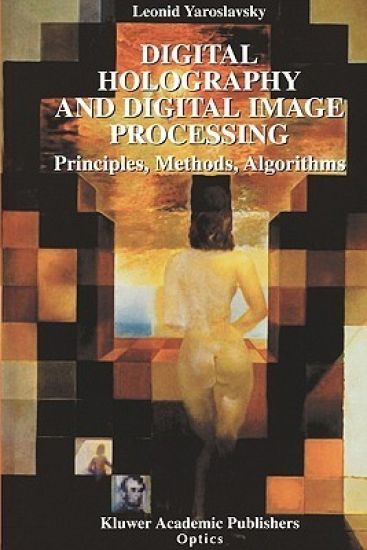
Digital holography and digital image processing are twins born by computer era. They share origin, theoretical base, methods and algorithms. The present book describes these common fundamentals principles, methods and algorithms including image and hologram digitization, data compression, digital transforms and efficient computational algorithms, statistical and Monte-Carlo methods, image restoration and enhancement, image reconstruction in tomography and digital holography, discrete signal resampling and image geometrical transformations, accurate measurements and reliable target localization in images, recording and reconstruction of computer generated holograms, adaptive and nonlinear filters for sensor signal perfecting and image restoration and enhancement. The book combines theory, heavily illustrated practical methods and efficient computational algorithms and is written for senior-level undergraduate and graduate students, researchers and engineers in optics, photonics, opto-electronics and electronic engineering.

Digital Holography and Digital Image Processing

Digital Holography and Digital Image Processing

Leonid Yaroslavsky

Springer-Verlag New York Inc.
2003
sidottu
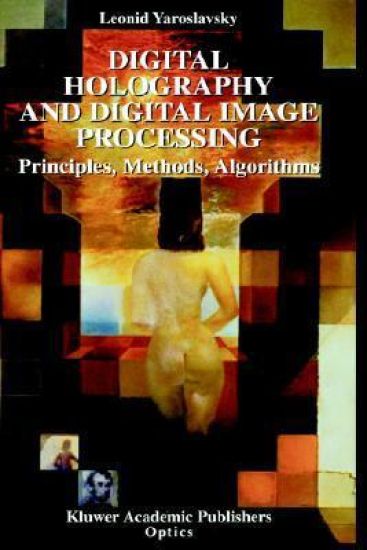
Digital holography and digital image processing are twins born by computer era. They share origin, theoretical base, methods and algorithms. The present book describes these common fundamentals principles, methods and algorithms including image and hologram digitization, data compression, digital transforms and efficient computational algorithms, statistical and Monte-Carlo methods, image restoration and enhancement, image reconstruction in tomography and digital holography, discrete signal resampling and image geometrical transformations, accurate measurements and reliable target localization in images, recording and reconstruction of computer generated holograms, adaptive and nonlinear filters for sensor signal perfecting and image restoration and enhancement. The book combines theory, heavily illustrated practical methods and efficient computational algorithms and is written for senior-level undergraduate and graduate students, researchers and engineers in optics, photonics, opto-electronics and electronic engineering.
Fundamentals of Digital Optics

Fundamentals of Digital Optics

Leonid Yaroslavsky; Murray Eden

Birkhauser Boston Inc
1996
sidottu
1.1 Digital Optics as a Subject Improvement of the quality of optical devices has always been the central task of experimental optics. In modern terms, improvements in sensitivity and resolution have equated higher quality with greater informational throughput. For most of today's applications, optics and electronics have, in essence, solved the problem of generating high quality pictures with great informational ca­ pacity. Effective use of the enormous amount of information contained in the images necessitates processing pictures, holograms, and interferograms. The manner in which information might be extracted from optical entities has be­ come a topic of current interest. The informational aspects of optical signals and systems might serve as a basis for attacking this question by making use of information theory and signal communication theory, and by enlisting modern tools and methods for data processing (the most important and powerful of which are those of digi­ tal computation). Exploiting modern advances in electronics has allowed new wavelength ranges and new kinds of radiation to be used in optics. Comput­ ers have extended our knowledge of the informational essence of radiation. Thus, computerized optical devices enhance not only the optical capabilities of sight, but also its analytical capabilities as well, thus opening qualitatively new horizons to all the areas in which optical devices have found application.