
Kirjojen hintavertailu – 12 859 828 kirjaa ja 27 kauppaa

Kirjailija

Leung Constant

Kirjat ja teokset yhdessä paikassa: 3 kirjaa, julkaisuja vuosilta 2000–2026, suosituimpiin kuuluu Ecological Languaging Competencies. Vertaile teosten hintoja ja tarkista saatavuus suomalaisista kirjakaupoista.

3 kirjaa

Kirjojen julkaisuvuodet: 2000–2026.

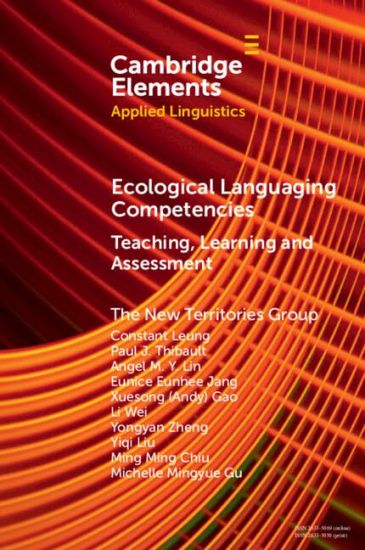
Ecological Languaging Competencies

Ecological Languaging Competencies

Leung Constant; Thibault Paul J.; Angel M. Y. Lin; Eunice EunHee Jang; Xuesong (Andy) Gao; Wei Li; Zheng Yongyan; Yiqi Liu; Ming Ming Chiu; Michelle Mingyue Gu

Cambridge University Press
2026
Nidottu
The concept of communicative competence has been rendered as context-abstracted code-bound knowledge for language teaching and assessment. This Element offers a different perspective on 'communication' and 'competence'. Part I offers the rationale for this re-orientation. Part II examines the conceptual and pedagogic affordances and delimitations of the prevailing approach to communicative competence; Part III describes a conceptual re-framing of language use as ecological languaging in terms of embodied, situation-sensitive action through which people coordinate with others, artefacts, and environments; Part IV explores assessment approaches built on Bayesian principles for tracking learner development and progress by taking account of prior accomplishment, expert opinion, and emerging performance to create probabilistic trajectories; Part V focusses on professional developments related to conceptual refinement, curriculum design, teaching materials, and teacher education. Part VI considers some key future challenges. This title is also available as Open Access on Cambridge Core.

Ecological Languaging Competencies

Ecological Languaging Competencies

Leung Constant; Thibault Paul J.; Angel M. Y. Lin; Eunice EunHee Jang; Xuesong (Andy) Gao; Wei Li; Zheng Yongyan; Yiqi Liu; Ming Ming Chiu; Michelle Mingyue Gu

Cambridge University Press
2026
Sidottu
The concept of communicative competence has been rendered as context-abstracted code-bound knowledge for language teaching and assessment. This Element offers a different perspective on 'communication' and 'competence'. Part I offers the rationale for this re-orientation. Part II examines the conceptual and pedagogic affordances and delimitations of the prevailing approach to communicative competence; Part III describes a conceptual re-framing of language use as ecological languaging in terms of embodied, situation-sensitive action through which people coordinate with others, artefacts, and environments; Part IV explores assessment approaches built on Bayesian principles for tracking learner development and progress by taking account of prior accomplishment, expert opinion, and emerging performance to create probabilistic trajectories; Part V focusses on professional developments related to conceptual refinement, curriculum design, teaching materials, and teacher education. Part VI considers some key future challenges. This title is also available as Open Access on Cambridge Core.
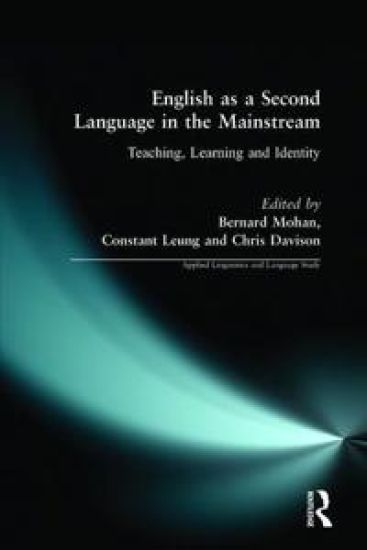
English as a Second Language in the Mainstream

English as a Second Language in the Mainstream

Leung Constant; Davison Christine; Bernard Mohan

Routledge
2000
nidottu
Since it was first established in the 1970's the Applied Linguistics and Language Study series has become a major force in the study of practical problems in human communication and language education. Drawing extensively on empirical research and theoretical work in linguistics, sociology, psychology and education, the series explores key issues in language acquisition and language use. English as a Second Language learners are now a considerable and increasing part of the mainstream of urban schools in English-speaking countries. Beyond the learning of English, this development raises broader questions of language as a medium of education in a multilingual, multicultural environment. Drawing on their experience as researchers and educators in Australia, Canada and England, the authors of English as a Second Language in the Mainstream present an up-to-date account of advances in theory and practice. Their analysis of system-wide provision however, suggests that a truly responsive educational vision is lacking: government policy is inadequate, educational practices for ESL students are either underdeveloped or poorly coordinated with practices for other students, and the rhetoric of reform fails to engage significantly with issues of teaching and resources. The authors argue towards a more comprehensive vision which can acknowledge the relation between issues concerning ESL students and issues concerning the educational system as a whole, which can coordinate reforms in ESL education with general reforms, which can explicitly and systematically integrate language learning and content learning, and which can build more positively on the multilingual and multicultural nature of modern education for all students.