Kirjojen hintavertailu – 12 859 829 kirjaa ja 27 kauppaa

Kirjailija

Lewis H. Gann

Kirjat ja teokset yhdessä paikassa: 4 kirjaa, julkaisuja vuosilta 1991–2016, suosituimpiin kuuluu Hope for South Africa?. Vertaile teosten hintoja ja tarkista saatavuus suomalaisista kirjakaupoista.

4 kirjaa

Kirjojen julkaisuvuodet: 1991–2016.

The Rulers of Belgian Africa, 1884-1914

The Rulers of Belgian Africa, 1884-1914

Lewis H. Gann

Princeton University Press
2016
sidottu
In this comprehensive picture of Belgian colonialism in the Congo, Lewis Gann and Peter Duignan trace the formation of the colonial state that became Zaire, considering it in the light of colonial experience in other African territories. Whereas most studies have focused on the conquest and subjugation of the African population, this study probes the colonial apparatus itself, investigating the attitudes and behavior of the civil servants and soldiers who built the empire. Originally published in 1979. The Princeton Legacy Library uses the latest print-on-demand technology to again make available previously out-of-print books from the distinguished backlist of Princeton University Press. These editions preserve the original texts of these important books while presenting them in durable paperback and hardcover editions. The goal of the Princeton Legacy Library is to vastly increase access to the rich scholarly heritage found in the thousands of books published by Princeton University Press since its founding in 1905.

The Rulers of Belgian Africa, 1884-1914

The Rulers of Belgian Africa, 1884-1914

Lewis H. Gann

Princeton University Press
2015
pokkari
In this comprehensive picture of Belgian colonialism in the Congo, Lewis Gann and Peter Duignan trace the formation of the colonial state that became Zaire, considering it in the light of colonial experience in other African territories. Whereas most studies have focused on the conquest and subjugation of the African population, this study probes the colonial apparatus itself, investigating the attitudes and behavior of the civil servants and soldiers who built the empire. Originally published in 1979. The Princeton Legacy Library uses the latest print-on-demand technology to again make available previously out-of-print books from the distinguished backlist of Princeton University Press. These editions preserve the original texts of these important books while presenting them in durable paperback and hardcover editions. The goal of the Princeton Legacy Library is to vastly increase access to the rich scholarly heritage found in the thousands of books published by Princeton University Press since its founding in 1905.

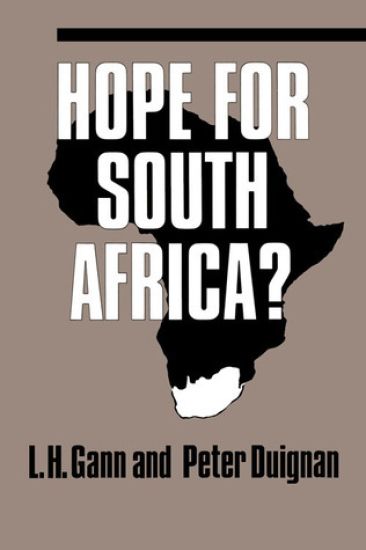
Hope for South Africa?

Hope for South Africa?

Peter Duignan; Lewis H. Gann

Hoover Institution Press,U.S.
1991
nidottu
Is there a path of peaceful evolutionary change for South Africa? Gann and Duignan have long thought so. The shooting at Sharpeville in 1960 focused worldwide attention on South Africa's politics; since then South Africa and its future have been regarded in the West as a continuing morality play, with whites standing staunchly against blacks and wrong pitted against right. South Africa in this view is a powder keg ready to explode-a land where the clock stands forever at five minutes to midnight. Dissenting from this view, L. H. Gann and Peter Duignan have consistently argued that the ruling Afrikaner establishment would, in and of itself, initiate far-reaching political, economic, and social changes without a breakdown in the economy. The authors' controversial views have been remarkably accurate. In this book the authors consider the recent reforms initiated by President F. W. de Klerk and the willingness of Pretoria to negotiate with the African Congress and leaders such as Nelson Mandela. They examine the country's power structure (armed forces, police, arms industry), economy, politics and the ways in which these various branches of government and the private sector interact. If apartheid is dissolved and a peaceful political system allowed to evolve, they envision a prosperous South Africa built on the principles of a free market economy and parliamentary compromise. This prosperity will become the engine of development for the whole of southern Africa.