

Kirjailija
Lewis H. Morgan
Kirjat ja teokset yhdessä paikassa: 21 kirjaa, julkaisuja vuosilta 1851–2025, suosituimpiin kuuluu Ancient Society. Vertaile teosten hintoja ja tarkista saatavuus suomalaisista kirjakaupoista.
Nimi esiintyy myös muodoissa: Lewis H Morgan
21 kirjaa
Kirjojen julkaisuvuodet: 1851–2025.


Reading this book takes you into deep considerations of who you are. Lewis Henry Morgan dives into the development of society in prehistoric times. His controversial proposition is that the earliest human domestic institution was the matrilineal clan, not the patriarchal family. In his book, Morgan rejects the Ages of Stone, Bronze, and Iron, as being insufficient characterizations of progress and for overlapping, and instead suggested that a society has a life like that of an individual and divided it into three main stages: Savagery, Barbarism, and Civilization, with three subdivisions for each. He demonstrates the first distinction of man from other animals, and reveals the origin of language, beginning as gestures, then evolving into monosyllabic, and then polysyllabic vocalizations. Morgan is the only American social theorist to be cited by such diverse scholars as Karl Marx, Charles Darwin, and Sigmund Freud in their works. Understand his fundamental thoughts on social evolution and learn why this book is banned in many universities worldwide "There exists a definitive book on the origins of society, as definitive as Darwin's book for biology, and it is, naturally, Morgan's Ancient Society." Friedrich Engels

This book has been considered by academicians and scholars of great significance and value to literature. This forms a part of the knowledge base for future generations. So that the book is never forgotten we have represented this book in a print format as the same form as it was originally first published. Hence any marks or annotations seen are left intentionally to preserve its true nature.
Ancient Society: Or Researches in the Lines of Human Progress from Savagery, Through Barbarism to Civilization (Hardcover)
Lewis H. Morgan
Lulu.com
2019
sidottu
Renowned anthropologist Lewis H. Morgan examines the origins and history of humanity, sharing abundant insights on the conditions of primitive society. Of particular interest to Morgan is the gradual process by which humans organized into civil societies. Examining a range of contrasting civilizations, from the Mayans to the Iroquois to the Romans, the author attempts to arrive at commonalities in how these peoples went from a primitive and barbaric early existence to a relatively civilized height, whereupon their greatest achievements left their mark. For the author, human civilization progressed in three broad stages - savagery, wherein hunter-gatherer behaviors, crude language and inbreeding is prevalent; barbarism, wherein the first centralized settlements and signs of organizational military and political hierarchy appear; and civilization, where humans are at their most organized and capable of great advances in science, wealth, culture and the general well-being of the population.
Ancient Society: Or Researches in the Lines of Human Progress from Savagery, Through Barbarism to Civilization
Lewis H. Morgan
Lulu.com
2019
nidottu
Renowned anthropologist Lewis H. Morgan examines the origins and history of humanity, sharing abundant insights on the conditions of primitive society. Of particular interest to Morgan is the gradual process by which humans organized into civil societies. Examining a range of contrasting civilizations, from the Mayans to the Iroquois to the Romans, the author attempts to arrive at commonalities in how these peoples went from a primitive and barbaric early existence to a relatively civilized height, whereupon their greatest achievements left their mark. For the author, human civilization progressed in three broad stages - savagery, wherein hunter-gatherer behaviors, crude language and inbreeding is prevalent; barbarism, wherein the first centralized settlements and signs of organizational military and political hierarchy appear; and civilization, where humans are at their most organized and capable of great advances in science, wealth, culture and the general well-being of the population.
Houses and House-Life of the American Aborigines
Lewis H. Morgan
Createspace Independent Publishing Platform
2016
nidottu

League of the Ho-De-No-Sau-Nee or Iroquois
Lewis H. Morgan
Createspace Independent Publishing Platform
2014
nidottu
Among all the Native American tribes, the Iroquois people are some of the most well documented Native Americans in history. Indigenous to the northeast region of what is now the United States and parts of Canada, they were among some of the earliest contacts Europeans had with the native tribes. And yet they have remained a constant source of mystery. The name "Iroquois", like many Native American tribal names, is not a name the people knew themselves by, but a word applied to them by their enemies the Huron, who called them "Iroquo" (rattlesnake) as an insult. The French later added the suffix "ois." Moreover, the Iroquois are not even a single tribe but a confederation of several different tribal nations that include the Seneca, Oneida, Onondaga, Mohawk, Cayuga and the Tuscarora, who didn't become part of the union until the early 1700's. The name Haudenosaunee (pronounced "ho-den-oh-SHO-nee") is the name the people use for themselves, which translates as "the People of the Longhouse." They are also commonly known as the Six Nations. Despite their own cultural differences, the nations that comprised the Iroquois Confederacy established their political dominance across much of America's East Coast and Midwest through conquest, and it is that aspect which has perhaps best endured among Americans in terms of the Iroquois' legacy. European settlers who came into contact with the Mohawks in the Northeast certainly learned to respect their combat skills, to the point that there were literally bounties on the Mohawks' heads, with scalps fetching money for colonists who succeeded in slaying them and carrying away the "battle prize". In addition to the constant state of conflict between the Iroquois and different nations, including the French and the colonists, the Six Nations are perhaps best known for their political structure, and their influence on American democracy is well documented if not well known by most Americans. Far from being relics of history, they are living communities who maintain political relationships with United States and Canada, as they have occupied their territories long before international borders were drawn. Their histories have left an indelible mark on the formation of the United States and Canada.
Houses and House-Life of the American Aborigines
Lewis H. Morgan
Literary Licensing, LLC
2014
nidottu
Houses And House-Life Of The American Aborigines (LARGE PRINT EDITION)
Lewis H. Morgan
KESSINGER PUBLISHING, LLC
2011
sidottu

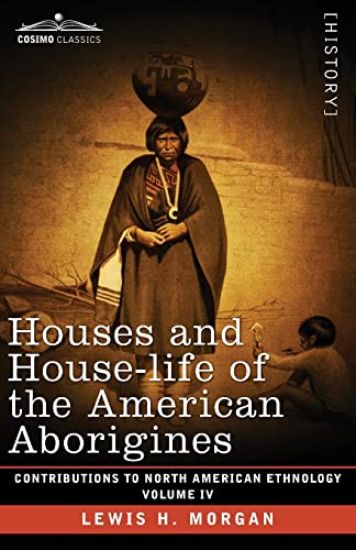
Houses and House-Life of the American Aborigines: Volume IV
Lewis H. Morgan; George Gibbs
Cosimo Classics
1881
nidottu
"Studied as one system, springing from a common experience, and similar wants, and under institutions of the same general character, forms of aboriginal architecture] are seen to indicate a plan of life at once novel, original, and distinctive."-Lewis H. Morgan, Houses and House-life of the American Aborigines (1881)Houses and House-life of the American Aborigines (1881) by Lewis Morgan is the fourth volume in a nine-part series entitled Contributions to North American Ethnology (all available from Cosimo Classics). In this book, sourced from North and Central American texts and illustrations, Morgan attempted to explain some of the ways domestic architecture reflects the development of kinship and property relations and helped anthropologists and archaeologists understand indigenous social organization. It can be considered a sequel to Morgan's book Ancient Society (also available from Cosimo Classics). This book offers a critical contribution to the history of Native Americans and is a must-read for anthropologists and students of Native American history.
Ancient Society: Researches in the Lines of Human Progress from Savagery through Barbarism to Civilization
Lewis H. Morgan
Cosimo Classics
1877
nidottu
Renowned anthropologist Lewis H. Morgan examines the origins and history of humanity, sharing abundant insights on the conditions of primitive society. Of particular interest to Morgan is the gradual process by which humans organized into civil societies. Examining a range of contrasting civilizations, from the Mayans to the Iroquois to the Romans, the author attempts to arrive at commonalities in how these peoples went from a primitive and barbaric early existence to a relatively civilized height, whereupon their greatest achievements left their mark. For the author, human civilization progressed in three broad stages - savagery, wherein hunter-gatherer behaviors, crude language and inbreeding is prevalent; barbarism, wherein the first centralized settlements and signs of organizational military and political hierarchy appear; and civilization, where humans are at their most organized and capable of great advances in science, wealth, culture and the general well-being of the population. Although many of Morgan's points are speculative and based purely off of sources as diverse and disparate as Christian missionary accounts of tribes and histories dating to antiquity, his is the among the first works of anthropology which seek to boldly tackle the questions of human history. Though many ideas herein have been disproven or discredited, they served as the foundation upon which modern-day anthropology as a formal discipline supported by sound evidence was built.

Systems of Consanguinity and Affinity of the Human Family
Lewis H. Morgan
Cosimo Classics
1872
nidottu
"Systems of Consanguinity and Affinity remains a towering monument... Morgan can never be ignored by the student of kinship."-Robert Lowie, early 20th century American anthropologistIn Systems of Consanguinity and Affinity of the Human Family (1871), Lewis Morgan described his fieldwork among Native American and the kinship systems of over 100 cultures that he studied. Its key findings are that kinship is an important factor in understanding cultures, and they can be studied through systematic, scientific means. By undertaking the first major study of the effects of kinship, Morgan pioneered in introducing a new field of research, and this book is considered a foundational text for the discipline of anthropology.