

Kirjailija
Lewis Mumford
Kirjat ja teokset yhdessä paikassa: 31 kirjaa, julkaisuja vuosilta 1956–2026, suosituimpiin kuuluu The Second American Caravan. Vertaile teosten hintoja ja tarkista saatavuus suomalaisista kirjakaupoista.
31 kirjaa
Kirjojen julkaisuvuodet: 1956–2026.


The American Caravan
Van Wyck Brooks; Alfred Kreymborg; Lewis Mumford
Tradd Street Press
2026
Nidottu

The American Caravan
Van Wyck Brooks; Alfred Kreymborg; Lewis Mumford
Tradd Street Press
2026
Kangassidos

The Second American Caravan
Alfred Kreymborg; Lewis Mumford; Paul Rossenfeld
Tradd Street Press
2026
Nidottu

The Second American Caravan
Alfred Kreymborg; Lewis Mumford; Paul Rossenfeld
Tradd Street Press
2026
Kangassidos
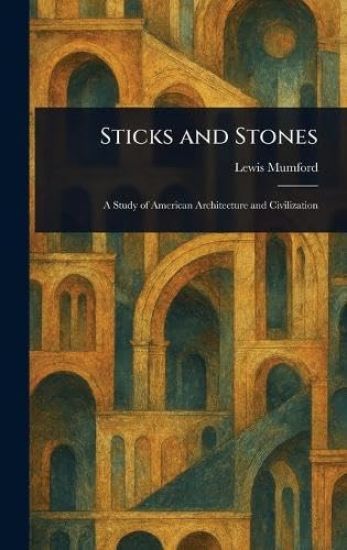
Sticks and Stones: A Study of American Architecture and Civilization, a classical book, has been considered important throughout the human history, and so that this work is never forgotten we at Alpha Editions have made efforts in its preservation by republishing this book in a modern format for present and future generations. This whole book has been reformatted, retyped and designed. These books are not made of scanned copies of their original work and hence the text is clear and readable.
Originally published in 1957, this volume compares the 20th Century transformation of human life to the revolution which swept early man into the first civilized communities. It shows how each radical new stage of human development grew out of changes in human personality and consciousness, such as the invention of language and symbols, the origins of universal religions and the mechanization of everyday life. Despite the threat that the author foresees from an over-reliance on automation, the book maintains that humanity still has the means, spiritual, personal and technological to create a sustainable future for itself, by increasing the usefulness and freedom of all men.
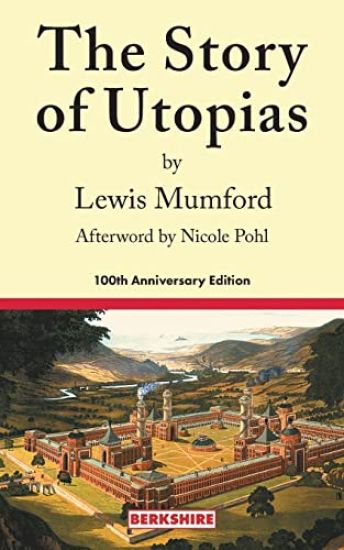
The Story of Utopias
Lewis Mumford; Nicole Pohl; Karen Christensen
Berkshire Publishing Group
2022
pokkari
This survey of utopias, which spans from Plato to the twentieth century, was Lewis Mumford's first success. He was particularly interested in what he calls utopias of reconstruction, models for reshaping an imperfect world. Beginning with a survey of famous utopian ideas and writings, he moves from Plato's Republic, More's Utopia, Andre 's Christianopolis, Bacon's New Atlantis, Campanella's City of the Sun, Fourier's phalanxes, Cabet's Icaria, Bellamy's Looking Backward, Morris's News from Nowhere, and finally on to H. G. Wells's utopian fiction. He then produces the essence of a checklist for assessing how closely a society comes to utopian ideals, looking at work and standards of living, housing, democratic (or not) governance, sex and marriage, the raising of children, our relationship with nature, and the importance of the arts and creativity. A century later, the book stands not only as an introduction to the work of a maverick scholar who had worldwide influence, but also suggests ways to approach a future even more challenging than that faced by Mumford's post-war generation. Mumford delves into issues that remain relevant today: social equity in his chapter on the country house, for example, and the relationship between science and the arts in his concluding chapter about how we can find, or build, utopia. Mumford was thinking, as many of us are, about the practical lessons offered by imagined utopias. He posits that there are utopias of escape and utopias of "reconstruction," and was particularly interested in these utopias of reconstruction, models for reshaping an imperfect world: The utopia of reconstruction is what its name implies: a vision of a reconstituted environment which is better adapted to the nature and aims of the human beings who dwell within it than the actual one; and not merely better adapted to their actual nature, but better fitted to their possible developments. If the first utopia of escape] leads backward into the utopian's ego, the second leads outward-outward into the world. In contrast with The Waste Land by T. S. Eliot, also published in 1922 by Boni & Liveright and republished by Berkshire Publishing Group in 2022, The Story of Utopias is largely about this idea of reconstruction, rather than the disillusion that Eliot's poem so powerfully captures.
Originally published in 1957, this volume compares the 20th Century transformation of human life to the revolution which swept early man into the first civilized communities. It shows how each radical new stage of human development grew out of changes in human personality and consciousness, such as the invention of language and symbols, the origins of universal religions and the mechanization of everyday life. Despite the threat that the author foresees from an over-reliance on automation, the book maintains that humanity still has the means, spiritual, personal and technological to create a sustainable future for itself, by increasing the usefulness and freedom of all men.
Sticks and Stones: A Study of American Architecture and Civilization
Lewis Mumford
Literary Licensing, LLC
2012
nidottu
Sticks and Stones: A Study of American Architecture and Civilization
Lewis Mumford
Literary Licensing, LLC
2012
sidottu
Planned Society: Yesterday, Today, Tomorrow
Findlay MacKenzie; Lewis Mumford
Literary Licensing, LLC
2012
sidottu
""Planned Society: Yesterday, Today, Tomorrow"" is a book written by Findlay MacKenzie that explores the concept of planned societies throughout history and their potential for the future. The book takes a critical look at past attempts at planned societies, such as communism and fascism, and examines their successes and failures. It also analyzes current planned societies, such as those found in Scandinavian countries, and discusses their effectiveness in achieving social and economic equality. The book delves into the various factors that contribute to the success or failure of planned societies, including government structure, economic policies, and cultural attitudes. It also considers the role of technology and innovation in shaping the future of planned societies. Overall, ""Planned Society: Yesterday, Today, Tomorrow"" provides a comprehensive analysis of planned societies and their potential for creating a more equitable and just society. It is a thought-provoking read for anyone interested in politics, economics, and social justice. Contributing Authors Include Margaret Mead, Sterling Tracy, Bernard W. Dempsey, And Others. A Symposium By Thirty-Five Economists, Sociologists, And Statesmen. This scarce antiquarian book is a facsimile reprint of the old original and may contain some imperfections such as library marks and notations. Because we believe this work is culturally important, we have made it available as part of our commitment for protecting, preserving, and promoting the world's literature in affordable, high quality, modern editions, that are true to their original work.
Planned Society: Yesterday, Today, Tomorrow
Findlay MacKenzie; Lewis Mumford
Literary Licensing, LLC
2012
nidottu