Kirjojen hintavertailu – 12 903 724 kirjaa ja 27 kauppaa

Kirjailija

Liesbet Van der Perre

Kirjat ja teokset yhdessä paikassa: 8 kirjaa, julkaisuja vuosilta 2001–2013, suosituimpiin kuuluu Green Software Defined Radios. Vertaile teosten hintoja ja tarkista saatavuus suomalaisista kirjakaupoista.

8 kirjaa

Kirjojen julkaisuvuodet: 2001–2013.

Software Defined Radios

Software Defined Radios

Sofie Pollin; Michael Timmers; Liesbet Van der Perre

Springer
2013
nidottu
Many and ever more mobile users wish to enjoy a variety of multimedia services, in very diverse geographical environments. The growing number of communication options within and across wireless standards is accommodating the growing volume and heterogeneity in wireless wishes. On the other hand, advancement in radio technologies opening much more flexibility, a.o. through Software Defined Radios, opens up the possibility to realize mobile devices featuring multi-mode options at low cost and interesting form factors. It is crucial to manage the new degrees of freedom opened up in radios and standards in a smart way, such that the required service is offered at satisfactory quality as efficiently as possible. Efficiency in energy consumption is clearly primordial for battery powered mobile terminals specifically, and in the context of growing ecological concerns in a broader context. Moreover, efficient usage of the spectrum is a growing prerequisite for wireless systems, and coexistence of different standards puts overall throughput at risk. The management of flexibility risks bringing about intolerable complexity and hamper the desired agility. A systematic approach, consisting of anticipative preparing for smooth operation, allows mastering this challenge. Case studies show that already today, this approach enables smart operation of radios realizing impressive efficiency gains without hampering Quality-of-Service. In the future wireless communication scenes will be able to profit form the opening of the spectrum. Even smarter and cognitive behavior will become possible and essential.
Space Division Multiple Access for Wireless Local Area Networks

Space Division Multiple Access for Wireless Local Area Networks

Patrick Vandenameele; Liesbet Van Der Perre; Marc Engels

Springer-Verlag New York Inc.
2013
nidottu
Wireless Local Area Networks (WLANs) are experiencing a growing importance recently. Whereas WLANs were primarily used for niche applications in the past, they are now deployed as wireless extensions to computer networks. The increase of the datarates from 2 Mbps up to 11 Mbps for roughly a constant price has played a major role in this breakthrough. As a consequence, an even greater success can be envisioned for the more recent OFDM-based WLAN standards in the 5 GHz band that offer up to 54 Mbps. At IMEC we have realized this potential already several years ago and have established a successful research program on OFDM-based WLAN. The program resulted in an operational prototype of a 5 GHz OFDM system. The longer term goals of this program are to extend the indoor range of the WLAN systems up to 100 m and to increase the capacity above 100 Mbps. Driven by these goals, Patrick embarked on the usage of multiple antenna techniques and, more in particular, Space Division Multiple Access (SDMA) for WLAN as the topic for his doctoral research. During this research, key contributions were made towards making SDMA for WLAN a reality. To name a few: A basic scheme for combining OFDM and SDMA was proposed. Also realistic non-linear detection methods were developed. These me- ods achieve a high implementation efficiency, by exploiting the p- allelism of the data model and the frequency-selectivity of the pr- agation channel.
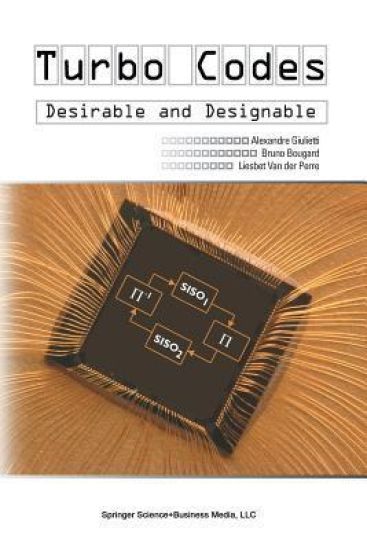
Turbo Codes

Turbo Codes

Alexandre Giulietti; Bruno Bougard; Liesbet Van Der Perre

Springer-Verlag New York Inc.
2012
nidottu
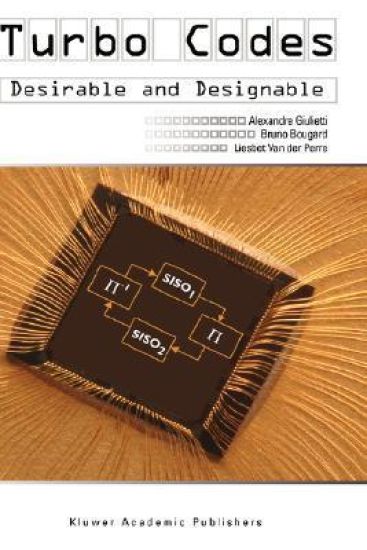
PREFACE The increasing demand on high data rate and quality of service in wireless communication has to cope with limited bandwidth and energy resources. More than 50 years ago, Shannon has paved the way to optimal usage of bandwidth and energy resources by bounding the spectral efficiency vs. signal to noise ratio trade-off. However, as any information theorist, Shannon told us what is the best we can do but not how to do it [1]. In this view, turbo codes are like a dream come true: they allow approaching the theoretical Shannon capacity limit very closely. However, for the designer who wants to implement these codes, at first sight they appear to be a nightmare. We came a huge step closer in striving the theoretical limit, but see the historical axiom repeated on a different scale: we know we can achieve excellent performance with turbo codes, but not how to realize this in real devices.
Software Defined Radios

Software Defined Radios

Sofie Pollin; Michael Timmers; Liesbet Van der Perre

Springer
2011
sidottu
Many and ever more mobile users wish to enjoy a variety of multimedia services, in very diverse geographical environments. The growing number of communication options within and across wireless standards is accommodating the growing volume and heterogeneity in wireless wishes. On the other hand, advancement in radio technologies opening much more flexibility, a.o. through Software Defined Radios, opens up the possibility to realize mobile devices featuring multi-mode options at low cost and interesting form factors. It is crucial to manage the new degrees of freedom opened up in radios and standards in a smart way, such that the required service is offered at satisfactory quality as efficiently as possible. Efficiency in energy consumption is clearly primordial for battery powered mobile terminals specifically, and in the context of growing ecological concerns in a broader context. Moreover, efficient usage of the spectrum is a growing prerequisite for wireless systems, and coexistence of different standards puts overall throughput at risk. The management of flexibility risks bringing about intolerable complexity and hamper the desired agility. A systematic approach, consisting of anticipative preparing for smooth operation, allows mastering this challenge. Case studies show that already today, this approach enables smart operation of radios realizing impressive efficiency gains without hampering Quality-of-Service. In the future wireless communication scenes will be able to profit form the opening of the spectrum. Even smarter and cognitive behavior will become possible and essential.
Green Software Defined Radios

Green Software Defined Radios

Liesbet Van der Perre; Jan Craninckx; Antoine Dejonghe

Springer
2010
nidottu
Green Software De?ned Radios, the title of this book may have originated from a lackofinspiration,andthecombinationofhardwork,jetlag,anddrinkinggreentea. The message we want to convey however, is that SDRs are a promising technology for the future, providing they are designed for ef?cient usage of scarce resources: energy and spectrum. In the last years, the R&D teams focusing on wireless c- munication (around the world and at IMEC speci?cally), have realized great bre- throughs. It is our honor, building on this knowledge, to bring a comprehensive overview of the essential technologies. We are grateful that Springer is willing to publish in their collection on radio technologies, a book on green SDRs, a weird species still today, yet maybe the baseline for the day after tomorrow. Dear reader, we wish that you ?nd in the following pages, including the references, some int- esting insights, and that this book may live more or less up to your expectations (and hopefully more than less). Thisbook’sclosingstatesthatthequestforGreenSDRshasnotended,thisisjust the beginning. Concerning this book however, we are happy that today the opposite is true. We want to acknowledge our colleagues at IMEC for their great scienti?c contribution, and even more for the enjoyable cooperation.
Green Software Defined Radios

Green Software Defined Radios

Liesbet Van der Perre; Jan Craninckx; Antoine Dejonghe

Springer-Verlag New York Inc.
2008
sidottu
Green Software De?ned Radios, the title of this book may have originated from a lackofinspiration,andthecombinationofhardwork,jetlag,anddrinkinggreentea. The message we want to convey however, is that SDRs are a promising technology for the future, providing they are designed for ef?cient usage of scarce resources: energy and spectrum. In the last years, the R&D teams focusing on wireless c- munication (around the world and at IMEC speci?cally), have realized great bre- throughs. It is our honor, building on this knowledge, to bring a comprehensive overview of the essential technologies. We are grateful that Springer is willing to publish in their collection on radio technologies, a book on green SDRs, a weird species still today, yet maybe the baseline for the day after tomorrow. Dear reader, we wish that you ?nd in the following pages, including the references, some int- esting insights, and that this book may live more or less up to your expectations (and hopefully more than less). Thisbook’sclosingstatesthatthequestforGreenSDRshasnotended,thisisjust the beginning. Concerning this book however, we are happy that today the opposite is true. We want to acknowledge our colleagues at IMEC for their great scienti?c contribution, and even more for the enjoyable cooperation.
Turbo Codes

Turbo Codes

Alexandre Giulietti; Bruno Bougard; Liesbet Van Der Perre

Springer-Verlag New York Inc.
2003
sidottu
PREFACE The increasing demand on high data rate and quality of service in wireless communication has to cope with limited bandwidth and energy resources. More than 50 years ago, Shannon has paved the way to optimal usage of bandwidth and energy resources by bounding the spectral efficiency vs. signal to noise ratio trade-off. However, as any information theorist, Shannon told us what is the best we can do but not how to do it [1]. In this view, turbo codes are like a dream come true: they allow approaching the theoretical Shannon capacity limit very closely. However, for the designer who wants to implement these codes, at first sight they appear to be a nightmare. We came a huge step closer in striving the theoretical limit, but see the historical axiom repeated on a different scale: we know we can achieve excellent performance with turbo codes, but not how to realize this in real devices.
Space Division Multiple Access for Wireless Local Area Networks

Space Division Multiple Access for Wireless Local Area Networks

Patrick Vandenameele; Liesbet Van Der Perre; Marc Engels

Springer
2001
sidottu
Wireless Local Area Networks (WLANs) are experiencing a growing importance recently. Whereas WLANs were primarily used for niche applications in the past, they are now deployed as wireless extensions to computer networks. The increase of the datarates from 2 Mbps up to 11 Mbps for roughly a constant price has played a major role in this breakthrough. As a consequence, an even greater success can be envisioned for the more recent OFDM-based WLAN standards in the 5 GHz band that offer up to 54 Mbps. At IMEC we have realized this potential already several years ago and have established a successful research program on OFDM-based WLAN. The program resulted in an operational prototype of a 5 GHz OFDM system. The longer term goals of this program are to extend the indoor range of the WLAN systems up to 100 m and to increase the capacity above 100 Mbps. Driven by these goals, Patrick embarked on the usage of multiple antenna techniques and, more in particular, Space Division Multiple Access (SDMA) for WLAN as the topic for his doctoral research. During this research, key contributions were made towards making SDMA for WLAN a reality. To name a few: A basic scheme for combining OFDM and SDMA was proposed. Also realistic non-linear detection methods were developed. These me- ods achieve a high implementation efficiency, by exploiting the p- allelism of the data model and the frequency-selectivity of the pr- agation channel.