Kirjojen hintavertailu – 12 903 724 kirjaa ja 27 kauppaa

Kirjailija

Lijuan Wang

Kirjat ja teokset yhdessä paikassa: 5 kirjaa, julkaisuja vuosilta 2018–2024, suosituimpiin kuuluu Vision-Language Pre-Training. Vertaile teosten hintoja ja tarkista saatavuus suomalaisista kirjakaupoista.

5 kirjaa

Kirjojen julkaisuvuodet: 2018–2024.

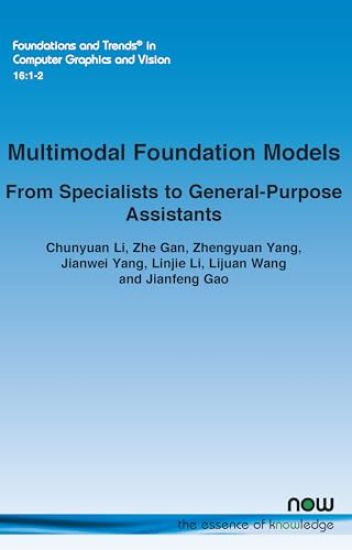
Multimodal Foundation Models

Multimodal Foundation Models

Chunyuan Li; Zhe Gan; Zhengyuan Yang; Jianwei Yang; Linjie Li; Lijuan Wang; Jianfeng Gao

Now Publishers Inc
2024
nidottu
This monograph presents a comprehensive survey of the taxonomy and evolution of multimodal foundation models that demonstrate vision and vision-language capabilities, focusing on the transition from specialist models to general-purpose assistants. The focus encompasses five core topics, categorized into two classes; (i) a survey of well-established research areas: multimodal foundation models pre-trained for specific purposes, including two topics – methods of learning vision backbones for visual understanding and text-to-image generation; (ii) recent advances in exploratory, open research areas: multimodal foundation models that aim to play the role of general-purpose assistants, including three topics – unified vision models inspired by large language models (LLMs), end-to-end training of multimodal LLMs, and chaining multimodal tools with LLMs. The target audience of the monograph is researchers, graduate students, and professionals in computer vision and vision-language multimodal communities who are eager to learn the basics and recent advances in multimodal foundation models.
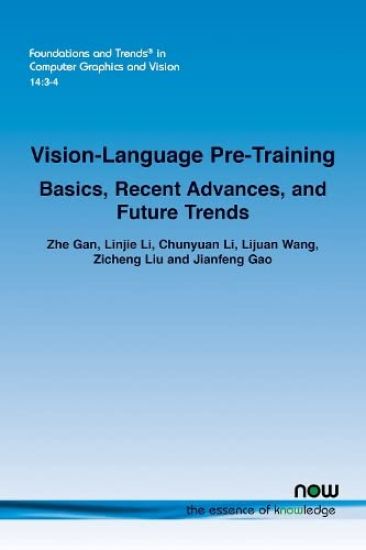
Vision-Language Pre-Training

Vision-Language Pre-Training

Zhe Gan; Linjie Li; Chunyuan Li; Lijuan Wang; Zicheng Liu; Jianfeng Gao

Now Publishers Inc
2022
nidottu
Humans perceive the world through many channels, such as images viewed by the eyes, or voices heard by the ears. Though any individual channel might be incomplete or noisy, humans can naturally align and fuse information collected from multiple channels in order to grasp the key concepts needed for a better understanding of the world. One of the core aspirations in Artificial Intelligence (AI) is to develop algorithms that endow computers with an ability to effectively learn from multimodal (or, multi-channel) data. This data is similar to sights and sounds attained from vision and language that help humans make sense of the world around us. For example, computers could mimic this ability by searching the most relevant images to a text query (or vice versa), and by describing the content of an image using natural language. Vision-and-Language (VL), a popular research area that sits at the nexus of Computer Vision and Natural Language Processing (NLP), aims to achieve this goal. This monograph surveys vision-language pre-training (VLP) methods for multimodal intelligence that have been developed in the last few years. Approaches are grouped into three categories: (i) VLP for image-text tasks, such as image captioning, image-text retrieval, visual question answering, and visual grounding; (ii) VLP for core computer vision tasks, such as (open-set) image classification, object detection, and segmentation; and (iii) VLP for video-text tasks, such as video captioning, video-text retrieval, and video question answering. For each category, a comprehensive review of state-of-the-art methods is presented, and the progress that has been made and challenges still being faced are discussed, using specific systems and models as case studies. In addition, for each category, advanced topics being actively explored in the research community are presented, such as big foundation models, unified modeling, in-context few-shot learning, knowledge, robustness, and computer vision in the wild, to name a few.
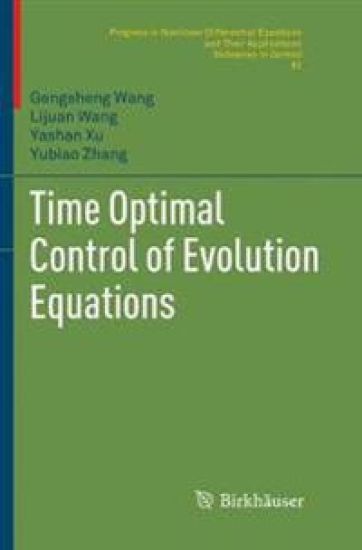
Time Optimal Control of Evolution Equations

Time Optimal Control of Evolution Equations

Gengsheng Wang; Lijuan Wang; Yashan Xu; Yubiao Zhang

Springer Nature Switzerland AG
2018
nidottu
This monograph develops a framework for time-optimal control problems, focusing on minimal and maximal time-optimal controls for linear-controlled evolution equations. Its use in optimal control provides a welcome update to Fattorini’s work on time-optimal and norm-optimal control problems. By discussing the best way of representing various control problems and equivalence among them, this systematic study gives readers the tools they need to solve practical problems in control. After introducing preliminaries in functional analysis, evolution equations, and controllability and observability estimates, the authors present their time-optimal control framework, which consists of four elements: a controlled system, a control constraint set, a starting set, and an ending set. From there, they use their framework to address areas of recent development in time-optimal control, including the existence of admissible controls and optimal controls, Pontryagin’s maximum principlefor optimal controls, the equivalence of different optimal control problems, and bang-bang properties. This monograph will appeal to researchers and graduate students in time-optimal control theory, as well as related areas of controllability and dynamic programming. For ease of reference, the text itself is self-contained on the topic of time-optimal control. Frequent examples throughout clarify the applications of theorems and definitions, although experience with functional analysis and differential equations will be useful.
Time Optimal Control of Evolution Equations

Time Optimal Control of Evolution Equations

Gengsheng Wang; Lijuan Wang; Yashan Xu; Yubiao Zhang

Birkhauser Verlag AG
2018
sidottu
This monograph develops a framework for time-optimal control problems, focusing on minimal and maximal time-optimal controls for linear-controlled evolution equations. Its use in optimal control provides a welcome update to Fattorini’s work on time-optimal and norm-optimal control problems. By discussing the best way of representing various control problems and equivalence among them, this systematic study gives readers the tools they need to solve practical problems in control. After introducing preliminaries in functional analysis, evolution equations, and controllability and observability estimates, the authors present their time-optimal control framework, which consists of four elements: a controlled system, a control constraint set, a starting set, and an ending set. From there, they use their framework to address areas of recent development in time-optimal control, including the existence of admissible controls and optimal controls, Pontryagin’s maximum principlefor optimal controls, the equivalence of different optimal control problems, and bang-bang properties. This monograph will appeal to researchers and graduate students in time-optimal control theory, as well as related areas of controllability and dynamic programming. For ease of reference, the text itself is self-contained on the topic of time-optimal control. Frequent examples throughout clarify the applications of theorems and definitions, although experience with functional analysis and differential equations will be useful.