Kirjojen hintavertailu – 12 859 819 kirjaa ja 27 kauppaa

Kirjailija

Lillian Hoddeson

Kirjat ja teokset yhdessä paikassa: 6 kirjaa, julkaisuja vuosilta 1993–2024, suosituimpiin kuuluu True Genius. Vertaile teosten hintoja ja tarkista saatavuus suomalaisista kirjakaupoista.

6 kirjaa

Kirjojen julkaisuvuodet: 1993–2024.

The Man Who Saw Tomorrow

The Man Who Saw Tomorrow

Lillian Hoddeson; Peter Garrett

MIT PRESS LTD
2024
pokkari
The first full-length biography of a brilliant, self-taught inventor whose innovations in information and energy technology continue to shape our world. The Economist called Stanford R. Ovshinsky (1922-2012) "the Edison of our age," but this apt comparison doesn't capture the full range of his achievements. As an independent, self-educated inventor, Ovshinsky not only created many important devices but also made fundamental discoveries in materials science. This book offers the first full-length biography of a visionary whose energy and information innovations continue to fuel our post-industrial economy. In The Man Who Saw Tomorrow, Lillian Hoddeson and Peter Garrett tell the story of an unconventional genius with no formal education beyond high school who invented, among other things, the rechargeable nickel metal hydride batteries that have powered everything from portable electronics to hybrid cars, a system for mass-producing affordable thin-film solar panels, and rewritable CDs and DVDs. His most important discovery, the Ovshinsky effect, led to a paradigm shift in condensed matter physics and yielded phase-change memory, which is now enabling new advances in microelectronics. A son of the working class who began as a machinist and toolmaker, Ovshinsky focused his work on finding solutions to urgent social problems, and to pursue those goals, he founded Energy Conversion Devices, a unique research and development lab. At the end of his life, battered by personal and professional losses, Ovshinsky nevertheless kept working to combat global warming by making solar energy "cheaper than coal"--another of his many visions of a better tomorrow.
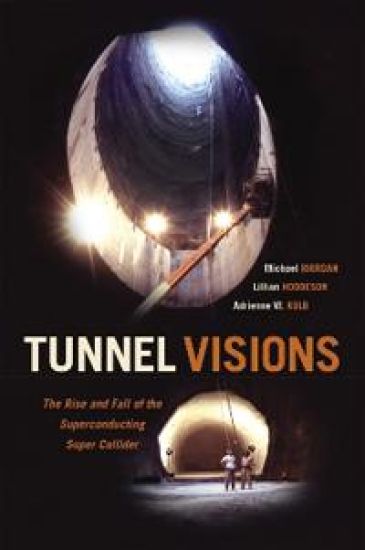
Tunnel Visions

Tunnel Visions

Michael Riordan; Lillian Hoddeson; Adrienne W. Kolb

University of Chicago Press
2018
nidottu

Halvin toimitettuna 39,30 €

Starting in the 1950s, US physicists dominated the search for elementary particles; aided by the association of this research with national security, they held this position for decades. In an effort to maintain their hegemony and track down the elusive Higgs boson, they convinced President Reagan and Congress to support construction of the multibillion-dollar Superconducting Super Collider project in Texas—the largest basic-science project ever attempted. But after the Cold War ended and the estimated SSC cost surpassed ten billion dollars, Congress terminated the project in October 1993. Drawing on extensive archival research, contemporaneous press accounts, and over one hundred interviews with scientists, engineers, government officials, and others involved, Tunnel Visions tells the riveting story of the aborted SSC project. The authors examine the complex, interrelated causes for its demise, including problems of large-project management, continuing cost overruns, and lack of foreign contributions. In doing so, they ask whether Big Science has become too large and expensive, including whether academic scientists and their government overseers can effectively manage such an enormous undertaking.
Tunnel Visions

Tunnel Visions

Michael Riordan; Lillian Hoddeson; Adrienne W. Kolb

University of Chicago Press
2015
sidottu
Starting in the 1950s, US physicists dominated the search for elementary particles; aided by the association of this research with national security, they held this position for decades. In an effort to maintain their hegemony and track down the elusive Higgs boson, they convinced President Reagan and Congress to support construction of the multibillion-dollar Superconducting Super Collider project in Texas-the largest basic-science project ever attempted. But after the Cold War ended and the estimated SSC cost surpassed ten billion dollars, Congress terminated the project in October 1993. Drawing on extensive archival research, contemporaneous press accounts, and over one hundred interviews with scientists, engineers, government officials, and others involved, Tunnel Visions tells the riveting story of the aborted SSC project. The authors examine the complex, interrelated causes for its demise, including problems of large-project management, continuing cost overruns, and lack of foreign contributions. In doing so, they ask whether Big Science has become too large and expensive, including whether academic scientists and their government overseers can effectively manage such an enormous undertaking.
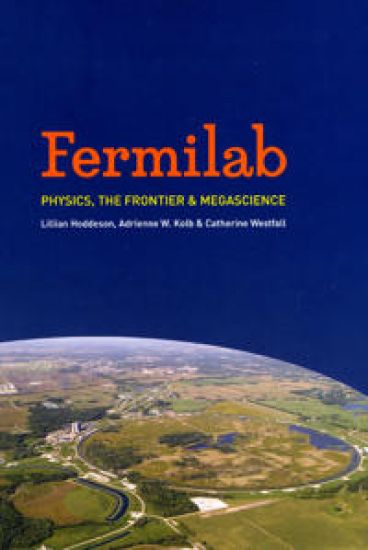
Fermilab

Fermilab

Lillian Hoddeson; Adrienne W. Kolb; Catherine Westfall

University of Chicago Press
2011
nidottu
Fermi National Accelerator Laboratory, located in the western suburbs of Chicago, has stood at the frontier of high-energy physics for forty years. "Fermilab" is the first history of this laboratory and of its powerful accelerators told from the point of view of the people who built and used them for scientific discovery. Focusing on the first two decades of research at Fermilab, during the tenure of the laboratory's charismatic first two directors, Robert R. Wilson and Leon M. Lederman, the authors trace the rise of what they call "megascience," the collaborative struggle to conduct large-scale international experiments in a climate of limited federal funding. In the midst of this new climate, "Fermilab" illuminates the growth of the modern research laboratory during the Cold War and captures the drama of human exploration at the cutting edge of science.
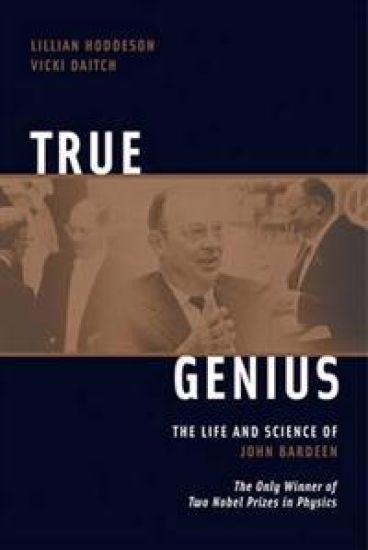
True Genius

True Genius

Vicki Daitch; Lillian Hoddeson

Henry (Joseph) Press
2002
nidottu
What is genius? Define it. Now think of scientists who embody the concept of genius. Does the name John Bardeen spring to mind? Indeed, have you ever heard of him? Like so much in modern life, immediate name recognition often rests on a cult of personality. We know Einstein, for example, not just for his tremendous contributions to science, but also because he was a character, who loved to mug for the camera. And our continuing fascination with Richard Feynman is not exclusively based on his body of work; it is in large measure tied to his flamboyant nature and offbeat sense of humor. These men, and their outsize personalities, have come to erroneously symbolize the true nature of genius and creativity. We picture them born brilliant, instantly larger than life. But is that an accurate picture of genius? What of others who are equal in stature to these icons of science, but whom history has awarded only a nod because they did not readily engage the public? Could a person qualify as a bona fide genius if he was a regular Joe? The answer may rest in the story of John Bardeen. John Bardeen was the first person to have been awarded two Nobel Prizes in the same field. He shared one with William Shockley and Walter Brattain for the invention of the transistor. But it was the charismatic Shockley who garnered all the attention, primarily for his Hollywood ways and notorious views on race and intelligence. Bardeen's second Nobel Prize was awarded for the development of a theory of superconductivity, a feat that had eluded the best efforts of leading theorists—including Albert Einstein, Neils Bohr, Werner Heisenberg, and Richard Feynman. Arguably, Bardeen's work changed the world in more ways than that of any other scientific genius of his time. Yet while every school child knows of Einstein, few people have heard of John Bardeen. Why is this the case? Perhaps because Bardeen differs radically from the popular stereotype of genius. He was a modest, mumbling Midwesterner, an ordinary person who worked hard and had a knack for physics and mathematics. He liked to picnic with his family, collaborate quietly with colleagues, or play a round of golf. None of that was newsworthy, so the media, and consequently the public, ignored him. John Bardeen simply fits a new profile of genius. Through an exploration of his science as well as his life, a fresh and thoroughly engaging portrait of genius and the nature of creativity emerges. This perspective will have readers looking anew at what it truly means to be a genius. Table of Contents Front Matter 1 The Question of Genius 2 Roots 3 To Be an Engineer 4 A Graduate Student's Paradise 5 Many-Body Beginnings 6 Academic Life 7 Engineering for National Defense 8 The Transistor 9 The Break from Bell 10 Homecoming 11 Cracking the Riddle of Superconductivity 12 Two Nobels Are Better Than One Hole in One 13 A Hand in Industry 14 Citizen of Science 15 Pins and Needles and Waves 16 Last Journey 17 Epilogue: True Genius and How to Cultivate It Bibliography Acknowledgments Notes Index
Critical Assembly

Critical Assembly

Lillian Hoddeson; Paul W. Henriksen; Roger A. Meade; Catherine L. Westfall

Cambridge University Press
1993
sidottu
This volume is a lucid and accurate history of the technical research that led to the first atomic bombs. The authors explore how the ‘critical assembly’ of scientists, engineers and military personnel at Los Alamos, responding to wartime deadlines, collaborated to create a new approach to large-scale research. The book opens with an introduction laying out major themes. After a synopsis of the prehistory of the bomb project, from the discovery of nuclear fission to the start of the Manhattan Engineer District, and an overview of the early materials programme, the book examines the establishment of the Los Alamos Laboratory, the implosion and gun assembly programmes, nuclear physics research, chemistry and metallurgy, explosives, uranium and plutonium development, confirmation of spontaneous fission in pile-produced plutonium, the thermonuclear bomb, critical assemblies, the Trinity test, and delivery of the combat weapons. Readers interested in history of science will find this volume a crucial resource for understanding the underpinnings of contemporary science and technology. It is the third book in a trilogy consisting of The Birth of Particle Physics (1986) and Pions to Quarks (1989).