Kirjojen hintavertailu – 12 859 826 kirjaa ja 27 kauppaa

Kirjailija

Lily Hamourtziadou

Kirjat ja teokset yhdessä paikassa: 5 kirjaa, julkaisuja vuosilta 2020–2026, suosituimpiin kuuluu Human Costs of War. Vertaile teosten hintoja ja tarkista saatavuus suomalaisista kirjakaupoista.

5 kirjaa

Kirjojen julkaisuvuodet: 2020–2026.

Human Costs of War

Human Costs of War

Bulent Gokay; Lily Hamourtziadou

TAYLOR FRANCIS LTD
2026
nidottu
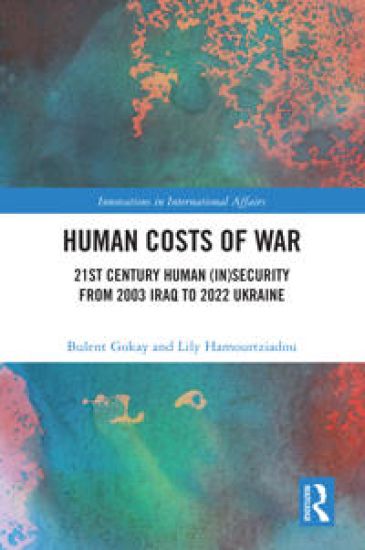
Human Costs of Wardocuments and analyses the direct and indirect toll that war takes on civilians and their livelihoods, taking a human security approach exploring personal, economic, political and community security in Afghanistan, Iraq and Ukraine, in the contexts of the War on Terror and the New Cold War. The book offers an understanding of war through the recording and comprehension of its civilian casualties and evaluates whether the force used has been proportionate to the threat that prompted it and the concern for human welfare. In the 21st century, the power of the USA has declined, while countries such as China and India become more powerful. The global power balance has been altered in a fundamental way towards a multi-polar world system, with the West no longer able to enforce its policies abroad. Regional and global governance are not assured, and devastating wars have taken a heavy toll in terms of death, poverty and displacement, which feed into the cycle of long-term insecurity. The authors argue that it is important for any conflict to be understood not only in terms of the perpetrators of violence, or of the political and economic reasons behind it, but also in terms of its impact on the civilian population and their security, focusing on conflicts in the Middle East which followed 9/11 and Russia’s invasion of Ukraine. The book will be of interest to academics, the public, the media, security agencies and international organisations. It will be useful for undergraduate and postgraduate students of International Relations, International Law, Security, Politics, Policing, Human Rights, Ethics, Peace Studies, Eastern Europe, American Studies and the Middle East.

The Ethics of Remote Warfare

The Ethics of Remote Warfare

Lily Hamourtziadou

UNIVERSITY OF WALES PRESS
2024
sidottu
Ethical approaches to war require that we don’t value only the lives of ‘our’ people, as Realism asserts; that we don’t enforce our sense of justice with weapons, as Militarism demands our ‘moral warriors’ do; that force is used only in self-defence, based on the principles of Just War Theory. However, can there be purely defensive or moral wars? This book offers unique insights into twenty-first century warfare through three approaches – Realism, Militarism, and Just war Theory – in the context of ‘precision’ weapons, celebrated for minimising risks to soldiers and civilians. The author questions whether the rapidly developing technology of lethal autonomous weapons is actually expanding an existing legal-ethical issue: the problem of civilian harm. Laws permits acts that cause incidental civilian harm; AI warfare puts the law’s accountability gap into sharper relief, highlighting the need for new accountability mechanisms that reflect a sense of legal and moral justice.
Human Costs of War

Human Costs of War

Bulent Gokay; Lily Hamourtziadou

TAYLOR FRANCIS LTD
2024
sidottu
Human Costs of War documents and analyses the direct and indirect toll that war takes on civilians and their livelihoods, taking a human security approach exploring personal, economic, political and community security in Afghanistan, Iraq and Ukraine, in the contexts of the War on Terror and the New Cold War. The book offers an understanding of war through the recording and comprehension of its civilian casualties and evaluates whether the force used has been proportionate to the threat that prompted it and the concern for human welfare. In the 21st century, the power of the USA has declined, while countries such as China and India become more powerful. The global power balance has been altered in a fundamental way towards a multi-polar world system, with the West no longer able to enforce its policies abroad. Regional and global governance are not assured, and devastating wars have taken a heavy toll in terms of death, poverty and displacement, which feed into the cycle of long-term insecurity. The authors argue that it is important for any conflict to be understood not only in terms of the perpetrators of violence, or of the political and economic reasons behind it, but also in terms of its impact on the civilian population and their security, focusing on conflicts in the Middle East which followed 9/11 and Russia’s invasion of Ukraine. The book will be of interest to academics, the public, the media, security agencies and international organisations. It will be useful for undergraduate and postgraduate students of International Relations, International Law, Security, Politics, Policing, Human Rights, Ethics, Peace Studies, Eastern Europe, American Studies and the Middle East.
Body Count

Body Count

Lily Hamourtziadou

Bristol University Press
2020
nidottu
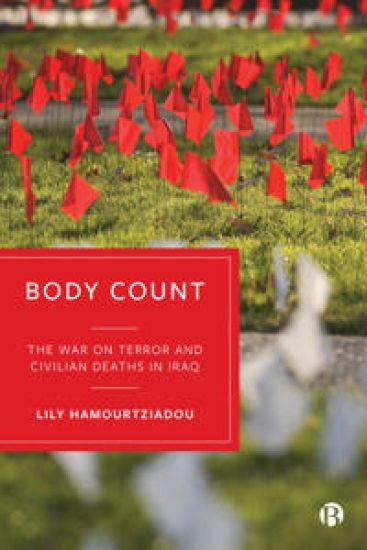
Lily Hamourtziadou’s investigation into civilian victims during the conflicts that followed the US-led coalition’s 2003 invasion of Iraq provides important new perspectives on the human cost of the War on Terror. From early fighting to the withdrawal and return of coalition troops, the Arab Spring and the rise of ISIS, the book explores the scale and causes of deaths and places them in the contexts of power struggles, US foreign policy and radicalisation. Casting fresh light on not just the conflict but international geopolitics and the history of Iraq, it constructs a unique and insightful human security approach to war.
Body Count

Body Count

Lily Hamourtziadou

Bristol University Press
2020
sidottu
Lily Hamourtziadou’s investigation into civilian victims during the conflicts that followed the US-led coalition’s 2003 invasion of Iraq provides important new perspectives on the human cost of the War on Terror. From early fighting to the withdrawal and return of coalition troops, the Arab Spring and the rise of ISIS, the book explores the scale and causes of deaths and places them in the contexts of power struggles, US foreign policy and radicalisation. Casting fresh light on not just the conflict but international geopolitics and the history of Iraq, it constructs a unique and insightful human security approach to war.