Kirjojen hintavertailu – 12 859 827 kirjaa ja 27 kauppaa

Kirjailija

LilyAnn Novak Frazer

Kirjat ja teokset yhdessä paikassa: 3 kirjaa, julkaisuja vuosilta 2002–2017, suosituimpiin kuuluu Essential Fungal Genetics. Vertaile teosten hintoja ja tarkista saatavuus suomalaisista kirjakaupoista.

3 kirjaa

Kirjojen julkaisuvuodet: 2002–2017.

Fungiflex: the untold story

Fungiflex: the untold story

Lilyann Novak Frazer; David Moore

Createspace Independent Publishing Platform
2017
nidottu
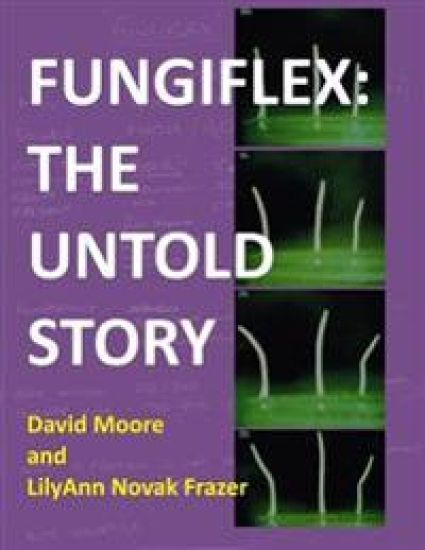
In the latter half of the 1990s, and into the first couple of years of the new millennium, we carried out some ground-breaking research into communication within mushroom fruit bodies by chemical signals. Because we were hoping to commercialise the research, the work was never published beyond initial patent applications, which have since lapsed. We believed at the time that we had accessed at least some of the controls of fungal morphogenesis by extracting compounds which caused mushroom stipes to bend at the point of application within hours of treatment. Using standardised bioassays, we made a start on purifying and chemically characterising the extracted substances. We worked with two components which had recognisably different activities in the bioassay. These we called Fungiflex 1 and Fungiflex 2. Our extracts caused (vertical) mushroom stipes to bend towards a drop of the extract within 1 hour of its application to the side of the stipe. This localised growth inhibition was Fungiflex 1 activity. Such stipes grew back to the vertical in about 9 hours, but then started bending in the opposite direction at the point of application of the drop. By 18 hours the stipe had bent to an angle of 90 from the vertical. This localised growth promotion was Fungiflex 2 activity. We got close to understanding the structure of these first fungal hormonal compounds but were unable to secure sufficient funding to take the research any further. Nonetheless, the scientific knowledge we revealed is still important and worthy of publication. Our research has not lost its uniqueness, nor has it been duplicated up to now. In this publication, we report in full the research we accomplished nearly 20 years ago in the hope that it might stimulate future work in the topic and prompt further advances. You could pick up the research where we left off. You could make yourself a fortune And if you do, please remember where you got the idea
Essential Fungal Genetics

Essential Fungal Genetics

David Moore; LilyAnn Novak Frazer

Springer-Verlag New York Inc.
2010
nidottu
Most genetics textbooks deal adequately with plant and animal genetics, but tend to neglect fungi except for two areas. Firstly, the ascus segregations which, in the 1960s, contributed so much to developing an understanding of the mechanism of recombination and secondly, the contribution that work on yeast (as a model eukaryote) is currently making to understanding cell cycle control and its genetic regulation. Consequently, most introductory genetics texts will leave the reader/student with the impression that fungi are of use when peculiarities of their structure or life style suit them to particular experimental approaches, but are not worth mentioning otherwise. The authors have produced a book that will compensate for this imbalance. This book discusses the genetics of fungi, or mycology, in a way that is attractive and challenging, succinct yet comprehensive, sensitive to commercial and applied aspects, yet also theoretical, dealing with their genetics from molecules to individuals to population. This short text will be an ideal supplement to the established basic textbooks in genetics or can be used as the sole text for an advanced course devoted to fungal genetics.
Essential Fungal Genetics

Essential Fungal Genetics

David Moore; LilyAnn Novak Frazer

Springer-Verlag New York Inc.
2002
sidottu
Most genetics textbooks deal adequately with plant and animal genetics, but tend to neglect fungi except for two areas. Firstly, the ascus segregations which, in the 1960s, contributed so much to developing an understanding of the mechanism of recombination and secondly, the contribution that work on yeast (as a model eukaryote) is currently making to understanding cell cycle control and its genetic regulation. Consequently, most introductory genetics texts will leave the reader/student with the impression that fungi are of use when peculiarities of their structure or life style suit them to particular experimental approaches, but are not worth mentioning otherwise. The authors have produced a book that will compensate for this imbalance. This book discusses the genetics of fungi, or mycology, in a way that is attractive and challenging, succinct yet comprehensive, sensitive to commercial and applied aspects, yet also theoretical, dealing with their genetics from molecules to individuals to population. This short text will be an ideal supplement to the established basic textbooks in genetics or can be used as the sole text for an advanced course devoted to fungal genetics.