
Kirjojen hintavertailu – 12 903 725 kirjaa ja 27 kauppaa

Kirjailija

Linda M. Lobao

Kirjat ja teokset yhdessä paikassa: 2 kirjaa, julkaisuja vuosilta 1990–2025, suosituimpiin kuuluu Rethinking Spatial Inequality. Vertaile teosten hintoja ja tarkista saatavuus suomalaisista kirjakaupoista.

2 kirjaa

Kirjojen julkaisuvuodet: 1990–2025.

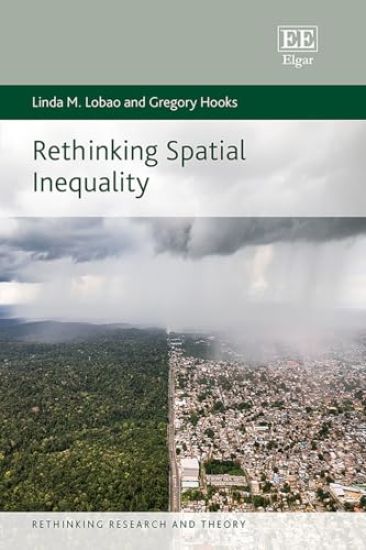
Rethinking Spatial Inequality

Rethinking Spatial Inequality

Linda M. Lobao; Gregory Hooks

EDWARD ELGAR PUBLISHING LTD
2025
sidottu

Halvin toimitettuna 160,10 €

This illuminating book offers a new perspective on social science inquiry into the spatial dimensions of societal well-being; addressing the key question of who gets what, and where. Leading scholars Linda M. Lobao and Gregory Hooks adopt an organizing framework that speaks to the concept of spatial inequality, how it forms a lens on societal disparities, and how it gives rise to work with underlying commonalities across different social science disciplines. With this scaffolding, the authors consider spatial inequality across spatial scales, places, and populations, including the subnational scale, so often missing in inequality research. Illustrative cases center on poverty, public service provision and austerity policies, environmental justice, and war and conflict. The book concludes by advancing an integrative social science agenda to guide future emancipatory research on inequality. Rethinking Spatial Inequality is a vital resource for students and scholars of inequality across the social sciences including sociology, human geography, development, regional, urban, and rural studies, demography, and political science. Policymakers and practitioners in public service provision will also benefit from this perceptive book.

Locality and Inequality

Locality and Inequality

Linda M. Lobao

State University of New York Press
1990
pokkari
This book explores how the recent restructuring of farming and industry has affected economic and social equality in the United States. The author explains how the farm sector has undergone a dramatic restructuring with profound effects. Moderate-size family farms, the mainstay of American agriculture, have declined during the postwar period and are now under severe financial stress. Large-scale industrialized farms - "the factories in the field," often run by corporations - continue to expand their share of agricultural sales while small farms operated on a part-time basis appear to be replacing traditional family farming. Lobao shows that public concern about farm restructuring is indeed warranted and that the nation now appears to be losing its most beneficial farms as well as industries. While local and regional social and economic forces and state policy can be brought to bear on these trends, Lobao particulary focuses on how community empowerment and broad-based political coalitions offer the most promise for fundamental change.