Kirjojen hintavertailu – 12 859 824 kirjaa ja 27 kauppaa

Kirjailija

Lindsay Paterson

Kirjat ja teokset yhdessä paikassa: 16 kirjaa, julkaisuja vuosilta 1994–2026, suosituimpiin kuuluu Lessons from Scottish Schools. Vertaile teosten hintoja ja tarkista saatavuus suomalaisista kirjakaupoista.

16 kirjaa

Kirjojen julkaisuvuodet: 1994–2026.

Lessons from Scottish Schools

Lessons from Scottish Schools

Lindsay Paterson

EDINBURGH UNIVERSITY PRESS
2026
nidottu
This book highlights the role of knowledge in school education. It shows that while the Scottish education system used to be among the strongest in Europe, its students’ attainment has dropped in recent years. The book argues that the clue to this decline is the new curriculum which has been in place for two decades. Lindsay Paterson notes the commendable aims of this approach, which includes working across subject boundaries, application of learning to real-world problems and focusing on creativity and citizenship. Studying Scotland’s strong educational reputation in the past and comparing it to other countries, such as Estonia, Singapore, Ireland and Japan, Paterson argues that the most student-centred education is one that is based on knowledge. This is key to students’ understanding, to their personal fulfilment, to their successful careers, and to their ability to make a worthwhile contribution to society.
Lessons from Scottish Schools

Lessons from Scottish Schools

Lindsay Paterson

EDINBURGH UNIVERSITY PRESS
2026
sidottu
This book highlights the role of knowledge in school education. It shows that while the Scottish education system used to be among the strongest in Europe, its students’ attainment has dropped in recent years. The book argues that the clue to this decline is the new curriculum which has been in place for two decades. Lindsay Paterson notes the commendable aims of this approach, which includes working across subject boundaries, application of learning to real-world problems and focusing on creativity and citizenship. Studying Scotland’s strong educational reputation in the past and comparing it to other countries, such as Estonia, Singapore, Ireland and Japan, Paterson argues that the most student-centred education is one that is based on knowledge. This is key to students’ understanding, to their personal fulfilment, to their successful careers, and to their ability to make a worthwhile contribution to society.
Scottish Education and Society since 1945

Scottish Education and Society since 1945

Lindsay Paterson

EDINBURGH UNIVERSITY PRESS
2025
nidottu
Scotland developed a series of educational surveys between the late-1940s and the early-21st century that allow the country's experience of education to be studied in systematic detail. No other country has an archive of this length and depth. The surveys include evidence on pupils' curriculum, attainment, subjective experience of school, and destinations after leaving school, as well as details of their social characteristics and of the secondary schools which they attended. By linking also to archival evidence on the histories of schools, the book's analysis investigates the interplay between deliberate policy and wider social change. The transformation of education in this period is accompanied by equally important economic restructuring which has led to unprecedented changes in the way that education relates to lifelong opportunity in the twenty-first century. The book investigates how these changes have underpinned Scotland's civic values, and have contributed fundamentally to shaping the debate about the country's constitutional future.

Scottish Education and Society Since 1945

Scottish Education and Society Since 1945

Lindsay Paterson

EDINBURGH UNIVERSITY PRESS
2023
sidottu
Uses a unique series of social surveys to study education and social change in Scotland Presents Scotland's internationally unique series of surveys of school students, from the late 1940s to the new century, with no parallel internationally in its longevity, range of topic, and depth Uses Scotland as a case study as it experienced all the major educational changes of the developed world in the second half of the 20th century Draws comparison to domestic education reform in England and Wales Draws comparison internationally with the rest of Europe and north America, and especially with France, the Netherlands and Ireland The social basis of these changes is systematically investigated: who benefited, who did not, did these divides narrow or widen, and what are the consequences for opportunity and civic values? The debate about Scottish independence has been transformed by this growth of education, especially among young people born since the 1960s who have been the main beneficiaries of educational expansion. Scotland developed a series of educational surveys between the late-1940s and the early-21st century that allow the country's experience of education to be studied in systematic detail. No other country has an archive of this length and depth. The surveys include evidence on pupils' curriculum, attainment, subjective experience of school, and destinations after leaving school, as well as details of their social characteristics and of the secondary schools which they attended. By linking also to archival evidence on the histories of schools, the book's analysis investigates the interplay between deliberate policy and wider social change. The transformation of education in this period is accompanied by equally important economic restructuring which has led to unprecedented changes in the way that education relates to lifelong opportunity in the twenty-first century. The book investigates how these changes have underpinned Scotland's civic values, and have contributed fundamentally to shaping the debate about the country's constitutional future.

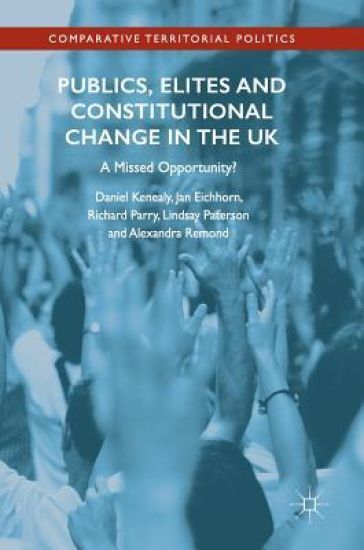
Publics, Elites and Constitutional Change in the UK

Publics, Elites and Constitutional Change in the UK

Daniel Kenealy; Jan Eichhorn; Richard Parry; Lindsay Paterson; Alexandra Remond

Springer International Publishing AG
2018
nidottu
This book explores the governance of the UK, and the process of constitutional change, between Scotland’s independence referendum in September 2014 and the UK general election in May 2015. The book contrasts the attitudes of the public, captured through an original survey, with those of politicians, civil servants, and civic leaders, identified through over forty interviews. It pays particular attention to two case studies involving recent changes to the UK’s governing arrangements: the Smith Commission and the transfer of further powers to the Scottish Parliament, and Greater Manchester’s devolution deal that has become a model for devolution across England. It also considers the issue of lowering the voting age to 16, contrasting the political attitudes of younger voters in Scotland with those in the rest of the UK. The book will be of interest to students and scholars of UK politics, devolution, constitutional change, public attitudes, and territorial politics.
Publics, Elites and Constitutional Change in the UK

Publics, Elites and Constitutional Change in the UK

Daniel Kenealy; Jan Eichhorn; Richard Parry; Lindsay Paterson; Alexandra Remond

Springer International Publishing AG
2017
sidottu
This book explores the governance of the UK, and the process of constitutional change, between Scotland’s independence referendum in September 2014 and the UK general election in May 2015. The book contrasts the attitudes of the public, captured through an original survey, with those of politicians, civil servants, and civic leaders, identified through over forty interviews. It pays particular attention to two case studies involving recent changes to the UK’s governing arrangements: the Smith Commission and the transfer of further powers to the Scottish Parliament, and Greater Manchester’s devolution deal that has become a model for devolution across England. It also considers the issue of lowering the voting age to 16, contrasting the political attitudes of younger voters in Scotland with those in the rest of the UK. The book will be of interest to students and scholars of UK politics, devolution, constitutional change, public attitudes, and territorial politics.
Social Radicalism and Liberal Education

Social Radicalism and Liberal Education

Lindsay Paterson

Imprint Academic
2015
pokkari
Liberal education used to command wide political support. Radicals disagreed with conservatives on whether the best culture could be appreciated by everyone, and they disagreed, too, on whether the barriers to understanding it were mainly social and economic, but there was no dispute that any worthwhile education ought to hand on the best that has been thought and said. That consensus has vanished since the 1960s. The book examines why social radicals supported liberal education, why they have moved away from it, and what the implications are for the future of an intellectually stimulating and culturally literate education.
Social Radicalism and Liberal Education

Social Radicalism and Liberal Education

Lindsay Paterson

Imprint Academic
2015
sidottu
Liberal education used to command wide political support. Radicals disagreed with conservatives on whether the best culture could be appreciated by everyone, and they disagreed, too, on whether the barriers to understanding it were mainly social and economic, but there was no dispute that any worthwhile education ought to hand on the best that has been thought and said. That consensus has vanished since the 1960s. The book examines why social radicals supported liberal education, why they have moved away from it, and what the implications are for the future of an intellectually stimulating and culturally literate education.
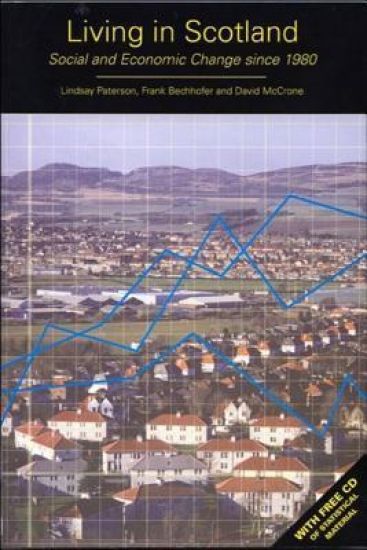
Living in Scotland

Living in Scotland

Lindsay Paterson; Frank Bechhofer; David McCrone

Edinburgh University Press
2004
nidottu
Shortlisted for the Saltire Society/NLS Scottish Research Book of the Year Award, 2005 Living in Scotland gives an account of the key social changes in Scottish society, describing how it has been transformed over the last two to three decades. Drawing on a uniquely wide range of data from government statistics, social surveys and over-time data sources, the book tells the story of society in Scotland during the approach and arrival of the new century. The authors analyse the large-scale changes which have profoundly altered Scottish society affecting the country's demography, patterns of work and employment, the distributions of income, wealth and poverty, social class and social mobility, educational opportunities, and patterns of consumption and lifestyle. While Scotland shares many of these social trends with similar western societies, its reaction to them is shaped by its own history and culture. The authors argue that Scotland is now a more affluent, comfortable and pleasant place to live in than just two or three decades ago, but that it remains seriously divided and stratified. A significant minority of its people remain disadvantaged and relatively deprived. This represents the major political and cultural challenge for the new Scotland. Living in Scotland is written by three of the country's foremost sociologists. Together, they build a picture of a changing Scotland at the beginning of the 21st century. Key Features: * A cd-rom of all the key tables is provided with the book * Written by three of Scotland's foremost sociologists * Builds a picture of the changing society of Scotland over the second half of the twentieth century * Uses a uniquely wide range of statistical data sources which are set in context and explained in non-technical ways
Scottish Education in the Twentieth Century

Scottish Education in the Twentieth Century

Lindsay Paterson

Edinburgh University Press
2003
nidottu
Scotland's education system has been claimed by many to be one of the most successful in the world and its alleged decline in recent decades has generated a great deal of controversy. This book is the first full account of the history of twentieth-century Scottish education, by Lindsay Paterson, a leading specialist in the area. Scottish Education investigates Scotland's response to the key question faced by all mass systems of education. How can democracy be reconciled with the necessity of selection -- both selection of culture in the maintenance of excellence, and selection of people, allocating them to differentiated occupations while also preparing them for life as equal citizens in the common culture of the community? Paterson argues that the Scottish answer to this has been recurrent attempts to give wide access to common types of educational institution, but continuing to define that education in fairly traditional academic terms. This is then also Scotland's attempt to reconcile the tension between social solidarity and liberal opportunity, between the needs of the individual and the needs of society and its inherited culture. This broad-ranging and stimulating account of a century of Scottish education is organised chronologically into two broad parts: Competition and Opportunity, 1880s--1930s; and Welfare and Individualism, 1940s--1990s. Within these periods are chapters on each of the main sectors of education. Key Features: *Scottish education often claimed to be a world-leader -- the facts behind this are explored *Written by one of the most prominent commentators in the area *Topical, in light of on-going controversy surrounding the Scottish Qualifications Authority *Provides background history to the development of Scottish education through the 20th century
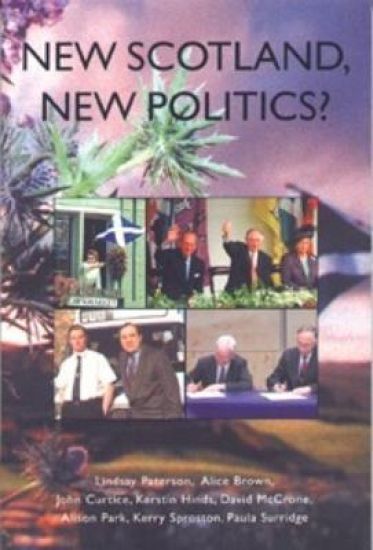
New Scotland, New Politics?

New Scotland, New Politics?

Lindsay Paterson; Alice Brown; John Curtice; Kerstin Hinds

Polygon at Edinburgh University Press
2001
nidottu
What are Scots' expectations of their new Parliament? What influenced them when they were casting their votes in the first elections? What social policies do they want the Parliament to pursue? How do they see the future of Scotland's relationship with the rest of the UK and the rest of Europe? And how does the country's new constitutional status relate to people's sense of national identity? The book analyses Scotland's first parliamentary election in May 1999, and looks to the future of Scottish politics, Scottish social attitudes and Scotland's relationship with the rest of the United Kingdom. Written by the leading authorities on Scottish politics and society, it provides a definitive account of social and political attitudes in Scotland at the beginning of the new parliamentary democracy, and at a time when Scotland's relationship with the rest of the United Kingdom is undergoing radical change.
Principles of Research Design in the Social Sciences

Principles of Research Design in the Social Sciences

Frank Bechhofer; Lindsay Paterson

Routledge
2000
sidottu
This practical introduction for first time researchers provides a bridge between how to conduct research and the philosophy of social science, allowing students to relate what they are doing to why. It does not provide a set of rigid recipes for social scientists as many methodology books do, rather it stimulates students to think about the issues involved when deciding upon their research design. By discussing standard approaches to research design and method in various social science disciplines, the authors illustrate why particular designs have traditionally predominated in certain areas of study. But whilst they acknowledge the strengths of these standard approaches, their emphasis is on helping researchers find the most effective solution to their problem by encouraging them, through this familiarity with the principles of various approaches, to innovate where appropriate. This text will prove indispensable for social science students of all levels embarking upon a research project, and for experienced researchers looking for a fresh perspective on their object of study.
Principles of Research Design in the Social Sciences

Principles of Research Design in the Social Sciences

Frank Bechhofer; Lindsay Paterson

Routledge
2000
nidottu
This practical introduction for first time researchers provides a bridge between how to conduct research and the philosophy of social science, allowing students to relate what they are doing to why. It does not provide a set of rigid recipes for social scientists as many methodology books do, rather it stimulates students to think about the issues involved when deciding upon their research design. By discussing standard approaches to research design and method in various social science disciplines, the authors illustrate why particular designs have traditionally predominated in certain areas of study. But whilst they acknowledge the strengths of these standard approaches, their emphasis is on helping researchers find the most effective solution to their problem by encouraging them, through this familiarity with the principles of various approaches, to innovate where appropriate. This text will prove indispensable for social science students of all levels embarking upon a research project, and for experienced researchers looking for a fresh perspective on their object of study.
A Diverse Assembly

A Diverse Assembly

Lindsay Paterson

Edinburgh University Press
1998
nidottu
The 1997 Scottish Referendum confirmed the wish of the people of Scotland for their first Parliament in almost 300 years. In A Diverse Assembly Lindsay Paterson draws together for the first time a collection of the key arguments for and against the reinstating of a Scottish Parliament. Gathered from newspapers, journals, books and speeches, the voices of the major players in the debate can be heard. Key Features * The only collection of its kind: allows the reader to trace the arguments behind the debate on a Scottish Parliament * Strong representation of the main viewpoints in the debate and of the four main political parties in Scotland * Includes the words of many of the key figures in politics including Edward Heath, John Smith, Robin Cook and Margaret Thatcher
Politics and Society in Scotland

Politics and Society in Scotland

Alice Brown; David McCrone; Lindsay Paterson

Red Globe Press
1998
nidottu
Substantially revised and rewritten in the light of the 1997 General Election and Devolution referendum, the 2nd edition of this widely-used text provides an up-to-date assessment of Scottish politics under Blair and the likely impact of the new Scottish Parliament. The book focuses in particular on Scotland's constitutional position within the UK; its system of policy making; the nature of the Scottish economy; and the changing patterns of party electoral and grass roots politics. An important feature is its focus throughout on the relationship between culture, identity and ethnicity and that between politics and civil society as it has developed since the Act of Union in 1707.
The Autonomy of Modern Scotland

The Autonomy of Modern Scotland

Lindsay Paterson

Edinburgh University Press
1994
nidottu
How much independence can a small country like Scotland have? Lindsay Paterson argues that throughout the last 300 years the nature of Scottish independence has changed frequently. While nationalists have successfully challenged old forms of autonomy, pragmatic unionists have influenced the outcome of these protests, negotiating workable compromises with England and the wider world.