Kirjailija
Lionel Robbins
Kirjat ja teokset yhdessä paikassa: 15 kirjaa, julkaisuja vuosilta 1990–2020, suosituimpiin kuuluu Lionel Robbins on the Principles of Economic Analysis. Vertaile teosten hintoja ja tarkista saatavuus suomalaisista kirjakaupoista.
15 kirjaa
Kirjojen julkaisuvuodet: 1990–2020.
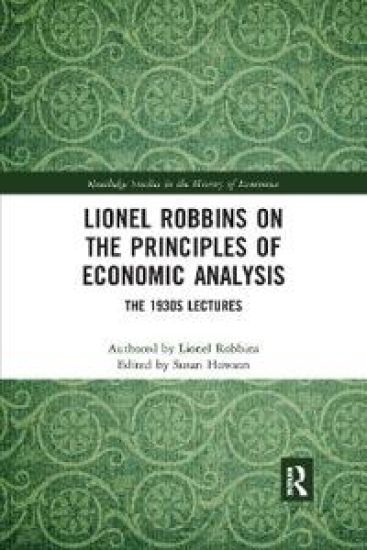
Lionel Robbins (1898–1984) is best known to economists for his Essay on the Nature and Significance of Economic Science (1932 and 1935). To the wider public he is well known for the 'Robbins Report' of the 1960s on Higher Education, which recommended a major expansion of university education in Britain. However, throughout his academic career – at Oxford and the London School of Economics in the 1920s, and as Professor of Economics at the School from 1929 to 1961 – he was renowned as an exceptionally gifted teacher. Generations of students remember his lectures for their clarity and comprehensiveness and for his infectious enthusiasm for his subject. Besides his famous graduate seminar his most important and influential courses at LSE were the Principles of Economic Analysis, which he gave in the 1930s and again in the late 1940s and 1950s, as well as the History of Economic Thought, from 1953 until long after his official retirement. This book publishes for the first time the manuscript notes Robbins used for his lectures on the Principles of Economic Analysis from 1929/30 to 1934/40. At the outset of his career he took the advice of a senior colleague to prepare his lectures by writing them out fully before he presented them; the full notes for most of his pre-war lectures survive and are eminently decipherable. Since he made two major revisions of the lectures in the 1930s the Principles notes show both the development of his own thought and the way he incorporated the major theoretical innovations made by younger economists at LSE, such as John Hicks and Nicholas Kaldor, or elsewhere, notably Joan Robinson. He intended to turn his lecture notes into a book, abandoning the project only when he was asked to chair the Committee on Higher Education in 1960. This volume is not exactly the book he wanted to write, but it is a unique record of what was taught to senior undergraduate and graduate economists in those 'years of high theory'. It will be of interest to all economists interested in the development of economics in the twentieth century.
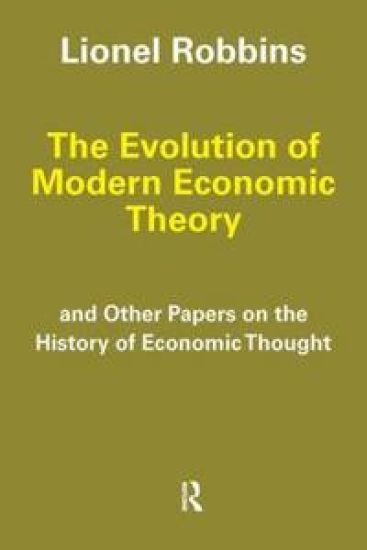
The long paper which gives the title to this collection and which has never before been published as paperback was initially an attempt to promote international academic understanding. The Economics Department at the London School of Economics had arranged a colloquy between two groups of Russian and British economists; and where the author asked to contribute a general survey of the present state of economic theory as taught in Western centers. For reasons, which are explained in the opening section, the author decided to adopt an historical approach; and the notes on which the present paper is based were the result. The remainders of the papers have as their common denominator a continuing interest in the history of economic thought. Beginning with a lengthy critique of Schumpeter's magisterial History of Economic Analysis, they range from an appraisal of Bentham's continuing relevance to a review of Robertson's Lectures on Economic Principles, with some special attention to John Stuart Mill both as a human being and as an economist. They have been written at various times in the last thirty-five years; and minute scrutiny, if such were thought to be worthwhile--which of course it is not--might detect some variations of emphasis, particularly perhaps in the implicit valuations of Marshall and his contribution, in the papers on Wicksteed and Schumpeter's History respectively. But in spite of a certain shift of perspective here, the author thought it worthwhile to attempt substantial redrafting. Apart from the correction of obvious inelegances or actual errors, the excision of some duplicating quotations and, in a few cases, the addition of supplementary material and references, the papers are reproduced as originally written. In each instance the author has given footnote acknowledgements of the place of original publication.
Lectures on Political Economy, V2: Money
Knut Wicksell; Lionel Robbins
Literary Licensing, LLC
2013
nidottu
Lectures on Political Economy, V2: Money
Knut Wicksell; Lionel Robbins
Literary Licensing, LLC
2013
sidottu
Lectures On Political Economy, Volume 2: Money is a book written by Knut Wicksell, a Swedish economist, and published in 1906. The book is a collection of lectures that Wicksell delivered on the subject of monetary economics at the University of Lund in Sweden. The book is divided into three main sections: the first section deals with the basic concepts of money and value, the second section discusses the role of money in the economy, and the third section explores the relationship between money and credit. Wicksell's lectures provide a comprehensive overview of the history of money, its functions and characteristics, and its relationship with other economic variables such as inflation, interest rates, and exchange rates. He also discusses the different types of money, including commodity money, fiat money, and credit money, and their respective advantages and disadvantages. Overall, Lectures On Political Economy, Volume 2: Money is a seminal work in the field of monetary economics and a must-read for anyone interested in understanding the role of money in the economy. This is a new release of the original 1935 edition. This scarce antiquarian book is a facsimile reprint of the old original and may contain some imperfections such as library marks and notations. Because we believe this work is culturally important, we have made it available as part of our commitment for protecting, preserving, and promoting the world's literature in affordable, high quality, modern editions, that are true to their original work.
The Economist In The Twentieth Century by Lionel Robbins is a comprehensive analysis of the role and impact of The Economist magazine in the 20th century. Robbins, a renowned economist and former editor of The Economist, examines the magazine's evolution from a small weekly publication in the late 19th century to a global media brand with a significant influence on economic and political discourse. The book covers the major events and trends of the 20th century, including the two world wars, the Great Depression, the rise of communism, the Cold War, and the globalization of the economy. Robbins delves into the magazine's coverage of these events and the opinions and ideas put forth by its writers and editors. Robbins also explores the personalities and leadership of the magazine's editors, including Walter Bagehot, Geoffrey Crowther, and his own tenure as editor. He discusses the challenges and controversies faced by the magazine, such as accusations of bias and criticism of its editorial stance. Overall, The Economist In The Twentieth Century provides a fascinating insight into the history of one of the world's most influential publications and its impact on the economic and political landscape of the 20th century. This is a new release of the original 1954 edition. This scarce antiquarian book is a facsimile reprint of the old original and may contain some imperfections such as library marks and notations. Because we believe this work is culturally important, we have made it available as part of our commitment for protecting, preserving, and promoting the world's literature in affordable, high quality, modern editions, that are true to their original work.
American Foreign Trade Policies: International Conciliation, No. 323, October, 1936
Cordell Hull; Lionel Robbins; Viscount Allenby
Literary Licensing, LLC
2013
nidottu
A Select Bibliography of Modern Economic Theory, 1870-1929
Harold Edward Batson; Lionel Robbins
Literary Licensing, LLC
2011
nidottu
A Select Bibliography of Modern Economic Theory, 1870-1929
Harold Edward Batson; Lionel Robbins
Literary Licensing, LLC
2011
sidottu
A Select Bibliography of Modern Economic Theory, 1870-1929 is a comprehensive guide to the development of economic theory during the late 19th and early 20th centuries. Written by Harold Edward Batson, this book is a valuable resource for students, scholars, and researchers interested in the history of economic thought. The book is organized chronologically and covers the major schools of economic thought that emerged during this period, including classical economics, neoclassical economics, and the Austrian School. It includes a detailed bibliography of books, articles, and other publications that were influential in shaping economic theory during this time. In addition to providing a comprehensive list of important works, A Select Bibliography of Modern Economic Theory also includes insightful commentary and analysis of the ideas and concepts that were central to the development of economic theory during this period. This makes it an ideal resource for anyone looking to gain a deeper understanding of the evolution of economic thought. Overall, A Select Bibliography of Modern Economic Theory, 1870-1929 is an essential reference for anyone interested in the history of economics and the development of economic theory. It provides a comprehensive overview of the major works and ideas that shaped the field during a critical period of its development. This scarce antiquarian book is a facsimile reprint of the old original and may contain some imperfections such as library marks and notations. Because we believe this work is culturally important, we have made it available as part of our commitment for protecting, preserving, and promoting the world's literature in affordable, high quality, modern editions, that are true to their original work.
The long paper which gives the title to this collection and which has never before been published as paperback was initially an attempt to promote international academic understanding. The Economics Department at the London School of Economics had arranged a colloquy between two groups of Russian and British economists; and where the author asked to contribute a general survey of the present state of economic theory as taught in Western centers. For reasons, which are explained in the opening section, the author decided to adopt an historical approach; and the notes on which the present paper is based were the result. The remainders of the papers have as their common denominator a continuing interest in the history of economic thought. Beginning with a lengthy critique of Schumpeter's magisterial History of Economic Analysis, they range from an appraisal of Bentham's continuing relevance to a review of Robertson's Lectures on Economic Principles, with some special attention to John Stuart Mill both as a human being and as an economist. They have been written at various times in the last thirty-five years; and minute scrutiny, if such were thought to be worthwhile--which of course it is not--might detect some variations of emphasis, particularly perhaps in the implicit valuations of Marshall and his contribution, in the papers on Wicksteed and Schumpeter's History respectively. But in spite of a certain shift of perspective here, the author thought it worthwhile to attempt substantial redrafting. Apart from the correction of obvious inelegances or actual errors, the excision of some duplicating quotations and, in a few cases, the addition of supplementary material and references, the papers are reproduced as originally written. In each instance the author has given footnote acknowledgements of the place of original publication.
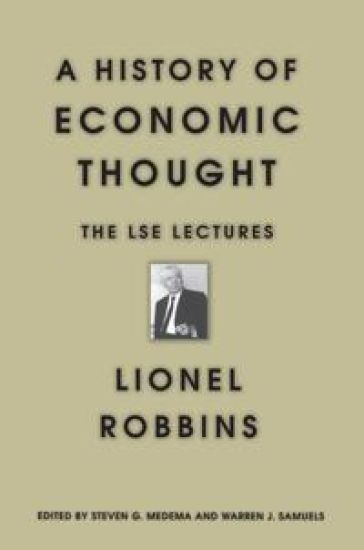
A History of Economic Thought
Lionel Robbins; William J. Baumol
Princeton University Press
2000
pokkari
Lionel Robbins's now famous lectures on the history of economic thought comprise one of the greatest accounts since World War II of the evolution of economic ideas. This volume represents the first time those lectures have been published. Lord Robbins (1898-1984) was a remarkably accomplished thinker, writer, and public figure. He made important contributions to economic theory, methodology, and policy analysis, directed the economic section of Winston Churchill's War Cabinet, and served as chairman of the Financial Times. As a historian of economic ideas, he ranks with Joseph Schumpeter and Jacob Viner as one of the foremost scholars of the century. These lectures, delivered at the London School of Economics between 1979 and 1981 and tape-recorded by Robbins's grandson, display his mastery of the intellectual history of economics, his infectious enthusiasm for the subject, and his eloquence and incisive wit. They cover a broad chronological range, beginning with Plato, Aristotle, and Aquinas, focusing extensively on Adam Smith, Thomas Malthus and the classicals, and finishing with a discussion of moderns and marginalists from Marx to Alfred Marshall. Robbins takes a varied and inclusive approach to intellectual history. As he says in his first lecture: "I shall go my own sweet way--sometimes talk about doctrine, sometimes talk about persons, sometimes talk about periods." The lectures are united by Robbins's conviction that it is impossible to understand adequately contemporary institutions and social sciences without understanding the ideas behind their development. Authoritative yet accessible, combining the immediacy of the spoken word with Robbins's exceptional talent for clear, well-organized exposition, this volume will be welcomed by anyone interested in the intellectual origins of the modern world.
Economic Science and Political Economy
Lionel Robbins; Susan (EDT) Howson
New York University Press
1997
sidottu
Until his death in 1984, Lionel Robbins was one of the world's most influential economic theorists and the foremost British economist of his generation. Appointed to a professorship at the prestigious London School of Economics when only thirty years old, Robbins dominated British economic thought for decades and proved a powerful force in the formulation of post-World War II economic policy.
Lionel Robbins, Professor of Economics at the London School of Economics, 1929-61, was the foremost British economist of his generation as well as being an influential public figure. Although he wrote many articles and books on economic theory, on contemporary issues of economic policy and in the history of economics, many of his academic articles, especially his early ones, have not been reprinted. This volume contains a selection of his major and most influential articles, in theory, policy and history.
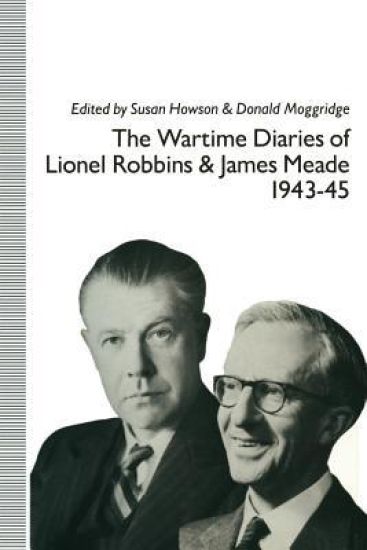
The Wartime Diaries of Lionel Robbins and James Meade, 1943–45
Lionel Robbins; James Meade
Palgrave Macmillan
1990
nidottu
Covering the period 1943-45, these diaries cover issues such as the Bretton Woods UN Monetary Conference in 1944 and loan negotiations and the ITO, as recorded by Meade and Robbins.