

Kirjailija
Lisa Stevenson
Kirjat ja teokset yhdessä paikassa: 5 kirjaa, julkaisuja vuosilta 2014–2026, suosituimpiin kuuluu Covenant of the Blood Rose. Vertaile teosten hintoja ja tarkista saatavuus suomalaisista kirjakaupoista.
5 kirjaa
Kirjojen julkaisuvuodet: 2014–2026.

Imagistic Care explores ethnographically how images function in our concepts, our writing, our fieldwork, and our lives. With contributions from anthropologists, philosophers and an artist, the volume asks: How can imagistic inquiries help us understand the complex entanglements of self and other, dependence and independency, frailty and charisma, notions of good and bad aging, and norms and practices of care in old age? And how can imagistic inquiries offer grounds for critique? Cutting between ethnography, phenomenology and art, this volume offers a powerful contribution to understandings of growing old. The images created in words and drawings are used to complicate rather than simplify the world. The contributors advance an understanding of care, and of aging itself, marked by alterity, spectral presences and uncertainty. Contributors: Rasmus Dyring, Harmandeep Kaur Gill, Lone Grøn, Maria Louw, Cheryl Mattingly, Lotte Meinert, Maria Speyer, Helle S. Wentzer, Susan Reynolds Whyte

Imagistic Care
Lisa Stevenson; Robert Desjarlais
FORDHAM UNIVERSITY PRESS
2022
pokkari
Halvin toimitettuna 34,60 €
Imagistic Care explores ethnographically how images function in our concepts, our writing, our fieldwork, and our lives. With contributions from anthropologists, philosophers and an artist, the volume asks: How can imagistic inquiries help us understand the complex entanglements of self and other, dependence and independency, frailty and charisma, notions of good and bad aging, and norms and practices of care in old age? And how can imagistic inquiries offer grounds for critique? Cutting between ethnography, phenomenology and art, this volume offers a powerful contribution to understandings of growing old. The images created in words and drawings are used to complicate rather than simplify the world. The contributors advance an understanding of care, and of aging itself, marked by alterity, spectral presences and uncertainty. Contributors: Rasmus Dyring, Harmandeep Kaur Gill, Lone Grøn, Maria Louw, Cheryl Mattingly, Lotte Meinert, Maria Speyer, Helle S. Wentzer, Susan Reynolds Whyte

In Life Beside Itself, Lisa Stevenson takes us on a haunting ethnographic journey through two historical moments when life for the Canadian Inuit has hung in the balance: the tuberculosis epidemic (1940s to the early 1960s) and the subsequent suicide epidemic (1980s to the present). Along the way, Stevenson troubles our commonsense understanding of what life is and what it means to care for the life of another. Through close attention to the images in which we think and dream and through which we understand the world, Stevenson describes a world in which life is beside itself: the name-soul of a teenager who dies in a crash lives again in his friend's newborn baby, a young girl shares a last smoke with a dead friend in a dream, and the possessed hands of a clock spin uncontrollably over its face. In these contexts, humanitarian policies make little sense because they attempt to save lives by merely keeping a body alive. For the Inuit, and perhaps for all of us, life is "somewhere else," and the task is to articulate forms of care for others that are adequate to that truth.
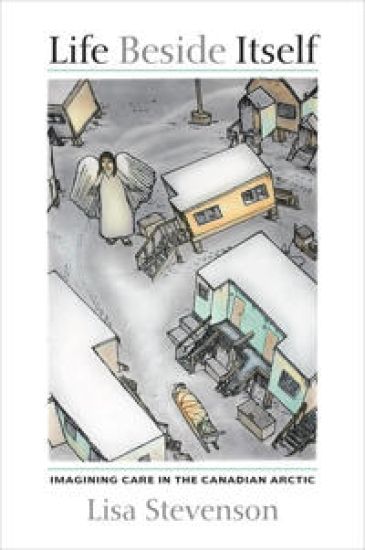
In Life Beside Itself, Lisa Stevenson takes us on a haunting ethnographic journey through two historical moments when life for the Canadian Inuit has hung in the balance: the tuberculosis epidemic (1940s to the early 1960s) and the subsequent suicide epidemic (1980s to the present). Along the way, Stevenson troubles our commonsense understanding of what life is and what it means to care for the life of another. Through close attention to the images in which we think and dream and through which we understand the world, Stevenson describes a world in which life is beside itself: the name-soul of a teenager who dies in a crash lives again in his friend's newborn baby, a young girl shares a last smoke with a dead friend in a dream, and the possessed hands of a clock spin uncontrollably over its face. In these contexts, humanitarian policies make little sense because they attempt to save lives by merely keeping a body alive. For the Inuit, and perhaps for all of us, life is "somewhere else," and the task is to articulate forms of care for others that are adequate to that truth.