
Kirjailija
Lisheng Dong
Kirjat ja teokset yhdessä paikassa: 5 kirjaa, julkaisuja vuosilta 2015–2026, suosituimpiin kuuluu From Sea Elections to State Control. Vertaile teosten hintoja ja tarkista saatavuus suomalaisista kirjakaupoista.
5 kirjaa
Kirjojen julkaisuvuodet: 2015–2026.
This book analyzes Donald Trump's three electoral campaigns - 2016, 2020, and 2024 - and exposes the hidden networks of power that shape modern campaigns and politics. The author maps the influence of financial oligarchs, deep state agencies, tech moguls, and celebrity elites, revealing how populist narratives intersect with corporate lobbying, military and intelligence continuity, and fragmented mass media. Blending cultural and structural perspectives, the book explains how Trump, often seen as an "outsider," was able to simultaneously serve entrenched interests. Each chapter examines critical turning points, from early endorsements and mainstream coverage to digital echo chambers, polling failures, and escalating conspiracy theories, culminating in Trump's victory in 2024. The book concludes with an assessment of democracy's resilience in an age of misinformation, economic inequality, and strategic realignment. It will appeal to scholars, students, and researchers in political science and related fields, as well as policymakers and the general public interested in better understanding the shifting power structures that underpin American democracy.
This book offers a comprehensive exploration of China’s governance evolution, focusing on its domestic transformation and the global political impact. The book charts China's trajectory from the reform and opening-up under Deng Xiaoping to the strategies employed by Xi Jinping, emphasizing the shifts in ideology, centralized governance, economic models, and international ambitions. It combines historical context, theoretical insights, and a nuanced comparison of key Chinese leaders, presenting a rich narrative that ties domestic policy to global aspirations.
Urban Mobilizations and New Media in Contemporary China
Lisheng Dong; Hanspeter Kriesi
Routledge
2020
nidottu
Popular protests are on the rise in China. However, since protesters rely on existing channels of participation and on patronage by elite backers, the state has been able to stymie attempts to generalize resistance and no large scale political movements have significantly challenged party rule. Yet the Chinese state is not monolithic. Decentralization has increased the power of local authorities, creating space for policy innovations and opening up the political opportunity structure. Popular protest in China - particularly in urban realm- not only benefits from the political fragmentation of the state, but also from the political communications revolution. The question of how and to what extent the internet can be used for mobilizing popular resistance in China is hotly debated. The government, virtual social organizations, and individual netizens both cooperate and compete with each other on the web. New media both increases the scope of the mobilizers and the mobilized (thereby creating new social capital), and provides the government with new means of social control (thereby limiting the political impact of the growing social capital). This volume is the first of its kind to assess the ways new media influence the mobilization of popular resistance and its possible effects in China today.
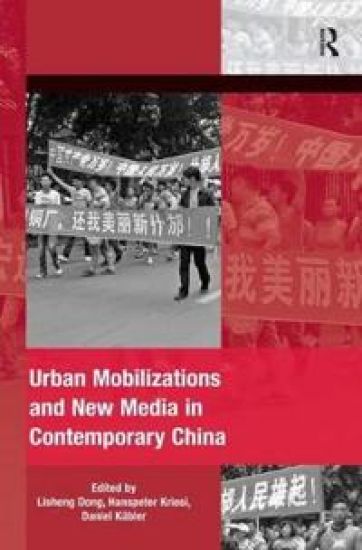
Urban Mobilizations and New Media in Contemporary China
Lisheng Dong; Hanspeter Kriesi
Routledge
2015
sidottu
Popular protests are on the rise in China. However, since protesters rely on existing channels of participation and on patronage by elite backers, the state has been able to stymie attempts to generalize resistance and no large scale political movements have significantly challenged party rule. Yet the Chinese state is not monolithic. Decentralization has increased the power of local authorities, creating space for policy innovations and opening up the political opportunity structure. Popular protest in China - particularly in urban realm- not only benefits from the political fragmentation of the state, but also from the political communications revolution. The question of how and to what extent the internet can be used for mobilizing popular resistance in China is hotly debated. The government, virtual social organizations, and individual netizens both cooperate and compete with each other on the web. New media both increases the scope of the mobilizers and the mobilized (thereby creating new social capital), and provides the government with new means of social control (thereby limiting the political impact of the growing social capital). This volume is the first of its kind to assess the ways new media influence the mobilization of popular resistance and its possible effects in China today.