Kirjojen hintavertailu – 12 903 725 kirjaa ja 27 kauppaa

Kirjailija

Ljiljana Šaric

Kirjat ja teokset yhdessä paikassa: 3 kirjaa, julkaisuja vuosilta 2008–2025, suosituimpiin kuuluu Evaluative Discourse Metaphor in Online Communities. Vertaile teosten hintoja ja tarkista saatavuus suomalaisista kirjakaupoista.

Nimi esiintyy myös muodoissa: Ljiljana Saric

3 kirjaa

Kirjojen julkaisuvuodet: 2008–2025.

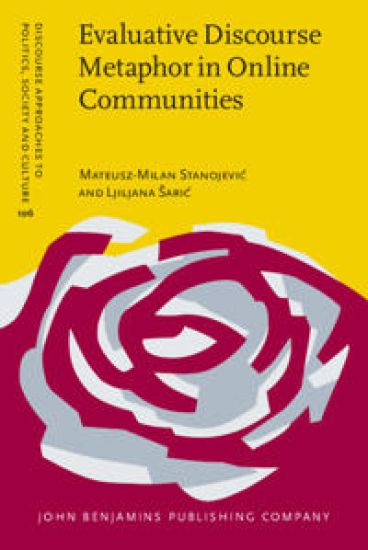
Evaluative Discourse Metaphor in Online Communities

Evaluative Discourse Metaphor in Online Communities

Mateusz-Milan Stanojevic; Ljiljana Šaric

John Benjamins Publishing Co
2025
sidottu
This monograph introduces the Evaluative Discourse Metaphor model, which argues that participants in public and semi-public online discourse (re)use evaluative metaphors to construct and maintain communities. We explore how such metaphors trigger others with similar forms, though not necessarily the same evaluative targets, generating discourse spaces unified by a shared evaluative ethos. The model draws on a discourse-based view of metaphor, Hallidayan metafunctions, Du Bois’s stance triangle, and insights from computer-mediated communication, with a focus on affordances and community-building. We define or redefine key concepts including single evaluative metaphors, metaphorical complexes, triggers, bondicons, and chains. Rather than departing from existing literature, we integrate it into a framework valuable to scholars in metaphor studies, digital ethnography, discourse analysis, and online communication.
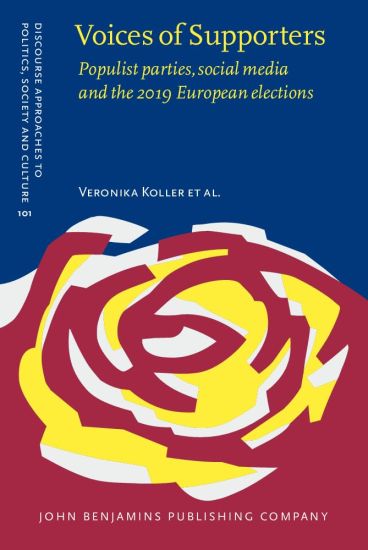
Voices of Supporters

Voices of Supporters

Veronika Koller; Natalia Borza; Massimiliano Demata; Laura Filardo-Llamas; Anna W. Gustafsson; Susanne Kopf; Marlene Miglbauer; Valeria Reggi; Ljiljana Šaric; Charlotta Seiler Brylla; Maria Stopfner

John Benjamins Publishing Co
2023
sidottu
This book addresses an under-researched area within populism studies: the discourse of supporters of populist parties. Taking the 2019 European elections as their case study, the authors analyse how supporters in eleven different countries construct identities and voting motivations on social media. The individual chapters comprise a range of methods to investigate data from different social media platforms, defining populism as a political strategy and/or practice, realised in discourse, that is based on a dichotomy between “the people”, who are unified by their will, and an out-group whose actions are not in the interest of the people, with a leader safeguarding the interests of the people against the out-group. The book identifies what motivates people to vote for populist parties, what role national identities and values play in those motivations, and how the social media postings of populist parties are recontextualised in supporters’ comments to serve as a voting motivation.
Spatial Concepts in Slavic: A Cognitive Linguistic Study of Prepositions and Cases
The focus of this book is how Slavic languages represent spatial relations, and how spatial cognition and perception influence the understanding and linguistic coding of nonspatial domains. Individual analyses concentrate on the semantics of selected prepositions and cases in Bosnian/Croatian/Serbian (B/C/S), providing a comparative perspective on other Slavic languages, primarily Russian and Polish. The opening analysis discusses the main theoretical notion - metaphorical extension - exemplifying the relation of spatial usages of linguistic items to non-spatial usages. This is followed by an analysis of the most basic spatial relations, "in-ness" and "on-ness." The meaning network of prepositions equivalent to on and in helps explain the meaning of the cases they combine with: the accusative and locative. Another crucial spatial relation, proximity, is taken into account in the semantic analysis of the B/C/S prepositions kod and pri, their Slavic equivalents, and cases they combine with: the genitive and locative. The next chapter deals with the spatial meaning of the dative case, examining dative's prepositional usages, the bare directional dative in B/C/S, and the semantic relation of the bare directional dative to other meaning domains of this case.