Kirjojen hintavertailu – 12 903 725 kirjaa ja 27 kauppaa

Kirjailija

Lochner Marais

Kirjat ja teokset yhdessä paikassa: 4 kirjaa, julkaisuja vuosilta 2022–2024, suosituimpiin kuuluu Resource Communities. Vertaile teosten hintoja ja tarkista saatavuus suomalaisista kirjakaupoista.

4 kirjaa

Kirjojen julkaisuvuodet: 2022–2024.

The Social Impacts of Mine Closure in South Africa
This book investigates the relationship between mining, mine closure and housing policy in post-apartheid South Africa, using concepts from new institutional economics and evolutionary governance theory. Mine closures present a major challenge to the mining industry and governments, with this being particularly noticeable in the Global South. This book argues that the dependencies created by the mining industry and mine housing policies while a mine is operational cause serious societal problems when it closes. To demonstrate this, the book applies the concepts of place attachment, asset-based development and social disruption. Conceptually, the book challenges the view that place attachment and asset-based development are the most appropriate and often the only policy responses in mining areas. In South Africa, the mining industry and the government have created comprehensive housing programmes linked to homeownership to promote place attachment, stability and wealth among mine workers. These programmes do not consider the disruption that mine closure might bring. The book challenges the blind application, during boom periods, of policies which create long-term dependencies that are difficult to manage when a mine closes. This book will be of interest to students and scholars researching the social impacts of mining and the extractive industries, social geography and sustainable development, as well as policymakers and practitioners working with mine closure or social impact assessments.
Resource Communities

Resource Communities

Kristof Van Assche; Monica Gruezmacher; Lochner Marais; Xaquin Perez-Sindin

TAYLOR FRANCIS LTD
2023
nidottu

Halvin toimitettuna 54,50 €

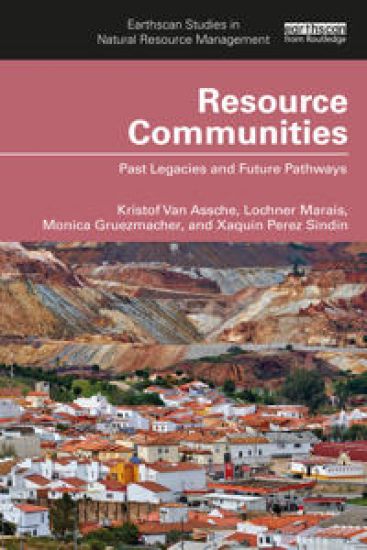
This book provides an innovative approach to understanding the governance of resource communities, by showcasing how the past and present informs the future. Resource communities have complicated relationships with the past, and this makes their relationship with the future, and the future itself, also complicated. The book digs deeply into the myriad legacies left by a history of resource extraction in a community and makes use of interdisciplinary and transdisciplinary perspectives to understand the complex issues being faced by a range of different communities that are reliant on different types of resources across the world. From coal and gold mining, to fishing towns and logging communities, the book explores the legacies of boom and bust economies, social memory, trauma and identity, the interactions between power and knowledge and the implications for adaptive governance. Balancing conceptual and theoretical understandings with empirical and practical knowledge of resource communities, natural resource use and social-ecological relationships, the book argues that solutions for individual communities need to be embraced in the community and not just in the perspectives of visiting experts. Linking the past, present and futures of resource communities in a new way, the book concludes by providing practical recommendations for breaking open dependencies on the past, including deepening awareness of the social, economic and environmental contexts, establishing strong governance and developing community strategies, plans and policies for the future. This book will be of great interest to students and scholars of natural resource governance and management, extractive industries, environmental policy, community planning and development, environmental geography and sustainable development, as well as policymakers involved in supporting community development in natural resource-dependent communities across the world.
Resource Communities

Resource Communities

Kristof Van Assche; Monica Gruezmacher; Lochner Marais; Xaquin Perez-Sindin

TAYLOR FRANCIS LTD
2023
sidottu
This book provides an innovative approach to understanding the governance of resource communities, by showcasing how the past and present informs the future. Resource communities have complicated relationships with the past, and this makes their relationship with the future, and the future itself, also complicated. The book digs deeply into the myriad legacies left by a history of resource extraction in a community and makes use of interdisciplinary and transdisciplinary perspectives to understand the complex issues being faced by a range of different communities that are reliant on different types of resources across the world. From coal and gold mining, to fishing towns and logging communities, the book explores the legacies of boom and bust economies, social memory, trauma and identity, the interactions between power and knowledge and the implications for adaptive governance. Balancing conceptual and theoretical understandings with empirical and practical knowledge of resource communities, natural resource use and social-ecological relationships, the book argues that solutions for individual communities need to be embraced in the community and not just in the perspectives of visiting experts. Linking the past, present and futures of resource communities in a new way, the book concludes by providing practical recommendations for breaking open dependencies on the past, including deepening awareness of the social, economic and environmental contexts, establishing strong governance and developing community strategies, plans and policies for the future. This book will be of great interest to students and scholars of natural resource governance and management, extractive industries, environmental policy, community planning and development, environmental geography and sustainable development, as well as policymakers involved in supporting community development in natural resource-dependent communities across the world.
The Social Impacts of Mine Closure in South Africa
This book investigates the relationship between mining, mine closure and housing policy in post-apartheid South Africa, using concepts from new institutional economics and evolutionary governance theory. Mine closures present a major challenge to the mining industry and governments, with this being particularly noticeable in the Global South. This book argues that the dependencies created by the mining industry and mine housing policies while a mine is operational cause serious societal problems when it closes. To demonstrate this, the book applies the concepts of place attachment, asset-based development and social disruption. Conceptually, the book challenges the view that place attachment and asset-based development are the most appropriate and often the only policy responses in mining areas. In South Africa, the mining industry and the government have created comprehensive housing programmes linked to homeownership to promote place attachment, stability and wealth among mine workers. These programmes do not consider the disruption that mine closure might bring. The book challenges the blind application, during boom periods, of policies which create long-term dependencies that are difficult to manage when a mine closes. This book will be of interest to students and scholars researching the social impacts of mining and the extractive industries, social geography and sustainable development, as well as policymakers and practitioners working with mine closure or social impact assessments.