Kirjojen hintavertailu – 12 903 725 kirjaa ja 27 kauppaa

Kirjailija

Lorenzo Pareschi

Kirjat ja teokset yhdessä paikassa: 3 kirjaa, julkaisuja vuosilta 2005–2025, suosituimpiin kuuluu Implicit-Explicit Methods for Evolutionary Partial Differential Equations. Vertaile teosten hintoja ja tarkista saatavuus suomalaisista kirjakaupoista.

3 kirjaa

Kirjojen julkaisuvuodet: 2005–2025.

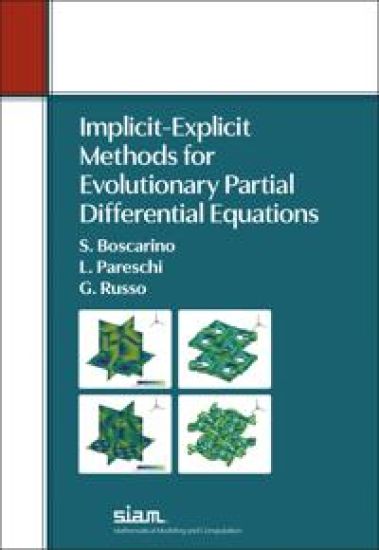
Implicit-Explicit Methods for Evolutionary Partial Differential Equations

Implicit-Explicit Methods for Evolutionary Partial Differential Equations

Sebastiano Boscarino; Lorenzo Pareschi; Giovanni Russo

SOCIETY FOR INDUSTRIAL APPLIED MATHEMATICS,U.S.
2025
nidottu
Implicit-explicit (IMEX) time discretization methods have proven to be highly effective for the numerical solution of a wide class of evolutionary partial differential equations (PDEs) across various contexts. These methods have become mainstream for solving evolutionary PDEs, particularly in the fields of hyperbolic and kinetic equations. The first book on the subject, Implicit-Explicit Methods for Evolutionary Partial Differential Equations provides an in-depth yet accessible approach. The authors summarize and illustrate the construction, analysis, and application of IMEX methods using examples, test cases, and implementation details; guide readers through the various methods and teach them how to select and use the one most appropriate for their needs; and demonstrate how to identify stiff terms and effectively implement high-order methods in time for a variety of systems of PDEs. Readers interested in learning modern techniques for the effective numerical solution of evolutionary PDEs with multiple time scales will find in this book a unified, compact, and accessible treatment.

Interacting Multiagent Systems

Interacting Multiagent Systems

Lorenzo Pareschi; Giuseppe Toscani

Oxford University Press
2013
sidottu
The description of emerging collective phenomena and self-organization in systems composed of large numbers of individuals has gained increasing interest from various research communities in biology, ecology, robotics and control theory, as well as sociology and economics. Applied mathematics is concerned with the construction, analysis and interpretation of mathematical models that can shed light on significant problems of the natural sciences as well as our daily lives. To this set of problems belongs the description of the collective behaviours of complex systems composed by a large enough number of individuals. Examples of such systems are interacting agents in a financial market, potential voters during political elections, or groups of animals with a tendency to flock or herd. Among other possible approaches, this book provides a step-by-step introduction to the mathematical modelling based on a mesoscopic description and the construction of efficient simulation algorithms by Monte Carlo methods. The arguments of the book cover various applications, from the analysis of wealth distributions, the formation of opinions and choices, the price dynamics in a financial market, to the description of cell mutations and the swarming of birds and fishes. By means of methods inspired by the kinetic theory of rarefied gases, a robust approach to mathematical modelling and numerical simulation of multi-agent systems is presented in detail. The content is a useful reference text for applied mathematicians, physicists, biologists and economists who want to learn about modelling and approximation of such challenging phenomena.
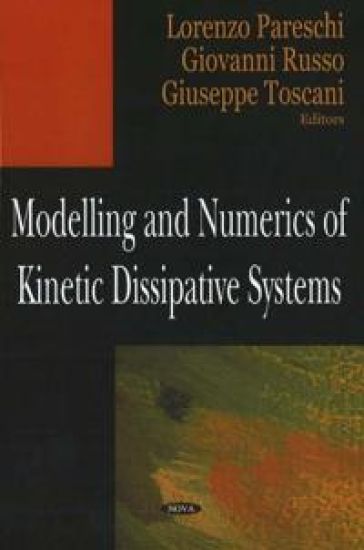
Modelling & Numerics of Kinetic Dissipative Systems

Modelling & Numerics of Kinetic Dissipative Systems

Lorenzo Pareschi; Giovanni Russo; Giuseppe Toscani

Nova Science Publishers Inc
2005
sidottu
The book is divided into three parts, which contain respectively recent results in the kinetic theory of granular gases, kinetic theory of chemically reacting gases, and numerical methods for kinetic systems. Part I is devoted to theoretical aspects of granular gases. Part II presents recent results on modelling of kinetic systems in which molecules can undergo binary collisions in presence of chemical reactions and/or in presence of quantum effects. Part III contains several contributions related to the construction of suitable numerical methods and simulations for granular gases.