Kirjojen hintavertailu – 12 859 819 kirjaa ja 27 kauppaa

Kirjailija

Lotfi A. Zadeh

Kirjat ja teokset yhdessä paikassa: 5 kirjaa, julkaisuja vuosilta 1995–2019, suosituimpiin kuuluu Fuzzy Logic And Soft Computing. Vertaile teosten hintoja ja tarkista saatavuus suomalaisista kirjakaupoista.

Nimi esiintyy myös muodoissa: Lotfi A Zadeh

5 kirjaa

Kirjojen julkaisuvuodet: 1995–2019.

Fuzzy Logic Theory And Applications: Part I And Part Ii

Fuzzy Logic Theory And Applications: Part I And Part Ii

Lotfi A Zadeh; Rafik Aziz Aliev

World Scientific Publishing Co Pte Ltd
2019
sidottu
Nowadays, voluminous textbooks and monographs in fuzzy logic are devoted only to separate or some combination of separate facets of fuzzy logic. There is a lack of a single book that presents a comprehensive and self-contained theory of fuzzy logic and its applications. Written by world renowned authors, Lofti Zadeh, also known as the Father of Fuzzy Logic, and Rafik Aliev, who are pioneers in fuzzy logic and fuzzy sets, this unique compendium includes all the principal facets of fuzzy logic such as logical, fuzzy-set-theoretic, epistemic and relational. Theoretical problems are prominently illustrated and illuminated by numerous carefully worked-out and thought-through examples. This invaluable volume will be a useful reference guide for academics, practitioners, graduates and undergraduates in fuzzy logic and its applications.

Computing with Words

Computing with Words

Lotfi A. Zadeh

Springer-Verlag Berlin and Heidelberg GmbH Co. K
2014
nidottu
In essence, Computing with Words (CWW) is a system of computation in which the objects of computation are predominantly words, phrases and propositions drawn from a natural language. CWW is based on fuzzy logic. In science there is a deep-seated tradition of according much more respect to numbers than to words. In a fundamental way, CWW is a challenge to this tradition. What is not widely recognized is that, today, words are used in place of numbers in a wide variety of applications ranging from digital cameras and household appliances to fraud detection systems, biomedical instrumentation and subway trains. CWW offers a unique capability—the capability to precisiate natural language. Unprecisiated (raw) natural language cannot be computed with. A key concept which underlies precisiation of meaning is that of the meaning postulate: A proposition, p, is a restriction on the values which a variable, X—a variable which is implicit in p—is allowed to take. CWW has an important ramification for mathematics. Addition of the formalism of CWW to mathematics empowers mathematics to construct mathematical solutions of computational problems which are stated in a natural language. Traditional mathematics does not have this capability.
Computing with Words

Computing with Words

Lotfi A. Zadeh

Springer-Verlag Berlin and Heidelberg GmbH Co. K
2012
sidottu
In essence, Computing with Words (CWW) is a system of computation in which the objects of computation are predominantly words, phrases and propositions drawn from a natural language. CWW is based on fuzzy logic. In science there is a deep-seated tradition of according much more respect to numbers than to words. In a fundamental way, CWW is a challenge to this tradition. What is not widely recognized is that, today, words are used in place of numbers in a wide variety of applications ranging from digital cameras and household appliances to fraud detection systems, biomedical instrumentation and subway trains. CWW offers a unique capability—the capability to precisiate natural language. Unprecisiated (raw) natural language cannot be computed with. A key concept which underlies precisiation of meaning is that of the meaning postulate: A proposition, p, is a restriction on the values which a variable, X—a variable which is implicit in p—is allowed to take. CWW has an important ramification for mathematics. Addition of the formalism of CWW to mathematics empowers mathematics to construct mathematical solutions of computational problems which are stated in a natural language. Traditional mathematics does not have this capability.
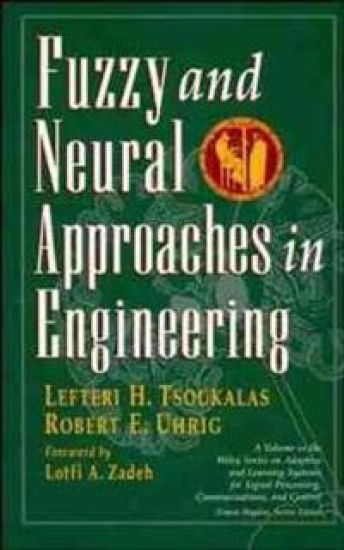
Fuzzy And Neural Approaches in Engineering

Fuzzy And Neural Approaches in Engineering

Lefteri H. Tsoukalas; Robert E. Uhrig; Lotfi A. Zadeh

John Wiley Sons Inc
1997
sidottu
Provides a truly accessible introduction and a fully integrated approach to fuzzy systems and neural networks—the definitive text for students and practicing engineers Researchers are already applying neural networks and fuzzy systems in series, from the use of fuzzy inputs and outputs for neural networks to the employment of individual neural networks to quantify the shape of a fuzzy membership function. But the integration of these two fields into a "neurofuzzy" technology holds even greater potential benefits in reducing computing time and optimizing results. Fuzzy and Neural Approaches in Engineering presents a detailed examination of the fundamentals of fuzzy systems and neural networks and then joins them synergistically—combining the feature extraction and modeling capabilities of the neural network with the representation capabilities of fuzzy systems. Exploring the value of relating genetic algorithms and expert systems to fuzzy and neural technologies, this forward-thinking text highlights an entire range of dynamic possibilities within soft computing. With examples specifically designed to illuminate key concepts and overcome the obstacles of notation and overly mathematical presentations often encountered in other sources, plus tables, figures, and an up-to-date bibliography, this unique work is both an important reference and a practical guide to neural networks and fuzzy systems.
Fuzzy Logic And Soft Computing

Fuzzy Logic And Soft Computing

Bernadette Bouchon-meunier; Ronlad R Yager; Lotfi A Zadeh

World Scientific Publishing Co Pte Ltd
1995
sidottu
Soft computing is a new, emerging discipline rooted in a group of technologies that aim to exploit the tolerance for imprecision and uncertainty in achieving solutions to complex problems. The principal components of soft computing are fuzzy logic, neurocomputing, genetic algorithms and probabilistic reasoning. This volume is a collection of up-to-date articles giving a snapshot of the current state of the field. It covers the whole expanse, from theoretical foundations to applications. The contributors are among the world leaders in the field.