
Kirjailija
Louis D Brandeis
Kirjat ja teokset yhdessä paikassa: 19 kirjaa, julkaisuja vuosilta 1914–2026, suosituimpiin kuuluu Other People's Money and How The Bankers Use It. Vertaile teosten hintoja ja tarkista saatavuus suomalaisista kirjakaupoista.
Nimi esiintyy myös muodoissa: Louis D. Brandeis
19 kirjaa
Kirjojen julkaisuvuodet: 1914–2026.

While Louis D. Brandeis's series of articles on the money trust was running in Harper's Weekly many inquiries came about publication in more accessible permanent form. Even without such urgence through the mail, however, it would have been clear that these articles inevitably constituted a book, since they embodied an analysis and a narrative by that mind which, on the great industrial movements of our era, is the most expert in the United States. The inquiries meant that the attentive public recognized that here was a contribution to history. Here was the clearest and most profound treatment ever published on that part of our business development which, as President Wilson and other wise men have said, has come to constitute the greatest of our problems. The story of our time is the story of industry. No scholar of the future will be able to describe our era with authority unless he comprehends that expansion and concentration which followed the harnessing of steam and electricity, the great uses of the change, and the great excesses. No historian of the future, in my opinion, will find among our contemporary documents so masterful an analysis of why concentration went astray.

The people of the State of New York, respondent, against Charles Schweinler Press, a corporation, defendant-appellant. A summary of "facts of knowledge" submitted on behalf of the people
Louis D Brandeis; Josephine Goldmark
Alpha Edition
2020
pokkari
This book has been considered by academicians and scholars of great significance and value to literature. This forms a part of the knowledge base for future generations. So that the book is never forgotten we have represented this book in a print format as the same form as it was originally first published. Hence any marks or annotations seen are left intentionally to preserve its true nature.
Legendary lawyer of the people, Louis Brandeis, displays his knowledge of the banking financial system and describes how it asserts staggering control over the economy of the United States. As relevant today as it was when first published in 1914, this book serves to demystify aspects of the banking system which are lost on those who are not employed within the finance sector. Explaining how banks have become a powerful oligarchy, Brandeis describes how the money trusts hold enormous and growing influence upon almost every large industry in the United States and much of the wider world. The monopolies of money trusts, and their role in controlling the economy, is described in detail. The deposits and savings of millions of ordinary Americans are put to work by the likes of J. P. Morgan who both lend to and purchase other banks and parts of companies. The trend towards small banks combining into larger entities, and the anti-competitive monopolies this entails are detailed.
Legendary lawyer of the people, Louis Brandeis, displays his knowledge of the banking financial system and describes how it asserts staggering control over the economy of the United States. As relevant today as it was when first published in 1914, this book serves to demystify aspects of the banking system which are lost on those who are not employed within the finance sector. Explaining how banks have become a powerful oligarchy, Brandeis describes how the money trusts hold enormous and growing influence upon almost every large industry in the United States and much of the wider world. The monopolies of money trusts, and their role in controlling the economy, is described in detail. The deposits and savings of millions of ordinary Americans are put to work by the likes of J. P. Morgan who both lend to and purchase other banks and parts of companies. The trend towards small banks combining into larger entities, and the anti-competitive monopolies this entails are detailed.

The Right to Privacy
Samuel D Warren; Louis D Brandeis; Steven Alan Childress
Quid Pro, LLC
2015
sidottu
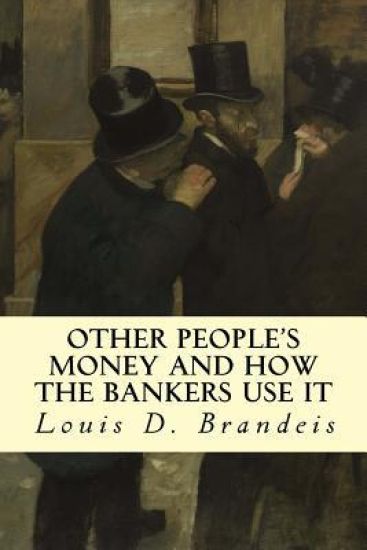
Other People's Money and How The Bankers Use It
Louis D. Brandeis
Createspace Independent Publishing Platform
2014
nidottu
Louis D. Brandeis was a Supreme Court Justice and a patriot. He wrote "Other People's Money and How Bankers Use It" to warn the American people about the greedy bankers that control the United States and drive us into financial ruin. The book attacked the use of investment funds to promote the consolidation of various industries under the control of a small number of corporations, which Brandeis alleged were working in concert to prevent competition. Brandeis harshly criticized investment bankers who controlled large amounts of money deposited in their banks by middle-class people. The heads of these banks, Brandeis pointed out, routinely sat on the boards of railroad companies and large industrial manufacturers of various products, and routinely directed the resources of their banks to promote the interests of their own companies. These companies, in turn, sought to maintain control of their industries by crushing small businesses and stamping out innovators who developed better products to compete against them. Brandeis supported his contentions with a discussion of the actual dollar amounts-in millions of dollars-controlled by specific banks, industries, and industrialists such as J. P. Morgan, noting that these interests had recently acquired a far larger proportion of American wealth than corporate entities had ever had before. He extensively cited testimony from a Congressional investigation performed by the Pujo Committee, named after Louisiana Representative Ars ne Pujo, into self-serving and monopolistic business dealing. Chapter V of the book ("What Publicity Can Do") contains in its opening section a well-known line that has frequently been cited in support of regulation through disclosure obligations: "Sunlight is said to be the best of disinfectants; electric light the most efficient policeman."


The People of the State of New York, Respondent, Against Charles Schweinler Press, a Corporation, Defendant-Appellant.
Louis D Brandeis
Gale, Making of Modern Law
2012
pokkari

The Right to Privacy: with 2010 Foreword by Steven Alan Childress
Louis D. Brandeis; Samuel D. Warren
Createspace Independent Publishing Platform
2010
nidottu
Warren and Brandeis's "The Right to Privacy," with 2010 Foreword by Steven Alan Childress, J. D., Ph. D., a senior law professor at Tulane University. Includes photos and rare news clippings. Part of the Legal Legends Series by Quid Pro Books. The most influential piece of legal scholarship, many scholars say, is this 1890 Harvard Law Review article by two Boston lawyers (one of whom later became a legendary Supreme Court Justice). Warren and Brandeis created -- by cleverly weaving strands of precedent, policy, and logic -- the legal concept of privacy and the power of legal protection for that right. Their clear and effective prose stands the test of time, and influenced such modern notions as "inviolate personality" and law's "elasticity." They saw the threat of new technology. Most of all, they asserted the fundamental "right to be let alone," and its implications to modern law are profound. Their privacy concept has grown over the decades, now raising issues about abortion, drug testing, surveillance, sexual orientation, free speech, the "right to die," and medical confidentiality. All these spinoffs trace their origins to this master work. It is simply one of the most significant parts of the modern canon of law, politics, and sociology. The extensive new Foreword by Professor Childress shares not only this import and effect, but also the fascinating backstory behind the article. Its origins are found in Warren's own prickly experiences with the press and the paparazzi of the day, famously after their reports about and photos of his family weddings.
Other People's Money and How the Bankers Use It
Louis D Brandeis; Norman Hapgood
Cosimo Classics
2009
sidottu
The Economist magazine recently called him "a Robin Hood of the law" American lawyer LOUIS DEMBITZ BRANDEIS (1856-1941) developed the concept of the "right to privacy" in an 1890 law journal article, and-in this classic 1914 work-he denounced investment banking, corporatism, monopolies, and the consolidation of American wealth in the hands of a privileged few. In this collection of essays first published the year before in Harper's Weekly, Brandeis championed the progressive economic ideals of Woodrow Wilson's "New Freedom," explained how entrepreneurial efforts and small businesses were being stifled and innovation and competition smothered in the fiscal environment he saw, and offered suggestions for reversing the trend. Hugely influential at the time, Other People's Money and How The Bankers Use It may have contributed to Brandeis's ascension to the United States Supreme Court Justice in 1916 (he would serve until 1939). Today, it serves another purpose: to remind us how the great experiment of American capitalism went astray... again, even in the wake of this powerful and important warning about the same dangers a century ago.
Other People's Money and How the Bankers Use It
Louis D Brandeis; Norman Hapgood
Cosimo Classics
2009
pokkari
Halvin toimitettuna 26,50 €
The Economist magazine recently called him "a Robin Hood of the law" American lawyer LOUIS DEMBITZ BRANDEIS (1856-1941) developed the concept of the "right to privacy" in an 1890 law journal article, and-in this classic 1914 work-he denounced investment banking, corporatism, monopolies, and the consolidation of American wealth in the hands of a privileged few. In this collection of essays first published the year before in Harper's Weekly, Brandeis championed the progressive economic ideals of Woodrow Wilson's "New Freedom," explained how entrepreneurial efforts and small businesses were being stifled and innovation and competition smothered in the fiscal environment he saw, and offered suggestions for reversing the trend. Hugely influential at the time, Other People's Money and How The Bankers Use It may have contributed to Brandeis's ascension to the United States Supreme Court Justice in 1916 (he would serve until 1939). Today, it serves another purpose: to remind us how the great experiment of American capitalism went astray... again, even in the wake of this powerful and important warning about the same dangers a century ago.
Philippa Strum, our foremost authority on Louis Brandeis, gathers together for the first time a sterling selection from his most provocative and profound writings. A kind of "Portable Brandeis," this book provides a concise and readable guide to the thought of a truly great American. Brandeis, the Ralph Nader of the early twentieth century, was known as the "People's Attorney" for his continuous crusades on behalf of the public. He spoke before citizens' groups and legislative bodies, wrote articles for popular magazines, put his ideas about industrial democracy in the briefs he submitted as a lawyer and later in the opinions he wrote as a Supreme Court justice (1916-1938), and advised presidents Woodrow Wilson and Franklin Roosevelt. The problems Brandeis faced and the answers he fashioned could have leaped from today's newspapers: corruption in government, conflicts between majority rule and minority rights, movements to limit free speech and the right to privacy, gender equality, the importance of education, the causes of and possible solutions for poverty, the social costs of excessive political or corporate power, the uneasy relationship between lawyers and the public, efficiency and justice in the workplace, the tension between Federal power and states' autonomy, and the responsibility of citizens to their community. In all his endeavors, Brandeis emphasized both political and economic democracy, citizen participation, and a balance between rights and responsibilities. As leader of the American Zionist movement from 1914 through the 1930s, he dreamed of a democratic Jewish homeland in Palestine founded on Jeffersonian principles. And there were similar echoes of the Founding Fathers in his campaign against the corporate trusts in the United States. These selections from Brandeis's speeches, letters to family and colleagues, newspaper interviews, articles, and judicial opinions offer us the essence of Brandeis's genius and allow us to appreciate the range and relevance of his ideas for America today.
The letters in this volume record an important transition in Brandeis's life. In July 1907, when the letters begin, Louis D. Brandeis was merely an unusually successful local reformer. His earlier victories against the Boston Elevated and the Boston Consolidated Gas Company, even his stunning success in the achievement of the Savings Bank Life Insurance law in Massachusetts, all centered exclusively upon Boston or Massachusetts problems. But by December 1912, when this book ends, Brandeis was one of the best known social activists in the United States. He received regular national attention in popular periodicals and advised the newly elected President of the United States. As these letters show, Brandeis always kept one eye on Massachusetts affairs-supervising the inauguration of the insurance reform, continuing to oppose long-term franchises for the subway, and advising Massachusetts governors on proposed bills and prospective appointments. But he devoted the major part of his energy in this five-and-a-half-year period to a series of crusades of crucial national importance. He attacked the attempt of Mellen and Morgan to gain a monopoly hold over new England transportation as he strenuously and doggedly opposed the merger of the Boston & Maine with the New Haven railroad. He entered, in a leading role, the most celebrated conservation battle of his generation, the Pinchot-Ballinger controversy, and he emerged as a major spokesman for the preservation and orderly development of natural resources. He helped to hammer together an arbitration mechanism to maintain industrial peace within the New York garment trades, a mechanism he believed would have broad implications for the future of industrial democracy in America. He battled the demands of the railroads for increased rates; he joined the crusade for efficiency and scientific management; and he directed repeated blows against the huge concentrations of economic power within the national economy. It should not be surprising that Brandeis and Robert M. LaFollette were drawn together, and these letters will show both the extent of that relationship and the way in which Brandeis's influence spread to other progressives in Congress. Other matters-his earliest Zionist activities, his achievement in defending progressive state legislation before the Supreme Court, his interest in Alaskan development along conservationist lines, his plan for the regularity of employment, his role in the Presidential campaign of 1912-are all part of his work during these turbulent years and are all touched upon in greater or lesser detail in these letters.
Louis D. Brandeis was a Supreme Court Justice and a patriot. He wrote "Other People's Money and How Bankers Use It" to warn the American people about the greedy bankers that control the United States and drive us into financial ruin. The book attacked the use of investment funds to promote the consolidation of various industries under the control of a small number of corporations, which Brandeis alleged were working in concert to prevent competition. Brandeis harshly criticized investment bankers who controlled large amounts of money deposited in their banks by middle-class people. The heads of these banks, Brandeis pointed out, routinely sat on the boards of railroad companies and large industrial manufacturers of various products, and routinely directed the resources of their banks to promote the interests of their own companies. These companies, in turn, sought to maintain control of their industries by crushing small businesses and stamping out innovators who developed better products to compete against them. Brandeis supported his contentions with a discussion of the actual dollar amounts--in millions of dollars--controlled by specific banks, industries, and industrialists such as J. P. Morgan, noting that these interests had recently acquired a far larger proportion of American wealth than corporate entities had ever had before. He extensively cited testimony from a Congressional investigation performed by the Pujo Committee, named after Louisiana Representative Ars ne Pujo, into self-serving and monopolistic business dealing. Chapter V of the book ("What Publicity Can Do") contains in its opening section a well-known line that has frequently been cited in support of regulation through disclosure obligations: "Sunlight is said to be the best of disinfectants; electric light the most efficient policeman."
The great monopoly in this country is money. So long as that exists, our old variety and individual energy of development are out of the question. A great industrial nation is controlled by its system of credit. Our system of credit is concentrated. The growth of the nation, therefore, and all our activities are in the hands of a few men.

Other People's Money and How the Bankers Use it (Annotated)
Louis D Brandeis
Books Explorer
1914
sidottu
Louis D. Brandeis, a practicing American attorney and subsequent Supreme Court Justice, composed many essays titled "Other Folk's Money and How the Bankers Use It." The book was initially published in 1914, and is mainly a criticism of the functionings of the American financial system at the time. Brandeis opposed the concentration of financial power in the command of a handful, critiquing investment bankers who manipulated the market for their advantage at the cost of average people. The "money trust" was Brandeis' main concern, talking about the disproportional influence of several big banks as well as investment firms over the world's cash as well as credit. He said this meant that transparency was lost and the potential risk increased for the average individual who had minimal influence over just how their money was used by these huge institutions. Also, he mentioned the consolidation of financial information produced conflicts of interest, as the institutions tasked with acting as neutral intermediaries were also interested in the companies they were meant to regulate.