Kirjojen hintavertailu – 12 903 737 kirjaa ja 27 kauppaa

Kirjailija

Louis D. Rubin Jr

Kirjat ja teokset yhdessä paikassa: 7 kirjaa, julkaisuja vuosilta 1999–2012, suosituimpiin kuuluu The Curious Death of the Novel. Vertaile teosten hintoja ja tarkista saatavuus suomalaisista kirjakaupoista.

7 kirjaa

Kirjojen julkaisuvuodet: 1999–2012.

The Curious Death of the Novel

The Curious Death of the Novel

Louis D. Rubin Jr

Louisiana State University Press
1999
nidottu
One of the country's more perceptive younger critics, Louis Rubin is well known for his commentaries on the literature of the South. These essays- selected from his critical works over a period of more than a dozen years- reflect his wider concern with the whole spectrum of American literature. In the title essay Rubin treats ""tired literary critics"" and the often-heard pronouncement that the novel is dead. He argues that the response of novelists to our difficult and demanding times ""will doubtless be what the response of writers to difficult and demanding times always has been: namely, difficult and demanding works of literature.""Another essay, The Experience Difference: Southerners and Jews, is a perceptive examination of the parallels in different factors and cultural experiences which brought Southern and Jewish writers to prominence. Rubin explores the potential pitfalls for Southern writers today in an essay called Getting Out From Under William Faulkner. Edgar Allan Poe's position in American literary history and H. L. Mencken's role as a literary critic and an ""artist of destruction"" who cleared the way and created an audience for the major American writers of the twenties are dealt with in other essays. The collection includes imaginative studies of Henry James, Mark Twain, Edmund Wilson, and Karl Shapiro. Several Southern writers, including Faulkner, Ellen Glasgow, Robert Penn Warren, Flannery O'Connor, and James Branch Cabell, also come under Rubin's scrutiny.
The Edge of the Swamp

The Edge of the Swamp

Louis D. Rubin Jr

Louisiana State University Press
1999
nidottu
The flowering of literary imagination known as the American Renaissance had few roots in the South. While Hawthorne, Emerson, Melville, Thoreau, and Whitman were creating a body of work that would endure, the only southern writer making a lasting contribution was Edgar Allan Poe. This failure on the part of antebellum southern writers has long been a subject of debate among students of southern history and literature. Now one of the region's most distinguished men of letters offers a cogently argued and gracefully written account of the circumstances that prevented early southern writers from creating transcendent works of art. Louis D. Rubin, Jr., brings forty years of critical integrity and imaginative involvement with the history and literature of the South to his informal inquiry into the foundations of the southern literary imagination. His exploration centers on the lives and works of three of the most important writers of the pre-Civil War South: Poe, William Gilmore Simms, and Henry Timrod. In a close and highly original reading of Poe's poetry and fiction, Rubin shows just how profoundly growing up in Richmond, Virginia, influenced that writer. The sole author of the Old South whose work has endured did not use southern settings or concern himself with his region's history or politics. Poe was, according to Rubin, in active rebellion against the middle-class community of Richmond and its materialistic values. Simms, on the other hand, aspired to the plantation society ideal of his native Charleston, South Carolina. He was not the most devoted and energetic of southern writers and one of the country's best-known and most respected literary figures before the Civil War. Rubin finds an explanation for much of the lost promise of antebellum southern literature in Simms's career. Here was a talented man who got caught up in the politically obsessed plantation community of Charleston, becoming an apologist for the system and an ardent defender of slavery. Timrod, also a Charlestonian native, was a highly gifted poet whose work attained the stature of literature when the Civil War gave him a theme. He was known as the poet laureate of the Confederacy. Only when his region was locked in a desperate military struggle for the right to exist did he suddenly find his enduring voice. Anyone interested in southern life and literature will welcome his provocative and engaging new look at southern writing from one of the region's most perceptive critics.
Fugitives' Reunion: Conversations at Vanderbilt, May 3-5, 1956

Fugitives' Reunion: Conversations at Vanderbilt, May 3-5, 1956

Rob Roy Purdy; Louis D. Rubin Jr

Literary Licensing, LLC
2012
sidottu
Fugitives' Reunion: Conversations At Vanderbilt, May 3-5, 1956 is a book written by Rob Roy Purdy. The book is a collection of conversations that took place at Vanderbilt University in May 1956, where a group of writers known as the Fugitives, who were prominent figures in the Southern Renaissance literary movement, reunited after many years. The conversations revolve around various literary topics such as poetry, fiction, and criticism. The book provides insights into the Fugitives' literary philosophy, their influences, and their impact on the Southern literary scene. It also includes personal anecdotes and recollections from the Fugitives about their lives and careers. Fugitives' Reunion is a valuable resource for anyone interested in Southern literature and the literary movements that shaped it. Vanderbilt Studies In The Humanities, V3. This scarce antiquarian book is a facsimile reprint of the old original and may contain some imperfections such as library marks and notations. Because we believe this work is culturally important, we have made it available as part of our commitment for protecting, preserving, and promoting the world's literature in affordable, high quality, modern editions, that are true to their original work.
Gather at the River

Gather at the River

Hal Crowther; Louis D. Rubin Jr

Louisiana State University Press
2005
sidottu
To read Hal Crowther is to find yourself agreeing with views on topics you never knew you cared so much about. In Gather at the River, Crowther extends the wide-angle vision of Southern life presented in his highly acclaimed collection Cathedrals of Kudzu. He cuts to the heart of recent political, religious, and cultural issues but pauses to appreciate the sweet things that the South has to offer, like music, baseball, great writers, and strong women. Some of these essays invite debate. Crowther gives a balanced perspective on the tragedy of the Branch Davidians at Waco, shedding light on a different world of religiosity and revealing urban media prejudices for what they are. He describes the unique heroism of a fallen Marine in the Iraq war, a war fought by one class and promoted by another. And his solution to racial conflict - interracial procreation - will jump-start readers' sensibilities. In other chapters, Crowther discusses the grim portrayal of the South in early film and the triumphs of Southern music. His literary essays include appreciations of William Faulkner, Thomas Wolfe, Elizabeth Spencer, and Wendell Berry, and a biting lampoon of exhibitionist memoirs. Among the Southerners Crowther profiles with pride are the art historian and Museum of Modern Art curator Kirk Varnedoe; the great, cursed baseball player Shoeless Joe Jackson; the curmudgeonly realist H. L. Mencken; and the singer Dolly Parton, whose candid artifice inspires the author's litmus test for Southern authenticity.
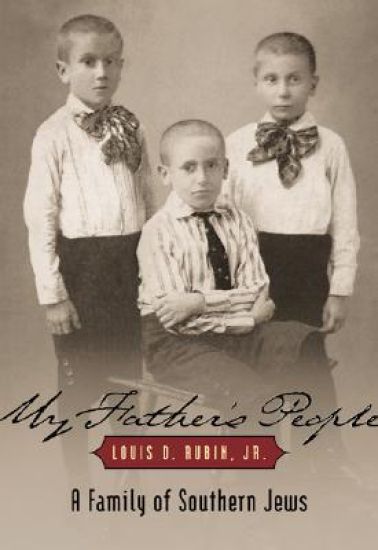
My Father's People

My Father's People

Louis D. Rubin Jr

Louisiana State University Press
2002
sidottu
Louis Rubin's people on his father's side were odd, inscrutable, and remarkable. In contrast to his mother's family, who were ""normal, good people devoid of mystery,"" the ways of the Rubins both puzzled and attracted him. In My Father's People, Rubin tells ""as best I can about them all -- my father, his three brothers, and his three sisters."" It is a searching, sensitive story of Americanization, assimilation, and the displacement -- and survival -- of a religious heritage. Born between 1888 and 1902 in Charleston, South Carolina, their father an immigrant Russian Jew, the Rubin children suffered dire poverty, humiliation, and separation when their parents became incapacitated. Three of the boys were sent to the Hebrew Orphans' Home in Atlanta for several years. Yet the sons all managed to build long, productive, even notable lives and livelihoods, becoming, variously, a newspaper editor, Broadway playwright and Hollywood screenwriter, businessman, and -- in the case of Rubin's father -- a far-famed long-range weather prognosticator. Private people, reticent to discuss their painful early years, the Rubins were not easily knowable. Still, the author draws a strikingly candid portrait of each, using memories, stories, keen insight, and broad empathy -- fascinating character studies full of individual propensities and peculiarities that together reveal the wider family resemblance. Although the Rubins were mostly nonreligious as adults, their family's rabbinical tradition and their experience as southern Jews were key to their vocational fervor and the lives they made for themselves. ""They were Americans, and they were Jews,"" Rubin concludes. ""These were enough.""Told with Louis Rubin's signature eloquence and wit, My Father's People is a testimony to the courage of immigrant southern Jews and their gifts to their chosen country.