Kirjojen hintavertailu – 12 903 725 kirjaa ja 27 kauppaa

Kirjailija

Louis W. Pauly

Kirjat ja teokset yhdessä paikassa: 5 kirjaa, julkaisuja vuosilta 1997–2025, suosituimpiin kuuluu The Myth of the Global Corporation. Vertaile teosten hintoja ja tarkista saatavuus suomalaisista kirjakaupoista.

5 kirjaa

Kirjojen julkaisuvuodet: 1997–2025.

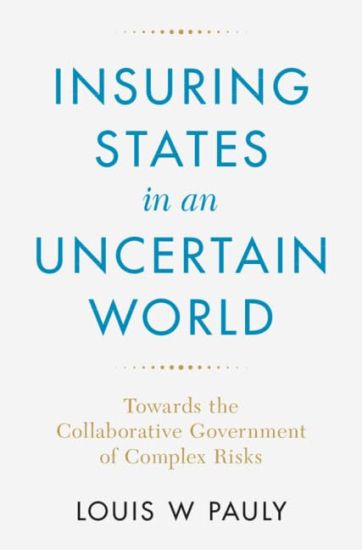
Insuring States in an Uncertain World

Insuring States in an Uncertain World

Louis W. Pauly

Cambridge University Press
2025
sidottu
Of the sectors comprising international capital markets, insurance and reinsurance have attracted relatively little attention from students of politics. New social conventions and financial instruments arising from the invention of probabilistic calculation and the discovery of risk began to spread around the world five centuries ago. Today, states and firms are harnessing the logic of insurance to address an expansive array of risks confronting their societies. In Insuring States in an Uncertain World, Louis Pauly examines the history and politics of pragmatic experiments aimed at governing complex global risks. His fascinating and accessible narrative explores the promise and the challenges of multi-faceted insurance arrangements in arenas ranging from nuclear energy production and international financial intermediation to those focused on environmental change, infectious diseases, and disruptive new technologies. At a time when the foundations of global order are under mounting stress, Pauly makes the case for limited and effective political innovation.

Democracy beyond the State?

Democracy beyond the State?

Michael Th. Greven; Louis W. Pauly

Rowman Littlefield
2000
nidottu
Political authority in todayOs leading democracies rests on generally shared perceptions by a given people that their government is responsible to them and considers each individual citizen equal under the law. Yet since the dawn of the industrial age, democratic governments have presided over economies that function on the basis of an unequal distribution of real resources. As globalization opens these economies, the gap between legal, ideal and economic reality widens and boundaries separating Othe peopleO of different democracies erode. This thought-provoking book explores the consequent challenge posed for the inherent legitimacy of democratic systems. When distinctive bonds between political power and social obligation break down, that erosion creates Odemocratic deficits. O Pressures build to reconstitute political authority beyond the state, and governance-in-practice grows ever more distant from democracy-in-principle. Nowhere is the deepening dilemma more evident than in the European Union. This book examines the contemporary breakdown and transformation of the democratic welfare state in Europe and draws fascinating contrasts with North America. In a cohesive and insightful collection of essays, a group of distinguished political scientists debates the implications of these trends both for theory and for policy.
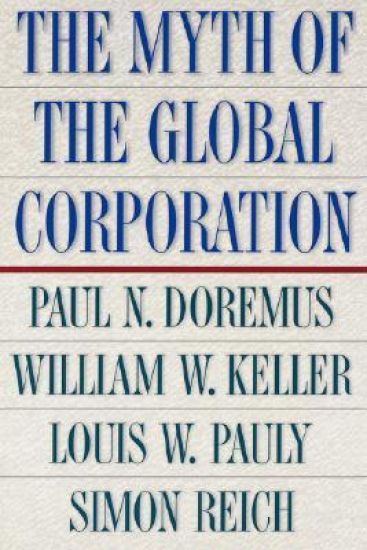
The Myth of the Global Corporation

The Myth of the Global Corporation

Paul Doremus; William W. Keller; Louis W. Pauly; Simon Reich

Princeton University Press
1999
pokkari
Critics and defenders of multinational corporations often agree on at least one thing: that the activities of multinationals are creating an overwhelmingly powerful global market that is quickly rendering national borders obsolete. The authors of this book, however, argue that such expectations commonly rest on a myth. They examine key activities of multinational corporations in the United States, Japan, and Europe and explore the relationship between corporate behavior and national institutions and cultures. They demonstrate that the world's leading multinationals continue to be shaped decisively by the policies and values of their home countries and that their core operations are not converging to create a seamless global market. With a wealth of fresh evidence, the authors show that Japanese and German multinationals, in particular, remain only weakly committed to laissez-faire policy orientations and continue to exhibit strong allegiance to national goals in such areas as investment and employment. They also bring to light the consequences of enduring differences in government policies on, for example, industrial cartels, capital markets, and research and development. The authors agree that the world economy is becoming more complex and integrated as overt barriers to trade and investment fall away. But they conclude that the extent of this integration is decisively limited by structural divergence at the level of the firm. The book will be essential reading for those seeking to understand the growing interdependence of still-distinctive industrial societies and the wellsprings of the true global economy.
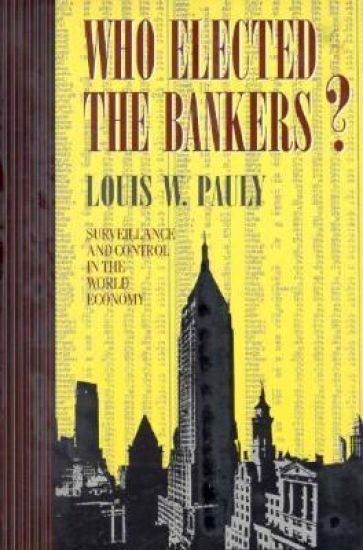
Who Elected the Bankers?

Who Elected the Bankers?

Louis W. Pauly

Cornell University Press
1998
pokkari
A former banker and staff member of the International Monetary Fund, Louis W. Pauly explains why people are deeply concerned about the emergence of a global economy and the increasingly integrated capital markets at its heart. In nations as diverse as France, Canada, Russia, and Mexico, the lives of citizens are disrupted when national policy falls out of line with the expectations of international financiers. Such dilemmas, ever more conspicuous around the world, arise from the disjuncture between a rapidly changing international economic system and a political order still constituted by sovereign states. The evolution of global capital markets inspires an understandable fear among people that the governing authorities accountable to them are losing the power to make substantive decisions affecting their own material prospects and those of their children. Pauly points out that today's capital markets resulted from decisions taken over many years by sovereign states, and particularly by the leading industrial democracies, who simultaneously crafted the instrument of multilateral economic surveillance. The effort to build adequate political foundations for global capital markets spans the twentieth century and links the histories of such institutions as the League of Nations, the International Monetary Fund, the European Union, and the Group of Seven.
Who Elected the Bankers?

Who Elected the Bankers?

Louis W. Pauly

Cornell University Press
1997
sidottu
A former banker and staff member of the International Monetary Fund, Louis W. Pauly explains why people are deeply concerned about the emergence of a global economy and the increasingly integrated capital markets at its heart. In nations as diverse as France, Canada, Russia, and Mexico, the lives of citizens are disrupted when national policy falls out of line with the expectations of international financiers. Such dilemmas, ever more conspicuous around the world, arise from the disjuncture between a rapidly changing international economic system and a political order still constituted by sovereign states. The evolution of global capital markets inspires an understandable fear among people that the governing authorities accountable to them are losing the power to make substantive decisions affecting their own material prospects and those of their children. Pauly points out that today's capital markets resulted from decisions taken over many years by sovereign states, and particularly by the leading industrial democracies, who simultaneously crafted the instrument of multilateral economic surveillance. The effort to build adequate political foundations for global capital markets spans the twentieth century and links the histories of such institutions as the League of Nations, the International Monetary Fund, the European Union, and the Group of Seven.