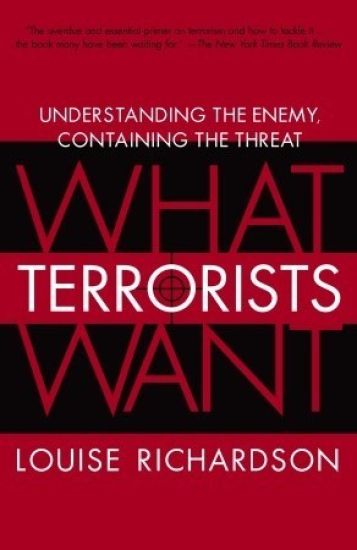
"This is at the top of my list for best books on terrorism."-Jessica Stern, author of Terror in the Name of God: Why Religious Militants Kill How can the most powerful country in the world feel so threatened by an enemy infinitely weaker than we are? How can loving parents and otherwise responsible citizens join terrorist movements? How can anyone possibly believe that the cause of Islam can be advanced by murdering passengers on a bus or an airplane? In this important new book, groundbreaking scholar Louise Richardson answers these questions and more, providing an indispensable guide to the greatest challenge of our age. After defining-once and for all-what terrorism is, Richardson explores its origins, its goals, what's to come, and what is to be done about it. Having grown up in rural Ireland and watched her friends join the Irish Republican Army, Richardson knows from firsthand experience how terrorism can both unite and destroy a community. As a professor at Harvard, she has devoted her career to explaining terrorist movements throughout history and around the globe. From the biblical Zealots to the medieval Islamic Assassins to the anarchists who infiltrated the cities of Europe and North America at the turn of the last century, terrorists have struck at enemies far more powerful than themselves with targeted acts of violence. Yet Richardson understands that terrorists are neither insane nor immoral. Rather, they are rational political actors who often deploy carefully calibrated tactics in a measured and reasoned way. What is more, they invariably go to great lengths to justify their actions to themselves, their followers, and, often, the world. Richardson shows that the nature of terrorism did not change after the attacks of September 11, 2001; what changed was our response. She argues that the Bush administration's "global war on terror" was doomed to fail because of an ignorance of history, a refusal to learn from the experience of other governments, and a fundamental misconception about how and why terrorists act. As an alternative, Richardson offers a feasible strategy for containing the terrorist threat and cutting off its grassroots support. The most comprehensive and intellectually rigorous account of terrorism yet, What Terrorists Want is a daring intellectual tour de force that allows us, at last, to reckon fully with this major threat to today's global order. KIRKUS- starred review"The short answer? Fame and payback, perhaps even a thrill. The long answer? Read this essential, important primer. Terrorist groups have many motives and ideologies, notes Richardson (Executive Dean/Radcliffe Institute for Advanced Study), but they tend to similar paths: They are founded by mature, well-educated men but staffed by less learned and certainly more pliable youths; they are fueled by a sense of injustice and the conviction that only they are morally equipped to combat it; they see themselves as defenders and not aggressors; they often define the terms of battle. And, of course, this commonality: "Terrorists have elevated practices that are normally seen as the excesses of warfare to routine practice, striking noncombatants not as an unintended side effect but as a deliberate strategy." Thus massacres, suicide bombings and assassinations are all in a day's work. Richardson argues against Karl Rove, who after 9/11 mocked those who tried to understand the enemy, by noting that only when authorities make efforts to get inside the minds of their terrorist enemies do they succeed in defeating them, as with the leadership of the Shining Path movement in Peru. Still, as Rove knows, if terrorists share a pathology, then so do at least some of their victims: Once attacked, people in democratic societies are more than willing to trade freedom for security. Richardson closes by offering a set of guidelines for combating terrorism, with such easily remembered rules as "Live by your principles" and "Engage others in countering terrorists with you"-observing, in passing, that the Bush administration's attack on Iraq and subsequent occupation will likely be remembered as serving as a recruiting poster for still more terrorists. How to win? Develop communities, settle grievances, exercise patience and intelligence. That said, watch for more terrorism to come: "We are going to have to learn to live with it and to accept it as a price of living in a complex world."_________________________________________________________________________________"Louise Richardson . . . has now produced the overdue and essential primer on terrorism and how to tackle it. What Terrorists Want is the book many have been waiting for."--The New York Times Book Review (Editor's Choice)"Lucid and powerful, Richardson's book refutes the dangerous idea that there's no point in trying to understand terrorists. . . . rich, readable."--Los Angeles Times Book Review "The kind of brisk and accessible survey of terrorism-as-modus operandi that has been sorely missing for the past five years . . . What Terrorists Want] ought to be required reading as the rhetoric mounts this campaign season."--The American Prospect"Richardson is one of the relative handful of experts who have been studying the history and practice of terrorism since the Cold War. . . . This book is a welcome source of information. It's written by a true expert, giving her measured thoughts."--Christian Science Monitor "Richardson's clear language and deep humanity make What Terrorists Want the one book that must be read by everyone who cares about why people resort to the tactic of terrorism."-Desmond M. Tutu, Archbishop Emeritus "This is a book of hope. Terrorism, like the poor, will always be with us in one form or another. But given sensible policies, we can contain it without destroying what we hold dear."-Financial Times "A passionate, incisive, and groundbreaking argument that provocatively overturns the myths surrounding terrorism."-Mary Robinson, former president of Ireland and former UN High Commissioner for Human Rights "In its lucid analysis and summary, What Terrorists Want] is simply the best thing of its kind available now in this highly crowded area."-The Evening Standard "If a reader has the time to read only one book on terrorism, What Terrorists Want is that book. Extensive historical knowledge, personal contacts, enormous analytic skills, common sense, and a fine mix of lucidity and clarity, make of this work a most satisfying dissection of terrorists' motives and goals, and of the effects of September 11, 2001. Richardson also offers a sharp critique of American counterterrorism policies, and a sensible plan for better ones."-Stanley Hoffmann, Buttenwieser University Professor, Harvard University "An astonishingly insightful analysis by one of the world's leading authorities on terrorism, this book is filled with wisdom-based not only on the author's extensive and long-term study of terrorism but also on her experience growing up in a divided Ireland."-Jessica Stern, author of Terror in the Name of God: Why Religious Militants Kill "A wide-ranging, clear headed, crisply written, cogently argued anatomy of terrorist groups around the world."-Peter Bergen, senior fellow, New America Foundation, and author of The Osama bin Laden I Know: An Oral History of al Qaeda's Leader "Among the numerous books published on terrorism after the 9/11 attacks, Louise Richardson's stands out as an unusually wise, sensible, and humane treatise. An engrossing and lucid book, which hopefully will be read by many and spread its unique spirit of realistic optimism." -Ariel Merari, Professor of Psychology, Tel Aviv University "Thoughtful and stimulating . . . Controversially, and indeed courageously, Richardson] argues that, instead of regarding the terrorists-even al-Qaeda types-as mindless and irrational creatures motivated by dark forces of evil, it would be more constructive to examine and seek to moderate some of the grievances that drive previously normal and even nondescript characters to kill and maim innocent people they don't even know."-The Irish Times "A textbook and a myth-buster . . . Richardson] is calling for nothing less than a total re-evaluation of how we consider, and react to, terrorism. . . . What Terrorists Want ought to be on the bookshelf in every government office. Certainly, for any student of international affairs it is an essential reading."-The Atlantic Affairs