
Kirjojen hintavertailu – 12 875 077 kirjaa ja 26 kauppaa

Kirjailija

Lucan Way

Kirjat ja teokset yhdessä paikassa: 3 kirjaa, julkaisuja vuosilta 2016–2024, suosituimpiin kuuluu Revolution and Dictatorship. Vertaile teosten hintoja ja tarkista saatavuus suomalaisista kirjakaupoista.

3 kirjaa

Kirjojen julkaisuvuodet: 2016–2024.

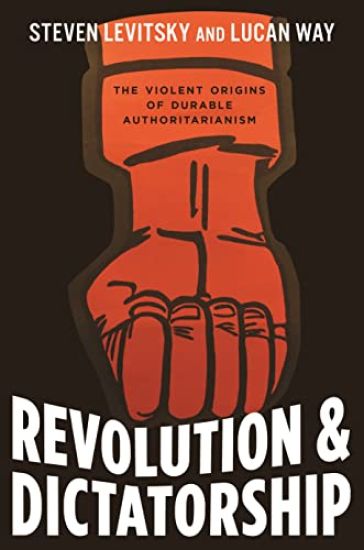
Revolution and Dictatorship

Revolution and Dictatorship

Steven Levitsky; Lucan Way

PRINCETON UNIVERSITY PRESS
2024
pokkari

Halvin toimitettuna 31,50 €

Why the world’s most resilient dictatorships are products of violent revolutionRevolution and Dictatorship explores why dictatorships born of social revolution—such as those in China, Cuba, Iran, the Soviet Union, and Vietnam—are extraordinarily durable, even in the face of economic crisis, large-scale policy failure, mass discontent, and intense external pressure. Few other modern autocracies have survived in the face of such extreme challenges. Drawing on comparative historical analysis, Steven Levitsky and Lucan Way argue that radical efforts to transform the social and geopolitical order trigger intense counterrevolutionary conflict, which initially threatens regime survival, but ultimately fosters the unity and state-building that supports authoritarianism. Although most revolutionary governments begin weak, they challenge powerful domestic and foreign actors, often bringing about civil or external wars. These counterrevolutionary wars pose a threat that can destroy new regimes, as in the cases of Afghanistan and Cambodia. Among regimes that survive, however, prolonged conflicts give rise to a cohesive ruling elite and a powerful and loyal coercive apparatus. This leads to the downfall of rival organizations and alternative centers of power, such as armies, churches, monarchies, and landowners, and helps to inoculate revolutionary regimes against elite defection, military coups, and mass protest—three principal sources of authoritarian breakdown. Looking at a range of revolutionary and nonrevolutionary regimes from across the globe, Revolution and Dictatorship shows why governments that emerge from violent conflict endure.
Revolution and Dictatorship

Revolution and Dictatorship

Steven Levitsky; Lucan Way

PRINCETON UNIVERSITY PRESS
2022
sidottu
Why the world’s most resilient dictatorships are products of violent revolutionRevolution and Dictatorship explores why dictatorships born of social revolution—such as those in China, Cuba, Iran, the Soviet Union, and Vietnam—are extraordinarily durable, even in the face of economic crisis, large-scale policy failure, mass discontent, and intense external pressure. Few other modern autocracies have survived in the face of such extreme challenges. Drawing on comparative historical analysis, Steven Levitsky and Lucan Way argue that radical efforts to transform the social and geopolitical order trigger intense counterrevolutionary conflict, which initially threatens regime survival, but ultimately fosters the unity and state-building that supports authoritarianism. Although most revolutionary governments begin weak, they challenge powerful domestic and foreign actors, often bringing about civil or external wars. These counterrevolutionary wars pose a threat that can destroy new regimes, as in the cases of Afghanistan and Cambodia. Among regimes that survive, however, prolonged conflicts give rise to a cohesive ruling elite and a powerful and loyal coercive apparatus. This leads to the downfall of rival organizations and alternative centers of power, such as armies, churches, monarchies, and landowners, and helps to inoculate revolutionary regimes against elite defection, military coups, and mass protest—three principal sources of authoritarian breakdown. Looking at a range of revolutionary and nonrevolutionary regimes from across the globe, Revolution and Dictatorship shows why governments that emerge from violent conflict endure.
Pluralism by Default

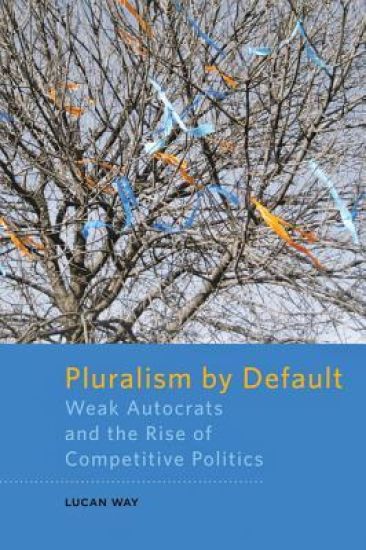
Pluralism by Default

Lucan Way

Johns Hopkins University Press
2016
pokkari
Pluralism by Default explores sources of political contestation in the former Soviet Union and beyond. Lucan Way proposes that pluralism in "new democracies" is often grounded less in democratic leadership or emerging civil society and more in the failure of authoritarianism. Dynamic competition frequently emerges because autocrats lack the state capacity to steal elections, impose censorship, or repress opposition. In fact, the same institutional failures that facilitate political competition may also thwart the development of stable democracy.